
For years, Ayush Shetty was spoken about in Indian badminton circles as a player for the future — gifted, towering, technically sound, but still waiting for that one tournament that would announce him to the wider sporting world.
That week has now arrived.
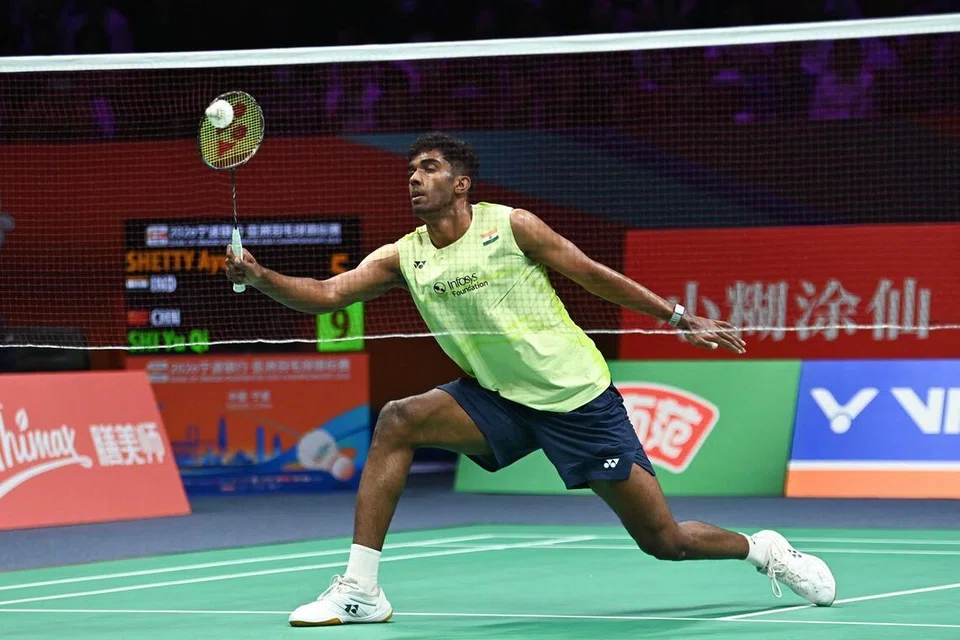
At the 2026 Badminton Asia Championships in Ningbo, China, the 20-year-old from Mangaluru did not just have a good run. He stormed into the final by beating three of the world’s top 10 players in a single week – world No. 1 Kunlavut Vitidsarn, former world No. 4 Jonatan Christie and world No. 7 Li Shi Feng – before falling to world champion Shi Yu Qi in the title clash.
The final score, 21-8, 21-10, on April 12, was one-sided. But it did little to diminish the significance of what Ayush had achieved. In fact, the silver medal felt less like a defeat and more like a declaration: Indian badminton may have found its next genuine men’s singles contender.
For a player who had endured an injury-hit start to the year, early exits and a crisis of momentum, Ningbo was both a breakthrough and vindication.
“I always wanted to be one of the best players in the world,” Ayush said after the tournament. “Earlier, I didn’t believe it as much as I do now. Now I want to be the best, and I’m working hard on that.”
That line says much about where he is in his journey. The ambition was always there. Now, belief is catching up.
Giant-slayer in Ningbo
Shetty’s run in China stood out not only because of the names he defeated, but also because of the way he did it. He showed composure, aggression and tactical maturity, qualities that are not easy to sustain in a high-level field packed with seasoned campaigners.
His semi-final win over Thailand’s Kunlavut, the Olympic silver medallist and reigning world No. 1, was perhaps the clearest sign of his temperament. After a rough start, Ayush recalibrated, stayed patient in longer rallies and found a way back. It was not just physical badminton; it was thoughtful play.
That quality has quietly been developing in him over the last year. His US Open title in 2025, India’s first title of that season, had already hinted at a player ready to rise. But this was different. This was a major continental event, against elite opposition, under pressure, with little room for error.
One moment, a reflex net block against Shi Feng, even went viral on social media – a split-second act of instinct and touch that captured the imagination of fans. Yet Ayush’s game is not built on trick shots. It is built on repeatable strengths.
Why Ayush is so good
At 1.93m tall, Ayush immediately stands out physically. His height and wingspan give him angles that many opponents simply cannot replicate. His smashes come down steeply, his reach allows him to intercept shuttles early, and he can cover the court in fewer steps than shorter players.
That naturally brings comparisons with two-time Olympic and two-time world champion Viktor Axelsen, another tall player who turned height into a major strategic advantage. Ayush has trained with the Danish great in Dubai and clearly studied him closely.
“Viktor is really strong and can get really low and has a really great defence,” Ayush said. “That is something I picked up on. I have to be like that if I want to play at my best.”
But Ayush is more than just height and power. His net game is unexpectedly delicate for a player of his size. He has quick hands, can disguise his intentions well, and increasingly looks comfortable mixing aggression with control. During the Asian Championships, he also showed a welcome change in mindset.
“I was more aggressive; usually I’m not,” he said. “I’m really happy with the way I showed the aggression on the court.”
That aggression matters because it complements his natural physical tools. A player with his build cannot afford to be passive. When he attacks with intent, he becomes difficult to handle.
Two-time Olympic medallist P.V. Sindhu, who trains in the same group under Indonesian coach Irwansyah Adi Pratama, called Ayush a “generational talent”. That is high praise, but it is not hard to see why.
The final showed the next steps
If Ningbo showed what Ayush can already do, the final against Shi showed what he still needs to improve.
Shi gave him almost nothing. The Chinese controlled length, tempo and space, denying Ayush the kind of front-court dominance that had powered his earlier wins.
Ayush admitted he became impatient after leading 7-2 in the second game and started chasing quick points instead of trusting the rally.
That honesty is encouraging. He already knows the path ahead.
Ayush has spoken about three areas in particular: patience, physical strength and on-court smarts.
Physically, he knows he must get stronger, especially in the legs, to defend lower and move more efficiently for long stretches. Taller players often struggle getting down to retrieve flat or fast exchanges, and that becomes glaring against the very best.
“I have to be a lot stronger if I want to consistently be among the best players in the world,” he said.
Tactically, the Indian must learn to build points better against elite opponents who won’t hand him attacking chances. The final exposed that. Against players like Shi, rallies have to be constructed with care, not forced.
Mentally, however, Ayush seems to be moving in the right direction. After a poor European swing, he worked with a psychologist to rebuild confidence, and he credited that support as vital to his run in Ningbo.
From promise to contender
India has been waiting for its next men’s singles force to consistently break into the sport’s top bracket. Ayush is not there yet. One brilliant week does not make a world champion. But it does offer a glimpse of what could come.
He now has proof that he can beat the biggest names, a live experience of what the sport’s highest level feels like, and a clearer sense of what separates a finalist from a champion.
To become world champion, Ayush will need to turn this promise into consistency – stay fit, get physically tougher, sharpen his rally construction, and learn to manage finals as well as he manages upsets. He will also need patience with himself. At 20, he is ahead of schedule, not behind it.