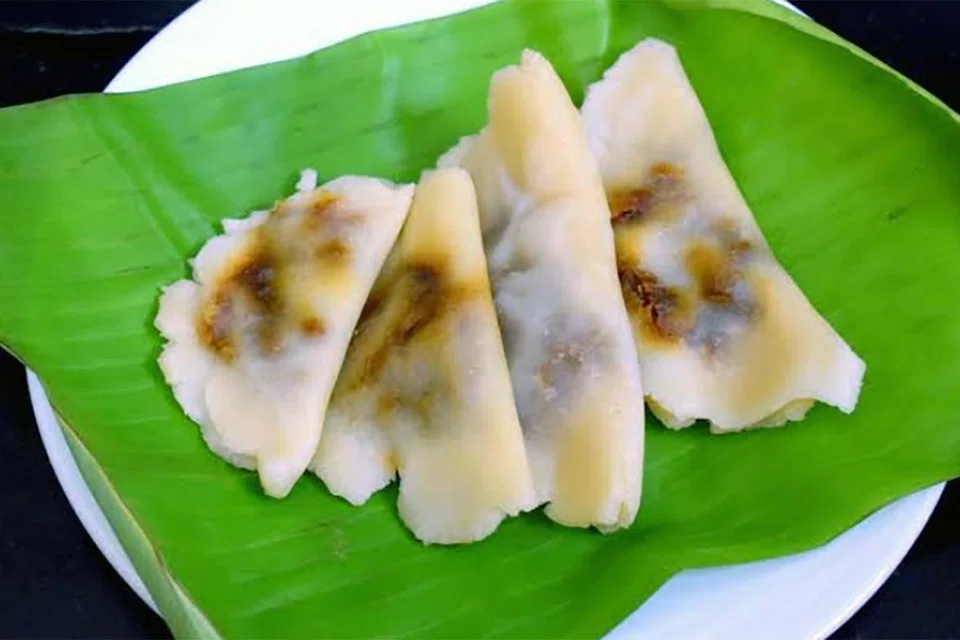

During my recent visit to Thiruvananthapuram, Amma prepared one of my childhood favourites – Valsan, known in most parts of Kerala as Ela Ada or Elayappam. It had been years since I last tasted it, and one bite instantly transported me back to simpler times, when life seemed to move at a gentler pace and happiness could be found in the simplest of homemade treats.
There was something comforting about watching Amma prepare it. Every movement was familiar and unhurried, refined over decades in the kitchen. The aroma that slowly filled the house was enough to make me feel like a child again, eagerly waiting for the steaming parcels to emerge from the pot.
The recipe is beautifully simple. A soft dough made from roasted rice flour is gently spread onto a fresh banana leaf before being filled with a fragrant mixture of grated coconut, melted jaggery and a touch of cardamom. The leaf is folded over with care and steamed until the filling becomes rich and luscious while the rice dough turns soft and delicate.
The real magic, however, lies in the banana leaf. As it steams, its natural oils and subtle fragrance seep into the dough, creating that unmistakable earthy aroma every Malayalee instantly recognises. It is impossible to recreate that flavour using modern cookware or synthetic substitutes. The banana leaf isn’t merely a wrapper – it is an essential ingredient.
What I love most about Valsan is that it never tries too hard to impress. There is no deep-frying, no artificial colours and no excessive sweetness. Instead, a handful of wholesome ingredients come together to create something incredibly satisfying. Naturally gluten-free, oil-free and nourishing, it remains one of Kerala’s healthiest traditional snacks. Pair it with a hot cup of tea as rain falls outside, and it becomes the very definition of comfort food.
Like many traditional dishes, Valsan also tells a fascinating story about cultural connections that stretch far beyond Kerala. Variations of this humble delicacy can be found across Southeast Asia – from Malaysia’s Kue Koci and Indonesia’s Nagasari to Thailand’s Khao Tom Mat and Vietnam’s Banh It. They may differ in shape, fillings or preparation, but they all reflect the same tropical culinary wisdom: Rice, coconut, banana leaves and steam.
These similarities are hardly surprising. For centuries, traders, travellers and seafarers crossed the Indian Ocean, carrying not only spices and textiles but also cooking techniques and food traditions. Long before the term “fusion cuisine” became fashionable, communities around the region were already sharing ideas through their kitchens.
Perhaps that is why Valsan still feels so familiar wherever I travel in Southeast Asia. Sitting in Kerala, enjoying Amma’s freshly steamed Valsan, I was reminded that food has always been one of humanity’s oldest storytellers. It preserves memories, transcends borders and quietly reminds us that despite our different languages and cultures, we have always been connected – through food.