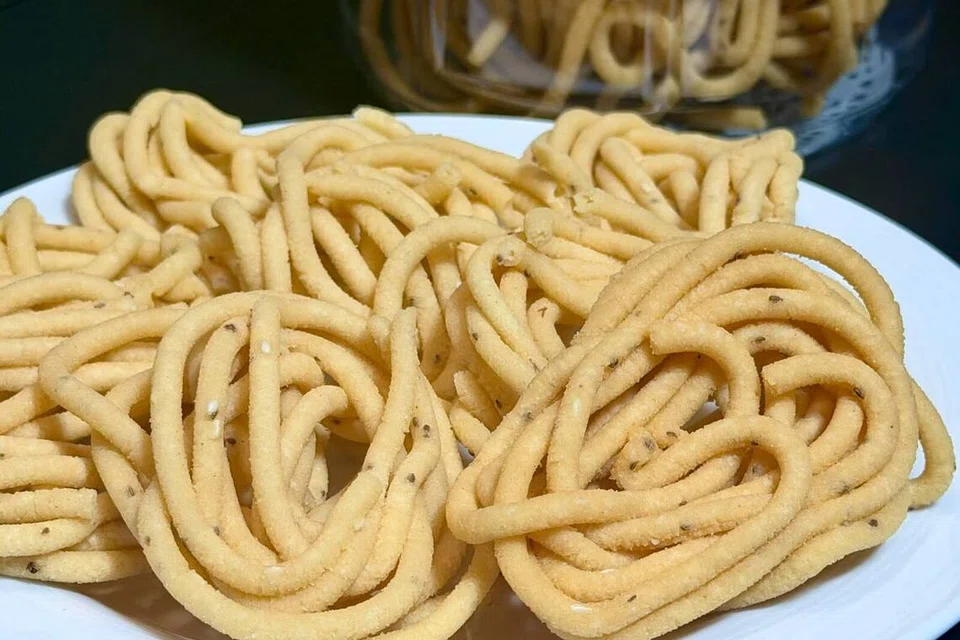

A quintessential component of any Deepavali spread is the murukku. Unending strands of extruded dough – made from rice, dal and assorted spices – are twisted or curled together to form circular clusters that are deep-fried to golden-brown perfection.
The crispy exterior provides a satisfying crunch with each bite, making it the perfect snack to munch while a bunch of nosy Indian relatives try to pry into your personal life with incessant questions and back-handed compliments.
However, the crunch factor alone is not enough these days.
“A lot of our customers want the murukku to be softer because they have aged parents,” said Ms Angeline Benjamin, the co-owner of Ange by Praj, a small home-based business that specialises in festive sweets and savouries.
Her solution is to add a little bit of butter to the dough, which creates a murukku that is less brittle and more melt in your mouth. It also lends a touch of richness for an elevated flavour in comparison to other fat sources such as ghee or margarine.
The higher water content in butter also results in a more malleable dough, making it difficult to pass through the murukku presser. “Between me and my niece, one will do the pressing and the other will do the frying,” Ms Angeline said.
“The minute the one who’s doing the pressing feels pain, then we will switch,” she quipped.
Although the base ingredients are super simple, murukku-making is a labour of love. For Ms Angeline, that labour begins a month in advance when she purchases her rice and urad dal.
The grains are then washed and left out to fully dry in the open corridor outside of her corner unit flat. “If the sunlight shines more inside my house, then I will dry it out in the hall instead,” Ms Angeline explained.
Once ready, the grains are then taken to a mill at the wet market to be ground into flour. For those who are less ambitious, murukku pre-mixes are also widely available in supermarkets.
“It was something I used to do with my grandmother, and we looked forward to it every year because it brought the family together,” Ms Angeline noted.
The deep-frying step is another hassle, as the oil temperature, cooking time, and thickness of the dough have to be absolutely precise – or risk batches of burnt and unsellable murukkus. For a larger-scale operation, the stakes are higher.
Meanwhile, homegrown Ajmir Store produces around 1,000 bottles of murukku per month. “During times like Deepavali, it is always two to three times more,” said Mr Ismail Mohamed, who co-owns the brand alongside his two brothers.
To achieve such large quantities, a mixture of automated and handmade techniques are employed. However, seasonal items, like the Butter Murukku, are made by hand from scratch with a team of eight staffers working around the clock to fulfil orders for just one item.
Based on his grandmother’s recipe, the Butter Murukku is Mr Ismail’s favourite. “I went through a tedious process to be able to cater it for a large audience because this is something that we usually make in small batches at home,” he said.
“It has the special homemade touch that puts you in the festive mode,” Mr Ismail added.