

“You’re kidding me! You’re going to a destination wedding in an ashram?” quipped my daughter.
When you think of a destination wedding, you picture sandy beaches, lavish resorts and choreographed sangeets; of guests dressed in Manish Malhotra’s finest with drones capturing their every pirouette for Instagram.
But have you ever considered swapping a private beach wedding in Bali for an ashram wedding in Dharampur (a town in Gujarat)? Well, neither had I until a close friend’s son tied the knot there. “Gosh, are we running out of exotic locations?” I thought.
The dusty roads of Dharampur, lined with rickety shops bearing names of gods, soon led to a huge welcome centre that resembled a posh hill station. There, we were slapped with a purple band on the wrist to indicate which wedding group we were with.
“Hang on. There were more than one?”
Turns out, five couples tied the knot at the Shrimad Rajchandra Mission, each ceremony presided over by Jain Gurudev Rakeshbhai. Instead of champagne toasts, there were moments of silence. The DJs and dhols were swapped for the soothing devotional songs.
While strolling through the tranquil grounds, surrounded by chirping birds and the occasional temple bell, I wondered: Is this the future of Indian weddings?
Marriage Olympics
Destination weddings are a big deal. They’re like the Olympics of one-upmanship, where families compete to out-spectacle each other. “Oh, your niece got married at Udaivilas? Ours is happening on a yacht in Greece!”
The guests endure sunburns, delayed flights and choreographer-induced muscle pulls, all for the promise of exotic backdrops.
But this wedding at Dharampur turned that concept on its head. No fireworks, no lavish buffet, no influencers posting #ShaadiGoals. Instead, there was simplicity, service and – hold your breath – introspection. The event radiated peace, like a shaadi that decided to go on a Vipassana retreat.
Mindfulness, not madness
When I arrived, I had the choice of a chauvihar dinner (a practice in Jainism where one does not eat or drink after sunset until sunrise the next day) or hi-tea featuring different varieties of paunk (a Gujurati snack made from sorghum grains).
Oh, okay, maybe all the action will be at the mehndi and sangeet, I thought. Nope. Instead, all the action was at a medical camp. Yes, a medical camp.
Picture this: Guests rolling up their sleeves to donate blood while others queued to volunteer at an ad hoc hospital. Some 70,000 villagers are at the camp seeking medical help. I walked around agape at the activity.
I overheard an aunty say: “Beta, did you get your cholesterol checked? It’s free here!” Not your typical mehndi ceremony chatter, but, somehow, it fit.
Later, we toured a veterinary hospital under construction. “What’s this for?” I asked one of the grooms, imagining wedding guests riding in on elephants. “It’s to serve injured animals in nearby villages,” he replied earnestly. The bride chimed in, “We wanted our wedding to reflect our values.”
Well, that’s one way to make a pre-wedding photoshoot memorable – pose with a rescued cow!
For breakfast, there was no dosa station or hot gossip. Instead, just fresh milk and rotlas (flatbread made with pearl millet flour) with fresh butter, followed by a group activity of rolling agarbatties and frying banana wafers to support underprivileged women. Refreshing.
Saffron and serenity
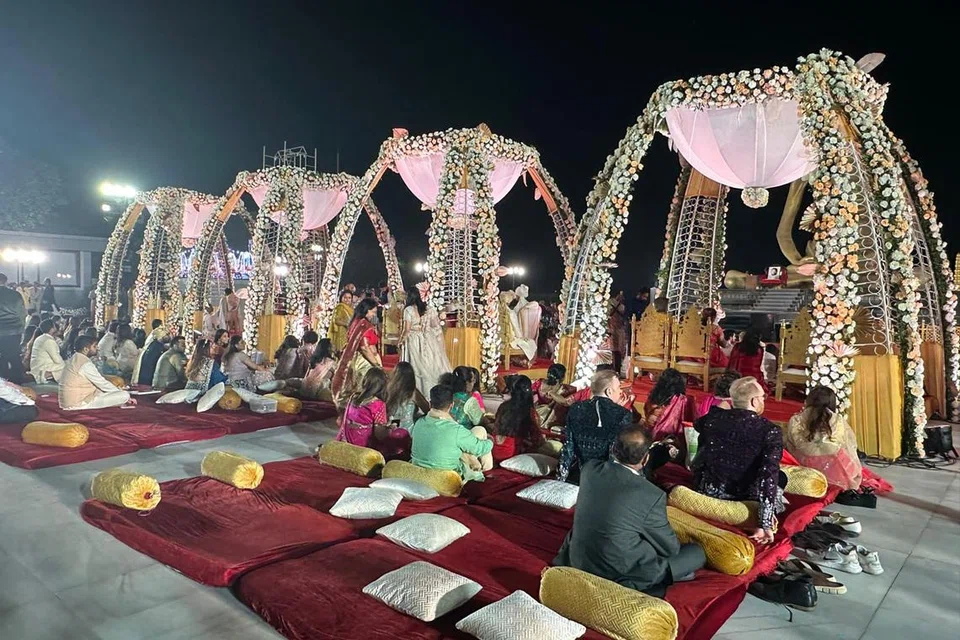
After dusk the wedding began with rituals performed collectively for all five couples.
No dramatic bridal entries to Bollywood songs, no flower boys tossing petals in slow motion. Just a simple procession into an amphitheater decorated with marigolds.
Rakeshbhai presided over the ceremony, sharing insights about love, commitment and compassion. His words weren’t just spiritual, they were oddly practical. “Marriage,” he said, “is not about finding the right person but about being the right person.”
The couples took their saptapadi (the most important rite of a Hindu wedding ceremony) vows about being faithful, equal and respectful not only to each other but to their extended families.
A sage sentiment, but let’s see how it holds up during family WhatsApp group debates.
As the ceremony concluded, the new moon shined behind a statue as though blessing the couples. No multi-tiered cakes or loud yam sengs! No dancing till 4am! Just warm hugs, photo-taking and promises to stay in touch.
Ashram weddings: A new trend with no hangover
So, is this the new normal for Indian weddings? Are we trading opulence for outreach, and party flavours for philanthropy? Possibly.
“My wedding is not just a personal milestone. Why spend millions on one night when we can use that money to create impact?” one bride remarked.
Fair point, though I suspect some in her family would’ve traded the ashram experience for a Taj ballroom in a heartbeat.
But maybe that’s the beauty of it. Not every wedding needs to be a spectacle. This one reminded me of what matters: togetherness, purpose and a lot less noise.
As I packed my bags, I felt oddly light. This wedding had left no room for hangovers or sore feet. Instead, it offered connection and enough laughter to keep things lively.
So the next time someone says “destination wedding”, don’t automatically think of Tuscany or the Maldives. Think of an ashram, where love isn’t just celebrated, it’s reflected in service, serenity and a cholesterol check.