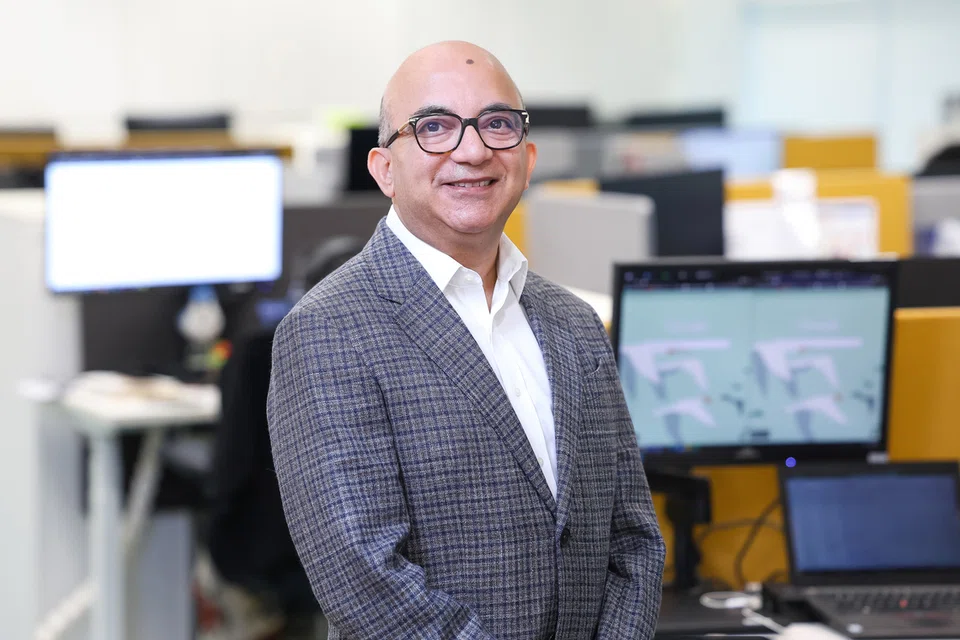
In his new book Maximum Purpose, Maximum Profit: Why Steward Leadership is the Answer, Singapore-based leadership expert Rajeev Peshawaria argues that businesses must move beyond shareholder returns and make solving society’s problems central to their success.
For decades, businesses have operated on a familiar principle: Maximise profits, satisfy shareholders, and leave broader social responsibilities largely to governments and charities.
But what happens when customers, employees and investors can scrutinise almost every corporate decision, from environmental practices to executive misconduct, within seconds?
Mr Rajeev believes the traditional rules of capitalism are rapidly becoming outdated.
In Maximum Purpose, Maximum Profit, published by Penguin Random House SEA in July 2026, he makes a compelling argument: Businesses that genuinely solve society’s problems are better positioned to achieve lasting profitability.
Mr Rajeev, CEO of the Steward Leadership Institute (a Singapore-based non-profit organisation dedicated to helping business and government leaders, investors and individuals activate steward leadership), calls today’s increasingly transparent business environment the “Naked Economy”.

Artificial intelligence, social media, and universal connectivity, he argues, have stripped companies of their ability to hide behind polished public relations campaigns and impressive sustainability reports.
“The old doctrine depended on opacity; the modern economy demands operating in total transparency to create value for a wider set of stakeholders,” he told tabla!.
His argument draws considerable weight from more than two decades of experience in major corporations, including Goldman Sachs, Coca-Cola and Morgan Stanley, where he held senior leadership development positions.
Having begun his career as a banker and currency trader, Mr Rajeev witnessed firsthand how short-term financial performance frequently overshadowed wider responsibilities.
The book challenges the profit-first philosophy associated with economist Milton Friedman, arguing that businesses can no longer afford to ignore the social and environmental consequences of their operations.
“Purpose and profit aren’t competing goals. They’re mutually reinforcing drivers of long-term value, Mr Rajeev explained.
What makes the book particularly interesting is its criticism of conventional environmental, social and governance (ESG) frameworks.
Mr Rajeev acknowledges that ESG represented progress but argues that disclosure requirements and compliance exercises have often failed to deliver meaningful change.
He advocates moving towards ESL — Environmental, Social and Leadership — with genuine leadership commitment replacing mechanical box-ticking.
His proposed alternative is Steward Leadership, built around five values: Interdependence, long-term thinking, ownership mentality, creative resilience and ethical integrity.
These principles, he argued, should guide decisions ranging from investment priorities to employee welfare and environmental protection.
Importantly, the book does not rely entirely on abstract management theories. Mr Rajeev examines businesses and initiatives that have successfully integrated commercial objectives with social responsibility.
Thailand’s Doi Tung Development Project transformed an impoverished, opium-growing region into a sustainable economy supported by coffee production, handicrafts and tourism.
India’s Tata Group provides another powerful example. Its founders embedded community welfare, education and employee benefits into the organisation long before corporate social responsibility became fashionable.
German stationery manufacturer Faber-Castell similarly invested in sustainable forestry decades before environmental sustainability became a mainstream corporate concern.
These examples reinforce Mr Rajeev’s central contention that doing good need not come at the expense of financial success.
However, he acknowledges an important complication.
“I do not want to overstate the case; there absolutely can be short-term tension,” he said, citing sustainable supply chains, living wages and abandoning harmful products as decisions that can initially reduce profits.
This admission strengthens the book’s credibility, although its larger proposition remains open to debate: purpose-driven strategies do not automatically guarantee commercial success, and their benefits may take years to materialise.
The book has attracted endorsements from prominent business leaders and academics.
Mr Desmond Kuek, CEO of Temasek Trust, observes that Mr Rajeev challenges the assumption that profit and purpose must be a “zero-sum choice”.
Ms Jolanda Grob, Group Chief People Officer at Zurich Insurance, highlights how long-term resilience, ethical integrity and interdependence can become competitive advantages.
Mr Arnoud De Meyer, former president of Singapore Management University, describes the book as “a bold and timely reframing of the profit-versus-purpose debate”.
Its relevance extends beyond multinational corporations to Singapore’s small and medium-sized enterprises and family businesses.
Mr Rajeev argues that smaller organisations may actually find it easier to integrate purpose into their operations because they are less constrained by established corporate structures.
Perhaps the book’s most valuable contribution is its insistence that responsible business must begin with leadership decisions rather than marketing slogans.
As Mr Rajeev puts it, “In the Naked Economy, candour earns more trust than a polished statement ever will.”
Maximum Purpose, Maximum Profit is a timely, thought-provoking examination of how capitalism might evolve in an age of unprecedented scrutiny.
Its message is both straightforward and challenging: Companies should stop treating social responsibility as an additional expense and start recognising it as a potential foundation for sustainable growth.
For business leaders navigating uncertain economic conditions, that is an argument worth considering.