
If there is one novel emblematic of the partition of British India into India and Pakistan, it is Khushwant Singh’s epic, Train To Pakistan.
The historical novel, published in 1956, recounts the momentous division in August 1947 through the perspective of Mano Majra, a fictional border village.
It skirts the political events, but focuses on the moral confusion: How a small Punjab village with residents from all religions and sects – Sikhs, Muslims, Hindus and Sindhis – living in harmony was split overnight into various factions, and egged on by fanatics to violently clash among themselves.
Amid the chaos lies the love of a Sikh man for a Muslim woman – a bond that stands as the last hope against the impending disaster that awaits the village.
Khushwant, who was born in Punjab and noted for his trenchant secularism, used his personal experience to narrate the tumultuous turn of events with a sense of reality and horror.
In 1998, Indian director Pamela Rooks made a film on Train To Pakistan, which received mixed reviews. Over the years, multiple plays based on the novel have appeared on stage.
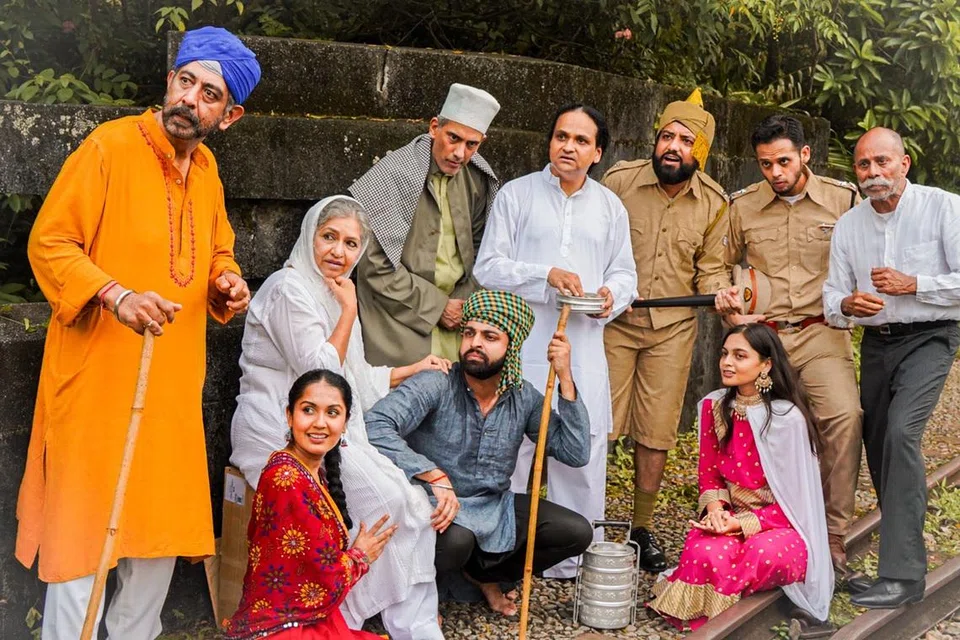
Now, Singaporean theatre personality Daisy Irani has tried her hand at adapting it. Her production will be staged at the Esplanade’s Kalaa Utsavam – Indian Festival of Arts 2024 from Nov 20 to 24.
“Telling it on stage is a tribute to this shared piece of history that we have with these minority communities in Singapore,” she told tabla!
“The story is also a reminder that we live in times where communities and societies are being torn apart as a consequence of wars and events not of their making. In that sense, it has additional relevance.”
Her husband Subin Subaiah, who wrote the script, said the play has largely remained true to the novel. “If aficionados feel their favourite parts are missing, it is a consequence of distilling the sprawling epic to an hour and 45 minutes of drama without an interval,” he said. “But we stayed true to the central characters and their journeys.”
Directed by Daisy, the play, produced by her HuM Theatre and Esplanade, features a cast of established theatre practitioners, including herself (playing two roles) – Shrey Bhargava, Ashie Singh, Yogesh Tadwalkar, Aizuddiin Nasser, Gautam Marathe, Dipeeka, Jawahar Kankilal and Aditya Mazumdar.
Partition is a sensitive issue that still rankles with many people in India and Pakistan. Subin said the story, however, has been played out without bias.
“What is history is history,” he said. “We haven’t messed with that by making independent opinions that don’t resonate with the times and with Khushwant Singh’s sentiments.
“When you read the interviews of the survivors, you notice that they speak without rancour about each other and are almost unanimous in their sentiment that such a tragedy should never happen again. I guess that speaks for itself as a matter of relevance.”
According to Daisy, the story speaks to the audience in different ways. “It is a thriller, a historical drama and a romance,” she said.
“If the audience goes away saying they had a good time at the theatre, that would be just dandy. If they contemplate on the material over dinner and find some kernels of contemporary relevance, that would be a bonus.”
Mazumdar, who plays a tea seller and ruffian, said the play “is a little homage to some of the sacrifices and bloodshed that we heard while growing up”.
“My grandfather and his family lived in Karachi in the 1930s and moved to India sometime in the 1940s,” he said. “I grew up listening to stories from my aunts about their happy childhood and later some of the horror stories they saw their friends go through during the partition. This play sort of brings that all together.”
Marathe, who acts as Iqbal, said Train To Pakistan is “a tale of that horrible time that everyone wants to forget and no one can”.
He added: “And no one should, as it contains lessons for all of us. It is a story that tells us that even when all the good intentions and hope fail in the face of extreme hatred, love can still inspire people to become heroes.”
Daisy said the project was a complex one, but was a pleasure to bring to fruition thanks to a committed cast and crew.
“HuM is a not-for-profit company and so I am delighted that we found support for this play from a few key collaborators, patrons and sponsors,” she said. “Without their backing, this play could never have been staged.”
The Esplanade’s Kalaa Utsavam – Indian Festival of Arts 2024 runs from Nov 15 to 24 and celebrates Indian arts and culture during the festive period of Deepavali. For more information, visit https://www.esplanade.com/whats-on/festivals-and-series/festivals/2024/kalaa-utsavam