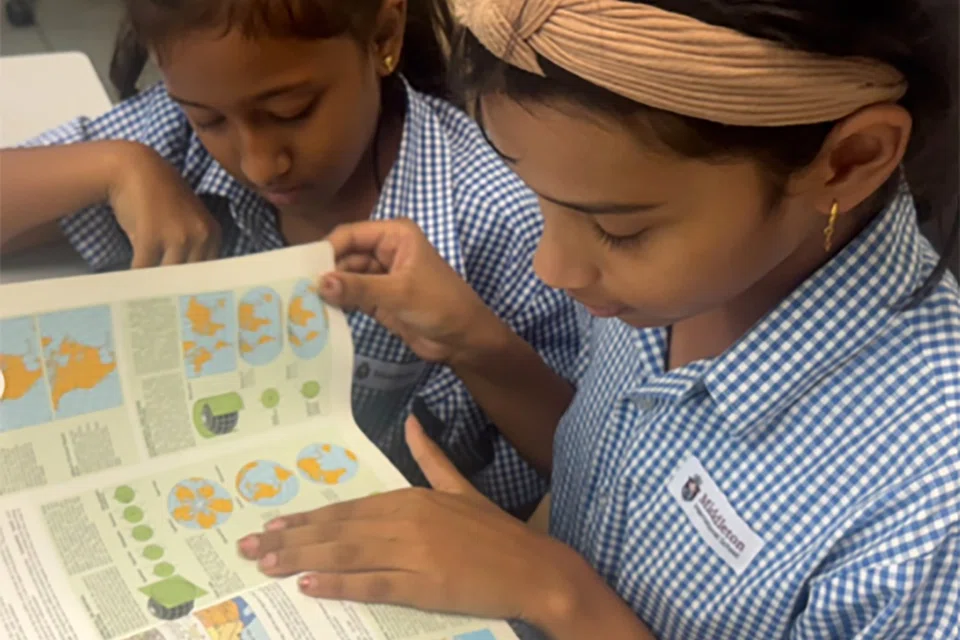

Students of Middleton International School in Singapore halt whatever they are doing when the clock strikes 3:30pm, and spend the next 15 minutes immersed in a book.
This practice is a part of “DEAR” (Drop Everything And Read), one of the many highlights of Middleton’s Book Week which took place from April 20 to 24.
“Reading is essential because it nurtures the soul and the mind. It allows us to think, imagine and create a world of our own,” said 44-year-old Nadia Khalid Feroze, organiser of Middleton’s Book Week and Head of Secondary English and Drama.
During Book Week, students also attended author visits and talks on student reading initiatives, all of which emphasised the importance of reading in building vocabulary, sparking innovation, and supporting mental health.
Avid reader Mark Navit Rolston, a 12-year-old student at Middleton, believes that reading is important because it “helps with your vocabulary, spelling, and helps you understand words you don’t know and then you ask your parents, and so you keep learning.”
A 2025 study published in Language (Journal of Language and Education) found that extensive reading significantly improves vocabulary across different levels of language proficiency as printed texts, such as books, contain words that are less prevalent in the spoken language, and so readers are exposed to a wider range of complex vocabulary.
Reading also allows words to be observed in context, enabling a deeper understanding of their meanings and nuances. It can also foster innovation, as it builds students’ problem-solving skills and knowledge, which enables them to develop new concepts.
“When I read history books, I see the inventions and the mistakes they made, and then you can learn from that and create a new thing,” noted Middleton student Deeksha Saravanan, 12.
As more youth struggle with mental health challenges, it has become one of the key issues in Singapore, with the government identifying it as a priority.
Immersing oneself in a good book can help improve mental wellness, according to Psychology Today. Reading fosters young people’s understanding of human nature and their place in the world. Also, identifying with characters in the story can provide comfort as readers feel they are not alone in their struggles or pain, which can help alleviate feelings of isolation and loneliness in young students.
For young Singaporean students with hectic schedules, reading provides a form of mental escape which can reduce stress and promote relaxation. Middleton student Kunjal Rathi, 12, described the experience as a “feeling I can’t put into words. I’m into the book. I’m the person.”
The benefits of reading were highlighted by a survey conducted by the University of Liverpool, of more than 4,000 participants, which found that reading served as a top method for reducing stress. Participants also reported that reading encouraged personal growth, such as improving health, picking up hobbies, and boosting empathy, with 64 per cent of readers having a better understanding of the feelings of others.
While a 2024 National Library Board (NLB) reading survey indicated a generally healthy youth readership in Singapore, with 81 per cent of teenagers reading more than once a week, around 9 per cent of teenagers in the study who didn’t read cited a lack of interest as their main reason for not reading.
“Reading is very essential not just for well-being but also for mental development”, noted Middleton English teacher Mr Mohamed Marecar, 36.
Mr Marecar believes that cultivating a love for reading among students requires them to discover books they genuinely enjoy. He implements this approach in his classes by encouraging students to choose books they like and commit to reading them for several weeks, rather than just a few lessons, which helps transform reading into a more personal and engaging experience.
“Reading is a life long skill, something that never stops. So starting at a young age gives you a head start, and it’s an opportunity not to be missed”, he added.