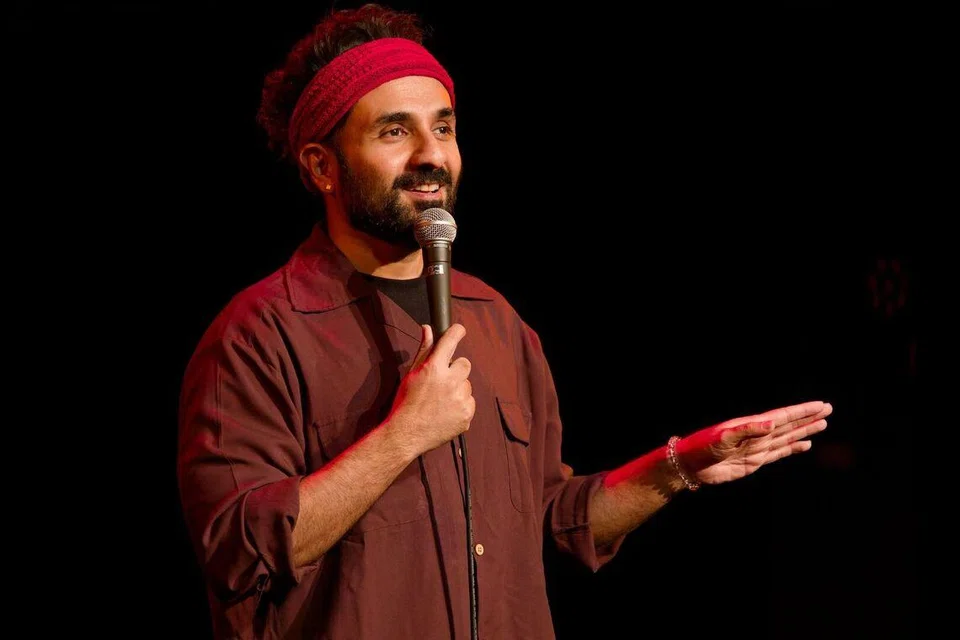

Most people spend their lives surrounded by people in their immediate periphery – family, partners, old friends, and colleagues. Vir Das, however, has spent most of his adult life in rooms full of strangers.
This revelation led to the inception of his new stand-up show, Hey Stranger.
In this show, he captures the fleeting intimacy that arises during exchanges with these strangers. The one question he ruminated over before writing his new special was: “What would you say to a stranger if you had nothing to lose?”
“I seem to have spent 90 per cent of my life with people I don’t know, and yet we share these really honest moments over the span of my show,” he told tabla!.
Hey Stranger grew from Vir’s fascination with the ephemeral nature of connection – for a couple of hours, in a theatre or comedy club where people shuffle in and out nightly, the audience and performer share a freedom reminiscent of the adage ‘What happens in Vegas stays in Vegas’.
Over the years, the 46-year-old has become one of India’s most recognisable global comedians – a touring performer with Netflix specials. Recently, he added a film, Happy Patel: Khatarnak Jasoos, to his portfolio.
“It’s a tiny film,” he said, noting that the project took nearly three years of work, including test shoots, rewrites, repeated narrations, and roughly 25 test screenings. The process, he admits, was “nothing short of blood.”
The film had a modest theatrical run but found a warmer reception online, unexpectedly ranking alongside major Indian blockbusters on Netflix.
“Our film was sitting between Dhurandhar and Border 2, and we thought to ourselves, ‘How is this little movie here?’” he recalled.
After Happy Patel, the safer route might have been another mainstream comedy. Instead, Vir is venturing into a “proper horror movie,” stepping outside his comfort zone.
His last foray into horror had been comedic – the zombie epic Go Goa Gone. “The minute I feel the safety net,” Vir said, “I feel like art gets compromised.”
This need to step out of his comfort zone mirrors the risks Vir has long navigated offstage.
For years, he has been both a performer and, oftentimes, a public advocate for comedians navigating backlash, censorship, and political scrutiny in a country where an ill-worded punchline can land you in legal hot soup.
Yet, Vir approaches these pressures with far less absolutism than public debates often demand. “There’s nothing to do but keep joking,” he quipped.
What makes him notable is that he also recognises the unequal realities underneath that freedom. He pointed out that every comedian’s relationship to political pressure is shaped differently – by money, by familial responsibilities, or by privilege.
“While some of us don’t play ball,” he said, “I never begrudge anybody who does.”
This is a surprisingly nuanced stance in a media environment that often rewards rigid declarations. Vir resists turning comedians into heroes or martyrs. While some push boundaries aggressively, others apologise, and some avoid certain topics entirely. To him, all these responses exist within the same ecosystem of survival.
“The important thing,” he said, “is that you just keep joking. If you don’t let us say something on a microphone, we’d whisper it to each other.”
Outside work, life is quieter. His wife, Shivani, is building shelters for rescued dogs in Goa, and Vir spends most of his downtime around injured animals and newly rescued puppies.
When asked what remains most important to him as a comedian, someone who once defined himself as an outsider, he emphasises the importance of authenticity.
Vir views social media with the same scepticism he applies to celebrity culture at large. Comedians, he believes, cannot convincingly sell aspiration.
“Nobody cool becomes a comedian,” he said dryly. In his view, comedians are often outsiders first – awkward kids, rejected teenagers, observers of social behaviour rather than participants. Trying to be anything but authentic online, he said, feels fundamentally dishonest to him.
Toward the end of the conversation, the topic shifted to legacy. Vir mentioned the comedians he admires – George Carlin, Lenny Bruce, and Richard Pryor – artists remembered by fragments of their most successful bits.
“I think I’ll have a legacy,” he said, “I just don’t think I’ll get to control it.”
Vir is set to perform in Singapore on May 21. Tickets are available on Ticketmaster.