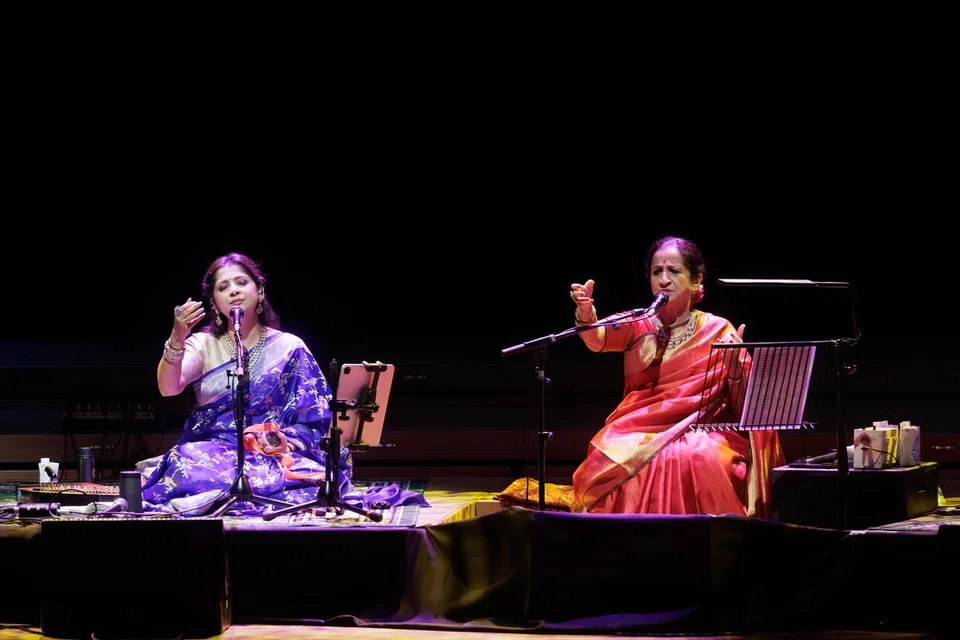
An evening of rare musical alchemy unfolded at the SIFAS Festival of Arts 2026 when DWI – Two Voices, One Soul brought together two towering figures of Indian classical music – Aruna Sairam and Kaushiki Chakraborty – for their first-ever stage collaboration.
Held at the Esplanade Concert Hall on April 26, the sold-out concert drew an audience of over 1,000 and quickly established itself as one of the defining highlights of this year’s festival, themed “Infinite Rasa”.
But, beyond the numbers, what unfolded over the next two hours was something far more profound – a deeply immersive artistic conversation that transcended genre, geography, and even tradition.
At its core, DWI was not about fusion in the conventional sense. There was no attempt to blur identities or create a hybrid soundscape for novelty’s sake. Instead, the concert respected the integrity of both Carnatic and Hindustani systems, allowing them to stand tall in their individuality while engaging in a nuanced, often intimate dialogue.
The central motif – “two voices, one soul” – was explored through the feminine archetype of Radha, charting an emotional journey through shringar (romance), viraha (separation) and bhakti (devotion).
The opening piece, Adharam Madhuram (a famous eight-verse Sanskrit devotional hymn composed by the saint-philosopher Vallabhacharya praising Lord Krishna), rendered jointly, immediately set the tone. There was an unmistakable sense of shared aesthetic sensibility between the two artistes – not just in their command over music, but in their understanding of silence, space and emotional cadence.
It felt less like a duet and more like a single voice expressed through two distinct idioms.
Aruna, with her unmistakable emotive intensity, anchored the Carnatic segment with authority and grace. Her rendition of Maamavathu Sri Saraswathi (a popular Sanskrit Carnatic classical krithi dedicated to Goddess Saraswathi) was expansive yet intimate, each phrase unfolding with a sense of lived experience.
The padam Payyada (composed by Kshetrayya in the Nadanamakriya raga) was particularly striking – its emotional weight carried effortlessly through her nuanced gamakas (ornamental “movement” or “shake” applied to a note in Indian classical music that brings a raga to life) and deeply internalised expression. There is a certain authenticity to Aruna’s music that resists ornamentation for its own sake; every note seems earned, every pause deliberate.
Kaushiki, representing the Hindustani tradition, offered a compelling counterpoint. Her elaboration of Raag Rageshree – moving from the meditative vilambit (slow tempo) to a more energetic drut (fast tempo) – was a masterclass in control and emotional layering.
Her thumri (semi-classical vocal genre of Hindustani music) in Mishra Pilu (a highly popular, emotive light-classical Hindustani raga) brought a different colour to the evening, marked by delicacy, restraint and a quiet intensity that complemented Aruna’s more expansive style.
What elevated the concert from excellence to something truly memorable was the seamless transition from individual expression to shared dialogue.
This was not a case of alternating performances; rather, the two artistes engaged in a genuine musical conversation, often picking up each other’s phrases, echoing motifs, and building on improvisations in real time. The interplay felt organic, unforced – a testament to both their artistry and mutual respect.
The ensemble played a crucial role in sustaining this delicate balance. The rhythmic dialogue between tabla exponent Ojas Adhiya and mridangam artiste Praveen Sparsh added depth without overshadowing the vocalists. Shadaj Godkhindi’s flute interludes served as elegant bridges between the two traditions, while the subtle inclusion of guitar and keys added texture without diluting the classical core.
The finale – a vibrant abhang (a form of devotional poetry and song dedicated to Lord Vitthal – Vishnu/Krishna – in Maharashtra) in Raag Hamsadhwani – brought the evening to a joyous crescendo.
Here, the boundaries between the two traditions dissolved completely, replaced by a shared celebratory energy that drew the audience into its orbit. It was spontaneous yet inevitable, the kind of moment that cannot be scripted but only experienced.
What stood out throughout the evening was the absence of ego. In a collaboration of this scale, the risk of imbalance is always present. Yet, both artistes seemed acutely aware that the music itself was the protagonist. There was generosity in their exchange, a willingness to listen as much as to lead – and that made all the difference.
The presence of Guest of Honour Eric Chua, Senior Parliamentary Secretary for Law and Social and Family Development, and the strong turnout underscored Singapore’s growing appetite for serious classical programming.
A visual arts exhibition by SIFAS students added another layer to the evening, reinforcing the festival’s multidisciplinary vision.