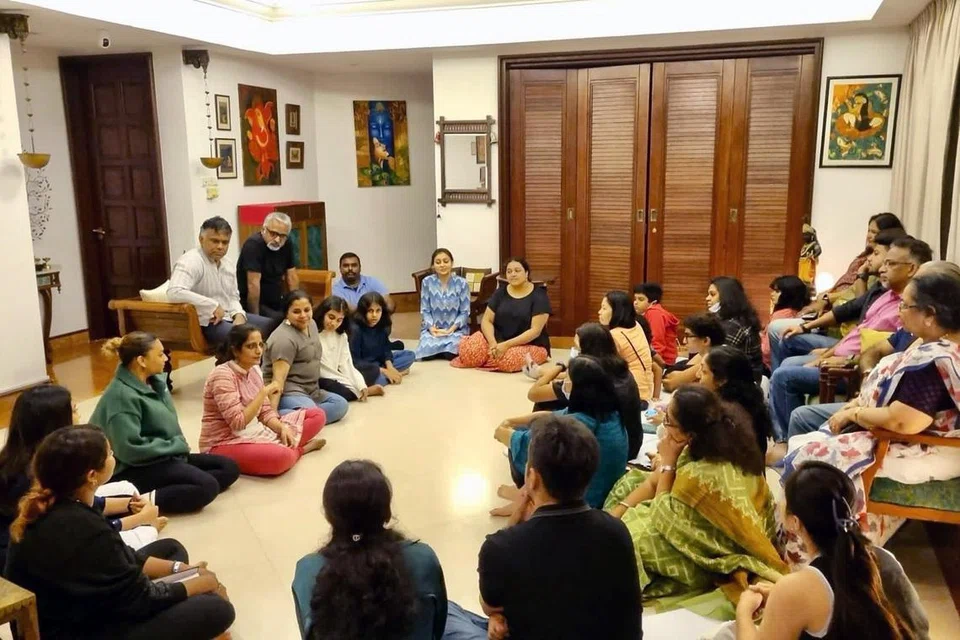

Baithak, meaning “living room” in Hindi and Urdu, is a bold new initiative by multi-disciplinary artiste Rachna Anand that transforms home spaces into intimate theatres for plays, poetry readings and deep conversations.
Inspired by her father’s mantra “Guftagu jari rahe” (Conversations must go on), Baithak aims to revive meaningful dialogue in an age dominated by digital noise.
Originally from New Delhi, Rachna has lived in Singapore for over 40 years. Growing up, she experienced mushairas – intimate gatherings where poetry and stories were shared by the glow of a shama (lamp).
When designing her home at Butterfly Avenue, Upper Serangoon, in 2016, the Singaporean envisioned it as a space for performances, ensuring a spacious living area that could serve as a modern-day mushaira.
Baithak’s first production, Marking, directed by theatre exponent and arts educator Dr Edmund Chow and assisted by Rachna, is an unfiltered exploration of emotional, psychological and physical “marks” that shape individuals. Six actors from diverse backgrounds share deeply personal stories in a barrier-free, home setting, making the experience raw, immersive and profoundly impactful.
The three scheduled shows (March 21-23) sold out quickly, leading to an additional matinee. Each performance concludes with an open discussion where the audience of about 40 people can reflect, share and engage – over refreshments.
Baithak follows a pay-as-you-can model with contributions starting at $25, while students attend for free. This keeps theatre accessible and affordable, unlike traditional productions where high venue costs drive up ticket prices.
Beyond theatre, Baithak will host book readings, music discussions and poetry sessions, offering a counterpoint to the superficial interactions of social media.
While home-based theatre is rare in Singapore’s Indian community, filmmaker and playwright Shilpa Krishnan first introduced the concept in February 2023 with The Living Room.
Wanting to experiment beyond film, the Singaporean staged the first edition at her friend Geeta Balagangadharan’s home in Pebble Bay condo, using real spaces to create an immersive storytelling experience.
“It wasn’t about cutting costs,” Shilpa explained. “After 15 years in filmmaking, I wanted to see how a play would unfold in a real, lived-in space.”
The three original performances sold out in days, each with an audience of 26. Viewers were captivated by the uniqueness of the concept – experiencing a play inside a real home; the immersive use of space – not just the living room but also the dining area, kitchen and doorways; and the storytelling itself – rooted in cultural authenticity and real-life experiences.
Geeta, who hosted the plays, said: “Unlike a theatre set, our home dictated the script – entryways, lighting and even furniture played a role.”
Shilpa donated all proceeds to charity.
Coincidentally, The Living Room is being restaged at Geeta’s home from March 21–23, 2025. Tickets at $50 for the five shows are sold out.
Home theatre is still a niche concept in Singapore, but France and Japan have long embraced intimate, non-traditional venues.
Shilpa believes that, while rewarding, home theatre requires significant effort. “It depends on whether people are willing to put in the time and energy for something with a limited audience capacity,” she said.
Rachna sees Baithak as more than just theatre – it’s a revival of deep, meaningful conversations.
“Today’s youth are digitally connected but emotionally disconnected. Baithak is about reclaiming real human interaction,” she said.
Actor Aditya Mazumdar believes theatre will always evolve.
“Art finds new ways to tell stories,” he said. “Home theatre will find its niche in Singapore, but it won’t be a replacement for commercial theatre.”
As Baithak and The Living Room gain momentum, they challenge the notion that theatre belongs only on grand stages.
These initiatives prove that all you need for great theatre is a story, a space and people ready to engage in real conversations.