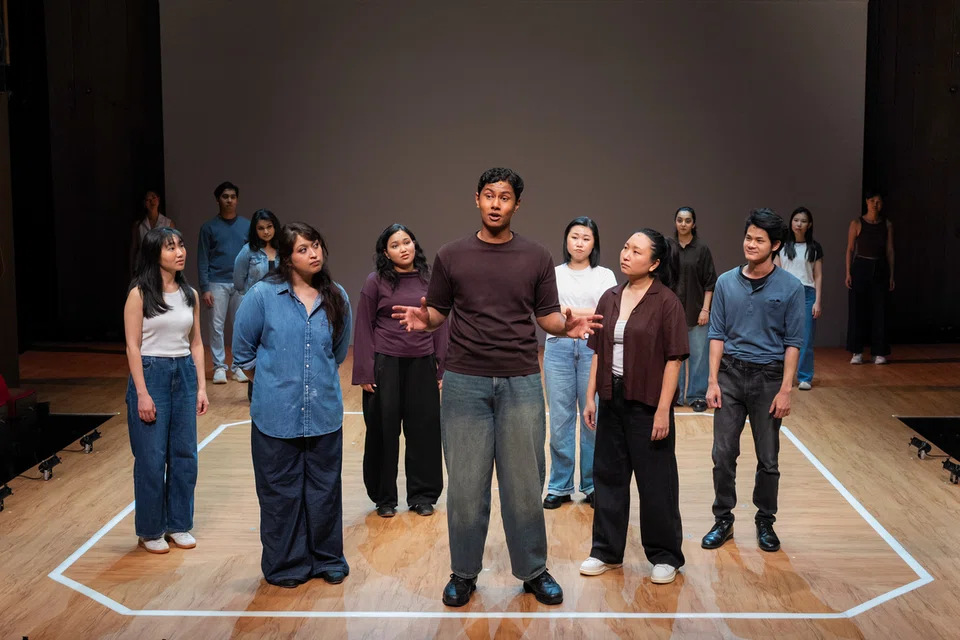

Audiences had their stomachs filled up by the delectable staging of Young and Wild’s All You Can Eat, an anthology of plays discussing the presence and power of food in human life.
Young and Wild is a programme under theatre company Wild Rice that professionally trains budding actors for about 10 months until they make their debut at the Ngee Ann Kongsi Theatre.
Mr Alfian Sa’at, who was one of the dramaturgs, or script consultants, and the writer of the opening play, Appetiser, said programmes like these are important for Singapore.
“There are young people who want to be on stage, and that is so fundamental and precious,” said Mr Sa’at, 48.
The set of 10 short plays was written by playwrights from another Wild Rice training programme, Rice Cooker, where, instead of actors, new writers hone their scriptwriting.
The buffet of plays includes Mee Soto, Layer Cake, and Dry Martini, with an ensemble cast as diverse as the range of “dishes” presented.
The plays also range from intimately simple to completely absurd.
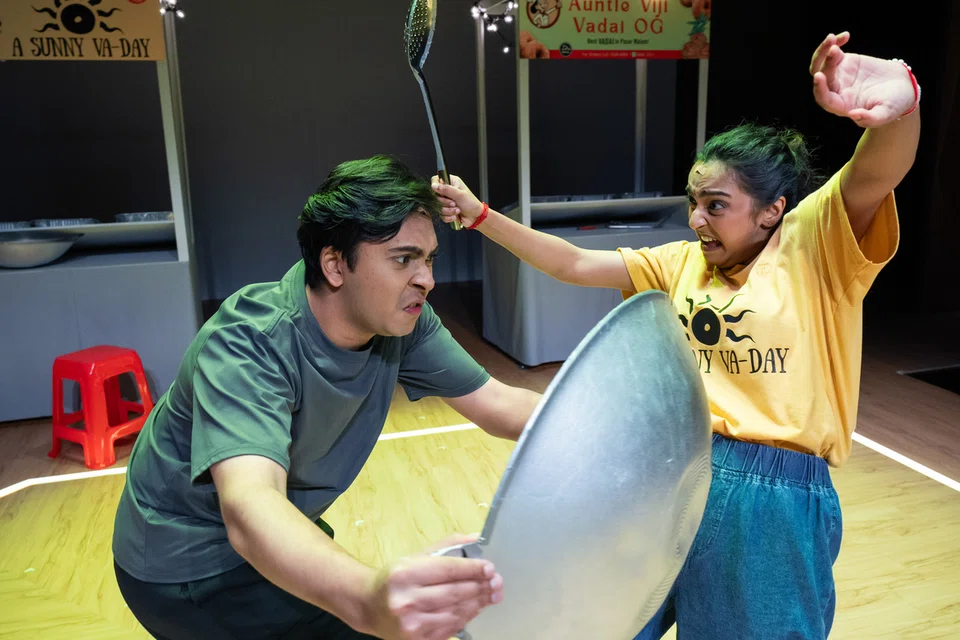
One that falls to the absurdist extreme is Vadai, written by Ms Melizarani T Selva.
Two vadai sellers battle it out for customers while on the same street: one, the daughter of a legacy vadai seller, played by Ms Hemalatha Ravinthran, who distanced herself from her mother to make more “efficient” fritters, and the other, her mother’s right-hand man, who insists on carrying on the business as she did, played by Mr Theijes Therrat Menon.
“You ownself gentrify your mother”, Mr Theijes’s, 23, favourite line, sums up the premise perfectly, with all of it feeling especially topical while living in uncertain times for family businesses, such as Komala Vilas.
But what follows is an over-the-top stage fight, with kicks, punches, and dented cooking vessels.
Ms Hemalatha, 25, a freelance performer specialised in dance, said that learning stage combat was one of her favourite parts of the rehearsals.
“Coming from a movement-based background, it was interesting to see how that changes for stage, and whether my body could take it,” she said.
On the other end of the spectrum, also based on an Indian dish, is Kanchi, written by Mitchell Fang.
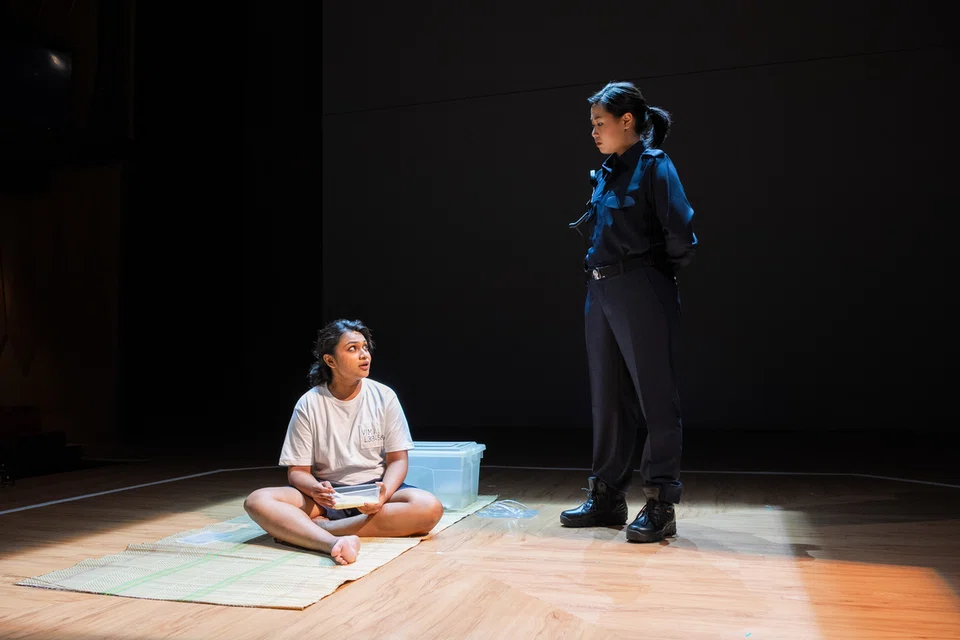
In it, Ms Gomathi Ravindran, resident production lead at AGAM Theatre Lab, plays a death-sentenced prisoner conversing with their warden, played by Ms Charmaine Teo, over their last meal.
Ms Gomathi, 31, makes this play one of the show’s standouts; the only props supporting her are a straw mat, a plastic box, and, of course, the bowl of porridge. And yet, she ignites on stage, balancing flavours of dread with acceptance of her circumstances.
Dealing with the delicate topic of the death penalty left Ms Gomathi with an initial internal conflict, even though the play focuses more on the conversation, leaving political stances to what is left unsaid.
“When I got the script, I began to worry whether I would be playing a stereotype, but I trusted my director, my castmates, and knew I could not be distracted by it,” she said.
Hotpot by Ms Rachael Ng, a high production, laugh-out-loud commentary on eating alone, and Last Course by Mr Joel Tan, the show’s closer about the life cycle of a woman as her moments count down on TV screens like order numbers, were two other standouts.
But some moments feel half-baked.
In the third course, Kachang Pool by Ms Euginia Tan sees an estranged father and son reuniting. Despite being straightforward in premise and execution, like some of the others, it feels bland because of mismatched pacing, leaving viewers unable to invest in the characters.
Ms Dia Hakim Khaeri’s $1 Ice Cream, a commentary on the hijacking of Singaporean cuisines, misses the nail it’s trying to hit, extremely hard. While there are some quippy lines and laughter, it’s a bit too on-the-nose, and, much like the ice cream it criticises, it looks like it has great promise, with nuances of conversation about the optics of activism, but is tainted by artificial filler.
In the end, the message of All You Can Eat is clear: Food follows us in every moment, tragic or celebratory; it is there. And when it isn’t, when we are too sick and too old to stomach even a drop of water, food still remains to end our story at the catering for our funerals.