
A crowd of buzzing secondary school students chatter as they wait for their school text to come to life in The Stage Club’s performance of Everything But The Brain. The play is a GCE O-Level and N-Level literature text, with some students even bringing the book of the script to follow along.
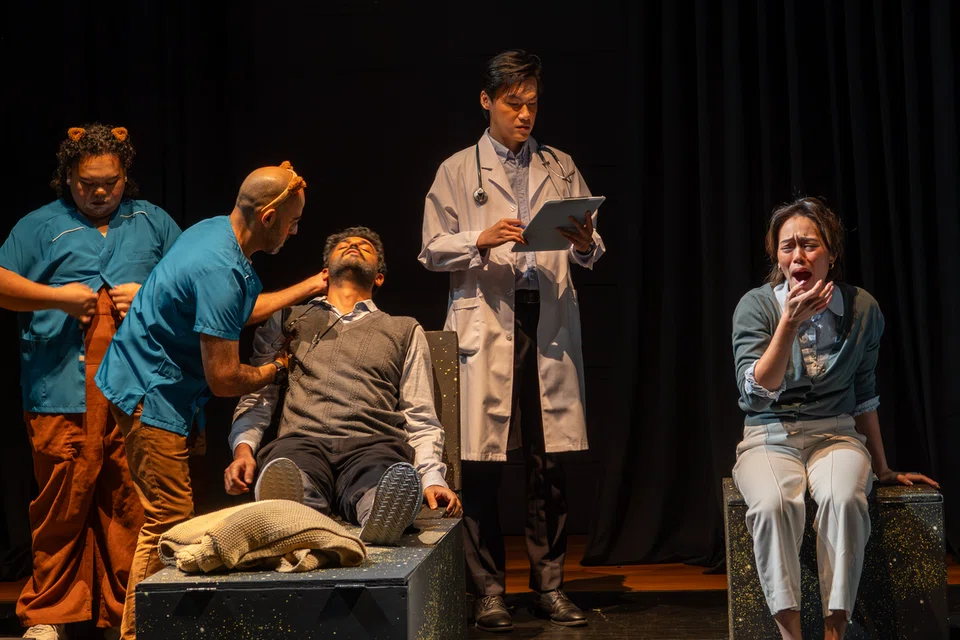
Elaine, a middle-aged secondary school Physics teacher played by Ms Terri Tan, is dealing with her father’s last year of life. Her psyche or conscience is personified by three bears, who also play various ensemble roles as the show goes on. The play is rather dark, with no escape for audiences during scenes like Father’s stroke or his incontinence.
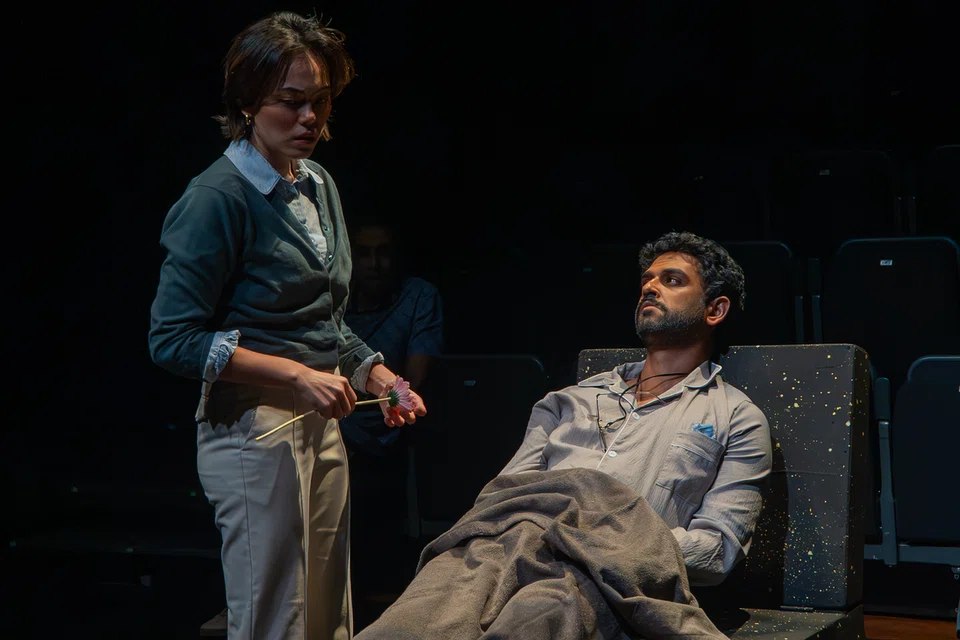
By far, the standout of the play was Mr Tarun Satyakumar, who plays the 66-year-old Father. Despite being 31 and apprehensive about the age disparity during auditions, he does not play the role like a caricature and is more reminiscent of Rishi Budrani’s portrayal of his father in Can I Make You A Suit, Mate?
“I think what we discussed was that we usually see our parents as much younger than they are, and this play is mainly seen through Elaine’s eyes,” he said. “It kind of hits you when you notice, ‘Oh my parents are older than I kind of internalised.’”
The role was originally written for an ethnically Chinese actor, but the script did not have to change much. However, some lines and behaviour naturally differ in context just by Mr Tarun being an Indian actor. For example, when Father is recovering from his stroke, he asks for his usual Thursday night prata.
Father also has two of the most crucial lines in the play: the title, “Everything but the brain”, and the heart-hitting “You are the one thing in my life that has never made sense”.
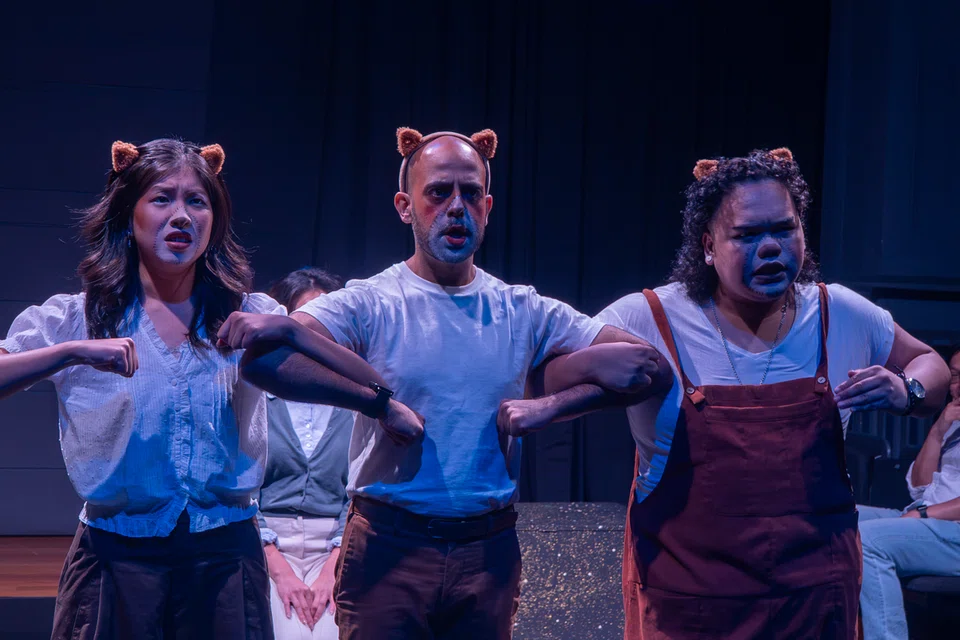
The three bears, played by Ms Charlotte Lim Kai Ler, Mr Hamza Qaiser, and Mr Diego Alfonso, also kept the play lively and whimsical. Their comedic insertions during some of the sadder parts added a layer of unease, like participating in a pseudo-game show as Elaine spirals over her father’s mortality.
Ms Deepa Pushpanathan, 23, the co-director of the play, said that the bears are very central to the plot. “With the bears, you have to balance surrealism with the realism, and it’s a really good way to introduce this sort of very complex topic of a child losing their father,” she said.
Physics is a central theme as it parallels both Elaine and Father, as one is a physics teacher and one used to be a Physics professor. Through science, they communicate with theories like Newton’s laws of motion. The script helps break down these concepts and breathe new life as plot devices through straightforward comparisons, such as explaining Einstein’s breakthrough e=mc2 through trains and bears.
“It was the first time I understood the theory of relativity,” said Mr Tarun.
Chemistry between the players waxed and waned through the approximately 90-minute runtime. While Elaine and Father did not seem convincing as parent and child initially, scenes where we flash back to her childhood or much later at the twilight of Father’s life made the duo come to life.
Where chemistry lacked the most was between the Doctor, played by Mr Max Ma, and Elaine. Initially his part felt extremely miscast, but later developments in the plot helped to clarify why the behaviour was as such.
The script is occasionally questionable at times, even leading to some delayed line delivery by the actors. There are moments where there is strange exposition and too much telling over showing, like when the Father starts an extensively earnest monologue about time.
But the main issue in the play by far is the music; it just does not fit. In fact, it was quite disruptive and distracting to some crucial scenes. There’s an action-movie-esque track behind “Eureka” moments or songs that are better suited to epics during the more emotional parts. By the end, it was like a parodic jab every time the music came on. Perhaps this was a choice to add to the absurdity of the play.
Past these issues is a story rooted in love and maturity. It is still understandable why Jean Tay’s script won the Straits Times Life! award in 2006 for Best Original Script and why it’s selected as an academic text, as its breakdown of scientific theories into emotional milestones is still a great accomplishment.
“The whole concept is to appreciate your parents more. Elaine starts to reflect a lot about her childhood and her relationship with her father, only after the stroke happens,” said Ms Deepa.
Everything But The Brain is playing at the Play Den @ The Arts House till Aug 9 (except on Mon-Wed), with shows at 7.30pm and matinees at 2.30pm on weekends.