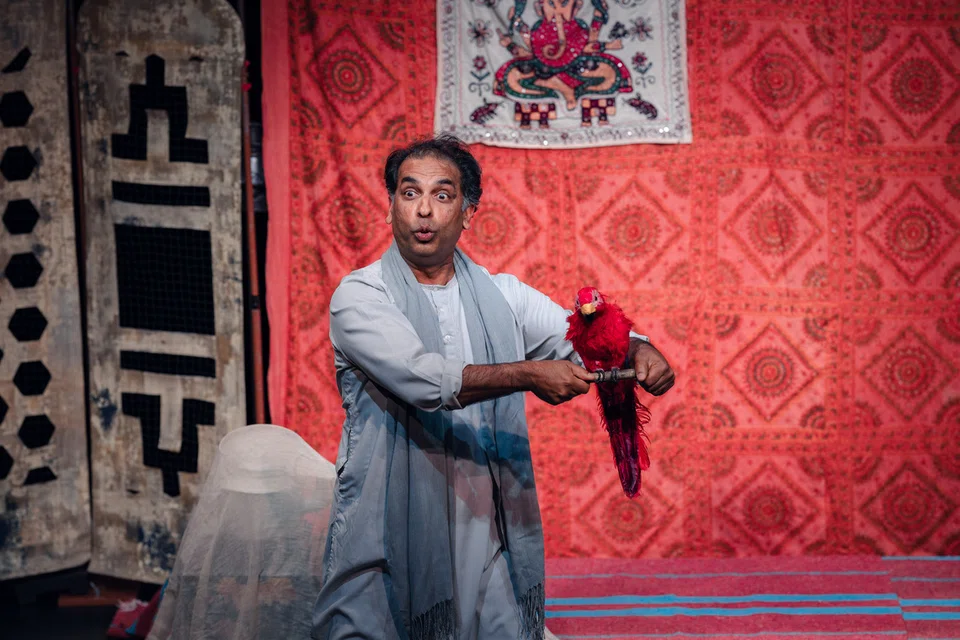


August saw Singapore’s first international Tamil Theatre festival, Nadagamic, organised by AGAM Theatre Lab. Eight plays celebrating global excellence in Tamil drama took over the Tanjong Pagar Distripark space from Aug 20 to 30, including two English plays: Guru Of Chai and Whose Sari Now?.
Guru Of Chai comes from a New Zealander theatre house, Indian Ink Theatre Company, following the story of a buck-toothed, train station tea-seller in India and his misadventures with gangs, orphans, and a parrot.
Jacob Rajan, who plays all 17 characters in Guru of Chai, said that, while he’s ageing over the years, he’s still telling stories from his past, and that doesn’t present any issues.
“He’s an older man now doing that. So when he plays a young girl, he’s still an older man playing a young girl,” he noted.
Whose Sari Now?, on the other hand, hails from the mind of United Kingdom-based actress Rani Moorthy, who also spent years teaching theatre in Singapore. The story is cut into five vignettes of different characters, from a woman suffering during the Tamil genocide in Sri Lanka to a Malaysian historian, all of whom have sarees embroidered in their stories.
“I’m not straightforward personally, in the way I write. To the point that I don’t have subtleties, and it’s all very clear what I’m trying to say. And I think that makes the work a little bit timeless, because you’re not setting it in any historical frame. I have chosen to write stories that are about the human condition,” said Rani.
Unlike Guru Of Chai, Whose Sari Now? relies heavily on audience participation. Rani hands out saris and even teaches a volunteer how to wrap one. Because of this, if the crowd doesn’t match her energy, the improvised moments can fall flat.
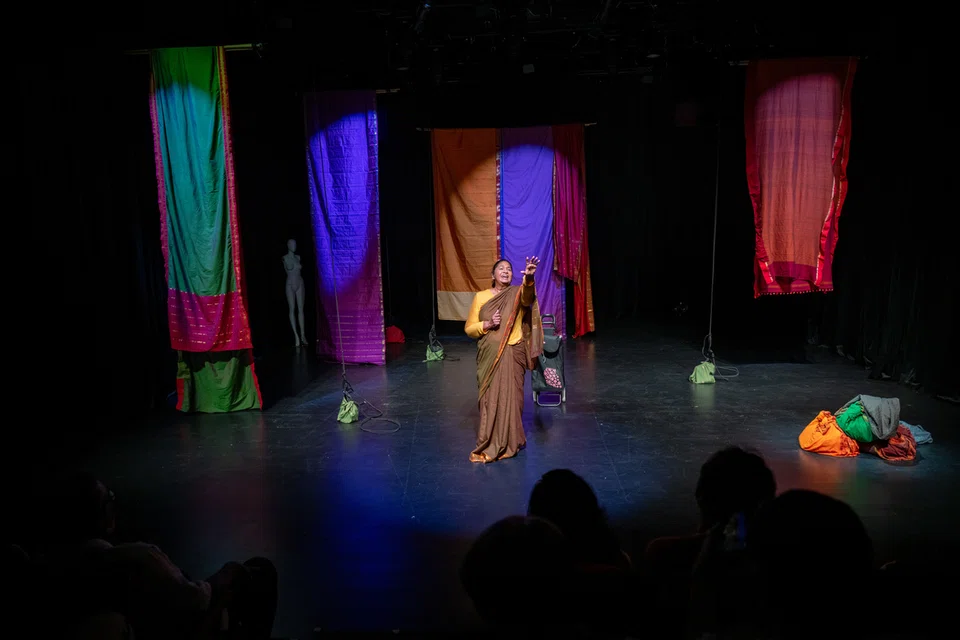
“I always use my audience as another character because I want to get them acclimated to the idea that I’m really good to be okay, I’m not dangerous at the start, and then I start to get dangerous. I think it’s disruptive. I think you’re okay with a mother feeding you something. And I did that with my other play, Curry Tales, and then I turn it on its head. So, I like to do that; I like to subvert people’s ideas,” said Rani.
Language is not the only thing that binds these plays together, as both are one-person productions. Guru of Chai includes a musician who accompanies the Guru, but he remains silent for most of the play, only singing at certain points.
The one-person format, and the fact that the main narrators are played to be older people, makes audiences feel like they are hearing their grandparents tell them tales with different voices to tuck them into bed.
There’s a warmth from both of them, even when they are talking about some of the harder topics like death or caste discrimination.
Speaking of those harder topics, neither play shies away from taboos or harsh realities, even though the majority of the scripts are based in comedy. Guru Of Chai’s major focus is on corruption in the police and government in India, while Whose Sari Now? touches on transgenderism and racism.
“I play a whole character in Tamil. She’s a Weaver, lower caste. So, I’m looking at issues of caste, and I’m looking at what that whole idea of creating a work of art in a sari, what it feels like when you are somebody who knows, you can’t wear it, you can’t own it,” said Rani.
Another commonality between the plays is the fact that both productions have been done across decades, and both Jacob and Rani have no interest in stopping them anytime soon.
“I still feel a connection to the storyteller that gets richer, and I don’t think I could play continuously like doing Les Misérables. But it’s like meeting an old friend when I put the teeth on, and also now it’s actually meeting new audiences. This is the thing because the show is just a vehicle for that, for the engagement with a new audience. When people meet the guru for the first time, it’s still a delight for me at the moment and matches my change,” said Jacob.