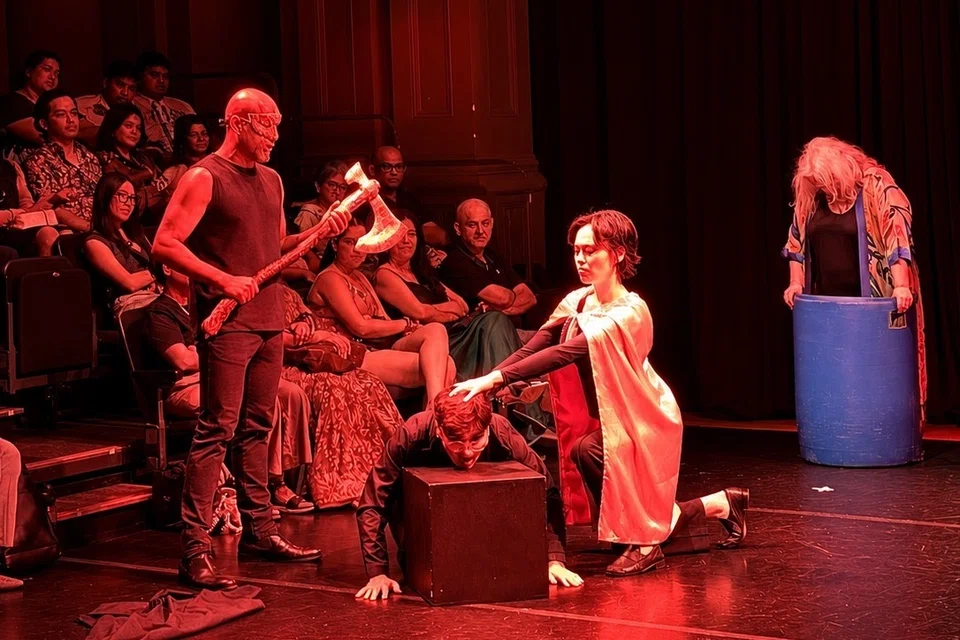

There is something strangely reassuring about watching a play in which almost nothing makes sense – particularly when the world outside occasionally feels much the same.
That was my takeaway from Durang Durang, Playacting Productions’ double bill of Christopher Durang’s An Actor’s Nightmare and Miss Witherspoon at the Play Den, The Arts House, on Sept 11 and 12.

The two plays are markedly different. Yet across 90 minutes, they complemented each other through Durang’s ability to turn anxiety, helplessness and existential dread into comedy.
An Actor’s Nightmare, directed by Neeraj Sujanani in his directorial debut, is the more immediately accessible and consistently funny of the two.
George suddenly finds himself backstage and is told he must replace an actor. He does not know his lines, the play or even whether he is actually an actor.
From there, the production hurtles through Shakespeare, Noel Coward, Beckett and A Man for All Seasons.
The premise is particularly delicious for anyone connected with theatre – an actor’s worst fear exaggerated into absurdity.
Neeraj wisely ensured the chaos remained controlled. The changing theatrical styles were clearly differentiated through voice, movement and rhythm, allowing the audience to follow the joke even as poor George became increasingly lost.
It worked because the actors committed themselves seriously to increasingly ridiculous situations.
Miss Witherspoon, directed by Neha Dadbhawala, travels into darker territory.
Its protagonist has had enough of life, only to discover that death provides no escape. In the Bardo, Maryamma repeatedly sends her back to Earth through reincarnation.
The laughs remain, but underneath them are questions about depression, mortality, purpose and our responsibility towards an imperfect world.
Neha resisted turning those ideas into a philosophical lecture. Her decision to make the humour and situations relatable to a Singapore audience helped. Her own Jain upbringing also informed her interpretation of reincarnation as a karmic journey, but this remained beneath the surface rather than being explained.
Producer Sangeeta Nambiar was right when she described Durang’s work as simultaneously uncomfortable and “gut wrenchingly accurate”.
That tension is the strength of the evening.
The ensemble – including Saurabh Sardana, Jeff Martin, Susie Penrice Tyrie, Sumati Nagrath, Terri Tan and Ashley Christudason in An Actor’s Nightmare, and Sangeeta, Kiki Darling, Sumathi and Jeff in Miss Witherspoon – embraced the tonal shifts demanded by Durang.
The laughter around the Play Den suggested the audience understood what lay beneath the absurdity.
And that is why Durang, who perhaps deserves to be performed more often in Singapore, feels surprisingly contemporary.
We live amid information overload, rapidly changing rules, anxiety and uncertainty. Sometimes reality itself appears badly scripted.
Durang Durang offered no easy solutions.
Instead, it allowed us to laugh at the madness – and then quietly consider why we were laughing.