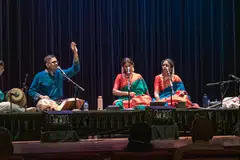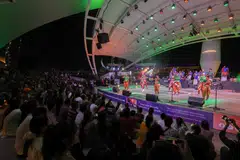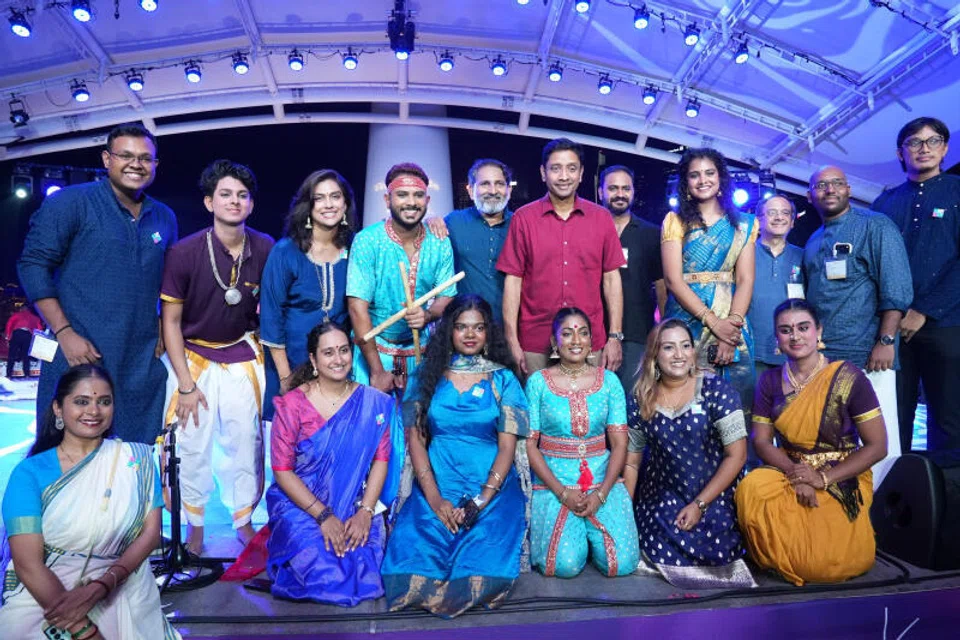

When the thunderous beats of the Tamil Parai drum echoed across the Esplanade Outdoor Theatre on Aug 14, they didn’t just mark the opening of Anandha Kondaattam 2026 but struck a chord that reverberated across regional and cultural boundaries.
For any spectator walking past the DBS Foundation Outdoor Theatre at Esplanade - Theatres on the Bay that Friday evening, the atmosphere was electrifying. Over 4,600 live audience members gathered to witness a rare cultural phenomenon: a grand tapestry where traditional Indian folk arts, alongside Singapore’s broader multicultural canvas, converged on a single stage.
Organised by non-profit organisation ATAM in collaboration with Esplanade - Theatres on the Bay, the festival’s third edition shifted from isolated regional showcases into a grand celebration of cross-cultural unity.
Driven by youth vitality, with over 80 per cent of participants under the age of 35, the showcase featured more than 18 traditional art forms, 10 of which made their maiden appearance.
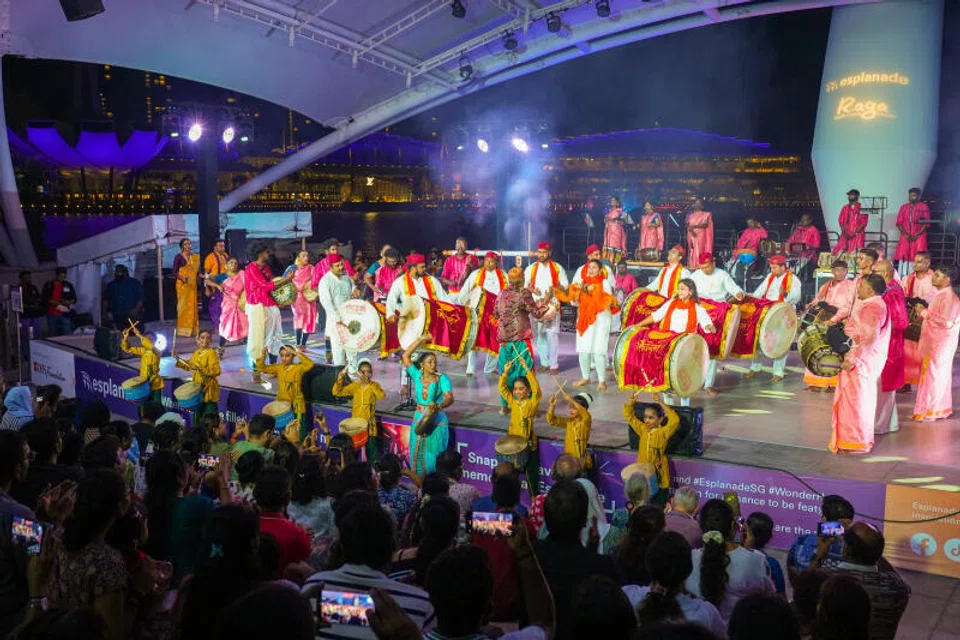
The audience was treated to a sweeping folk arts journey, featuring the handkerchief-swaying Oyilattam, the energetic Sakkai Kuchi Aattam, and the high-energy tribal Kambathattam from Tamil Nadu. Eastern and northern traditions flared brightly as Odisha’s Sambalpuri, Rajasthan’s spinning Ghoomar, and the massive procession drums of Maharashtra’s Dhol Tasha filled the air.
Guest of honour Mr Dinesh Vasu Dash, Minister of State for Culture, Community and Youth, and Manpower, noted that Anandha Kondaattam mirrors the core mission of the ‘INEI’ initiative he leads. By uniting diverse folk traditions from across India on a single stage, the festival fosters deep community integration while inspiring the younger generation to carry these living heritage forms forward.
Beyond bringing together India’s varied regions, the production pushed cultural synthesis further through artistic fusions. In a deeply moving segment, the mournful strains of South Indian Oppari were paired with the evocative notes of the Chinese Erhu, holding the amphitheatre in mesmerised silence.
This spirit of unity culminated in a spectacular multicultural finale featuring four distinct horse and animal folk dances: the Javanese-origin Kuda Kepang, the Chinese Lion Dance, the Tamil Mayilattam, and Poikkaal Kuthirai Aattam.
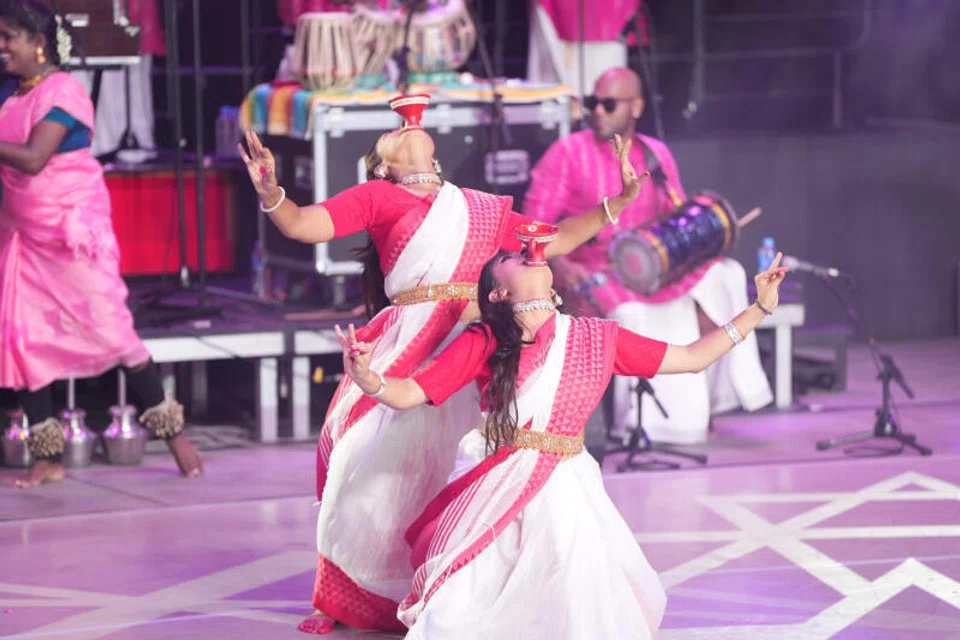
For Ms Sylvia Siow, 24, who attended the festival with a friend, the finale was a heartwarming surprise.
“I never expected to see Kuda Kepang on this stage,” said Ms Siow, who is of Javanese heritage. “Seeing a traditional art form from my own heritage showcased alongside Tamil folk dances right here at the Esplanade gave me absolute goosebumps.”
Every Tamil song presented on stage featured original lyrics and fresh music compositions, performed entirely live. Lyricist Vivek Bharathi, who has penned lyrics for the festival over the past two years, watched his words come alive on stage for the very first time. “Hearing live traditional music paired with fresh lyrics connects us deeply to our identity,” he said.
For 34-year-old Mr Avinash Rai, a performer who took part in Kambathattam for the first time, the physical rigour was both a challenge and a thrill. “The primary challenge of these folk arts is the intense energy required by the artists. We trained rigorously to match that high-tempo pace,” he shared.
ATAM Advisory Board Chairman Mr Raja Segar highlighted that the festival not only enhances mutual understanding within the Indian community but truly reflects Singapore in its entirety.