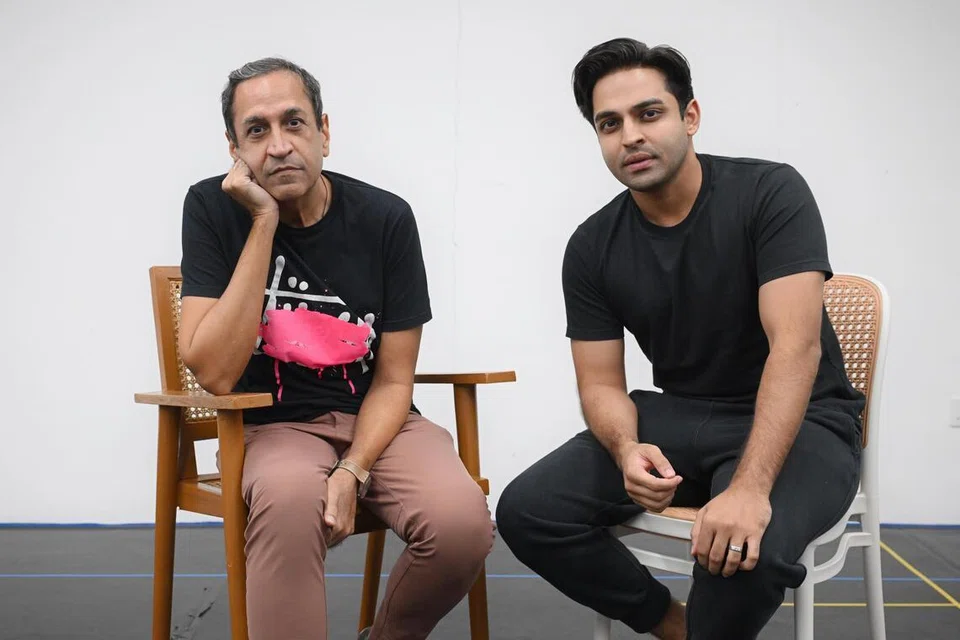
Two plays on the 1947 India-Pakistan partition within two months doesn’t make it a theme for playwright Haresh Sharma.
His play Eclipse, which will be staged at the M1 Singapore Fringe Festival from Jan 15 to 18, depicts three generations of men in a family and their journeys and understanding of the momentous separation.
It follows on the heels of HuM Theatre’s Train to Pakistan, staged at the Esplanade Theatre Studio from Nov 20 to 24, which starkly portrayed the violent and tragic aftermath of the division of British India.
“You know, there are many plays about LGBT that’s not necessarily a theme,” said Haresh, 59, a Cultural Medallion recipient. “It’s just part and parcel of life that people are looking back at history to see what’s important in society today.
“I think the world is going through a kind of transformation, and it’s a good time to look at historical events – to look at what terrible things are happening in front of our eyes that we should not repeat, or we should not support.”
Eclipse, Haresh’s monologue about a young man journeying to his father’s birthplace in Hyderabad, Pakistan, was first staged as a 20-minute play in Edinburgh in 2007. It was developed into a full-length monologue at the M1 Singapore Fringe Festival in 2008, and is being restaged at the festival this time as a 70-minute monologue.
“A Scottish theatre company commissioned me to do a play about separation,” said Haresh, who has written over 120 plays that have been staged in more than 20 cities. “The most obvious thing to do was write about the separation of Singapore and Malaysia. Instead, I decided to write about the India-Pakistan partition.
“As a playwright, I’m so used to writing Singapore stories. So I thought this was an opportunity to look into another kind of narrative. I know that my family was affected by partition, so I thought it would be good to ask my dad a few questions, get some facts, add a lot of fiction, and get the script done.
“It was also an opportunity to look at personal stories – how people are affected by events that are beyond their control and why they have to bear the brunt of the pain and suffering for decisions made by people in power.”
Having learnt from his father that his grandfather was not in India during the partition but working in a textile shop in Japan from the 1930s, Haresh came up with a play about three generations of men as they deal with the turbulence of migration.
“I thought I would create this story where there is the son, the person in the present and the main storyteller; the father, who talks about his experience with partition; and the grandfather, who reminisces about his experience of leaving his homeland voluntarily to find work in Japan. The play is about the lives of these three men who were impacted by what happened during partition.”
Singaporean actor Shrey Bhargava, noted for his performances across theatre, film and television, plays all three characters. The only support he gets on stage is from the songs rendered by Hindustani vocalist Sveta Kilpady.
Eclipse’s first iteration was played by Glaswegian actor Umar Ahmed – in a Scottish accent, which was probably jarring for audiences in 2008.
For 29-year-old Shrey, it is the first time carrying a play on his shoulders from start to finish. So the pressure is intense. “I’ve never done a solo show where the focus is all on me,” he said. “But as an artiste, you want to challenge yourself.
“It has also been a process of discovery. A lot of times the director is not so much telling me what I have to do. I am talking to the audience, so I know from the start I have to bring them in, look at their reactions and respond accordingly.
“That is not to say that I’m improvising on stage. It’s all in the script. But I have to know what the audience might think at certain points, respond to that and carry the story forward.”
Shrey will wear one costume throughout; there will be no change of props or set. The three characters, though, will be played with distinct voices, postures and ways of walking.
“I have to make sure they look and sound different,” he said. “We worked a lot on the transitions. How do I change from one character to another? Is it a simple snap? Is it more of a fluid change? We found solutions to all that.”
Director A. Yagnya, whose plays have featured at Esplanade’s Kala Utsavam and other theatre festivals, said it was all about “how to get the words out”.
“Because it’s so full frontal, I had to take out all the decorations (from the previous iteration),” she said. “At the same time, I had to keep the storytelling engaging and bring the audience into the story.
“Many Singaporeans do not know much about the partition or the turmoil connected with it. So, the story is basically narrated from the viewpoint of the son, a Singaporean in his 30s. You quite literally go on the journey with him – how he learnt and understood what had happened and what he felt about the whole thing.”