For nearly three decades, tabla virtuoso Nawaz Mirajkar has used Indian classical music as a foundation to build musical conversations across Singapore’s diverse cultures.
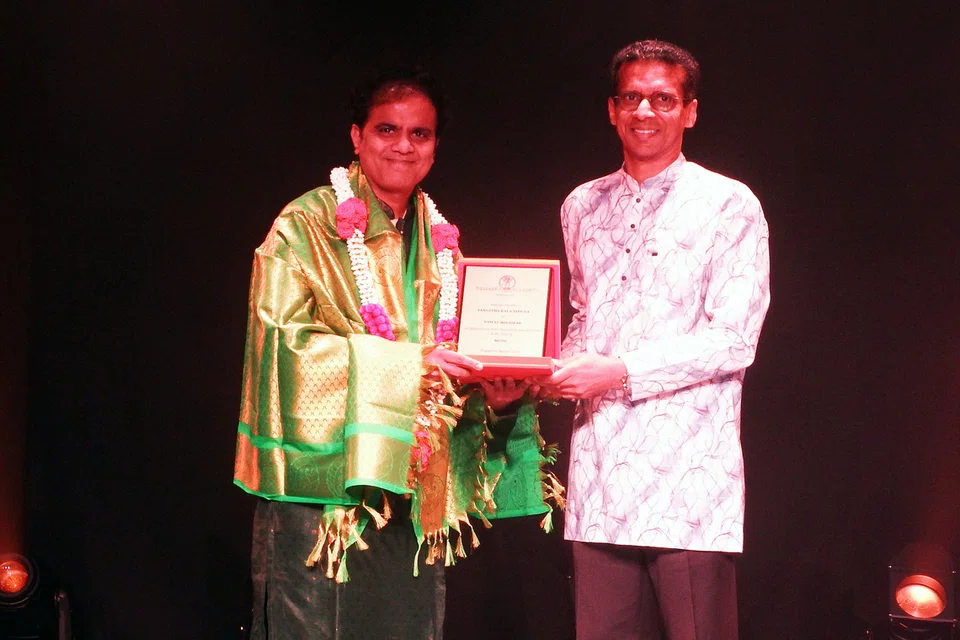
His journey as a performer, composer, conductor and educator was recognised when he received the Sangitha Kala Nipuna Award 2026 from Bhaskar’s Arts Academy on Aug 14.
The award was presented during the Bhaskareeyam 2026 festival at the Stamford Arts Centre Black Box, following an evening of music and dance performances.
For Nawaz, who moved to Singapore from India in 1996, the recognition carries particular significance because it comes from the country where much of his artistic career has developed.
“This recognition from Bhaskar’s Arts Academy is particularly special to me because it comes from the country I have called home for more than 29 years, and where I have spent much of my artistic life contributing to and growing alongside the arts community,” he said.
He regards the award not simply as an individual achievement, but as recognition of the students, collaborators, institutions and communities that have accompanied him on his musical journey.
Nawaz’s relationship with the tabla began at seven under the guidance of his father, Ustad Mohammad Hanif Khan Mirajkar. He later received a National Scholarship from India’s Centre for Cultural Resources and Training and completed his Tabla Visharad with First Class.
His move to Singapore proved transformative.
Surrounded by Indian, Chinese, Malay and Western artistic traditions, Nawaz began exploring how Indian classical music could retain its foundations while entering into conversations with other musical cultures.
Although the tabla remains at the heart of his work, his career expanded into composition, conducting, artistic direction, education and cross-cultural collaboration.
Productions including Taal Express, Damaru, Anthar Agni, Bhumi Pranaam and Samudra brought Indian music into dialogue with African, Middle Eastern, Chinese, Malay, Spanish and other traditions.
Singapore-based pianist, composer and educator Renu Suresh said: “As an artistic director, Nawaz has a remarkable ability to conceptualise thematic musical productions. Over the past 20 years, his works have ranged from Taal Express, a musical train journey through India, to Samudra, which brought together diverse musical traditions, a Western string orchestra and sand art. His ability to blend percussion and musical elements across cultures has helped these productions resonate with Singapore’s diverse audiences.”
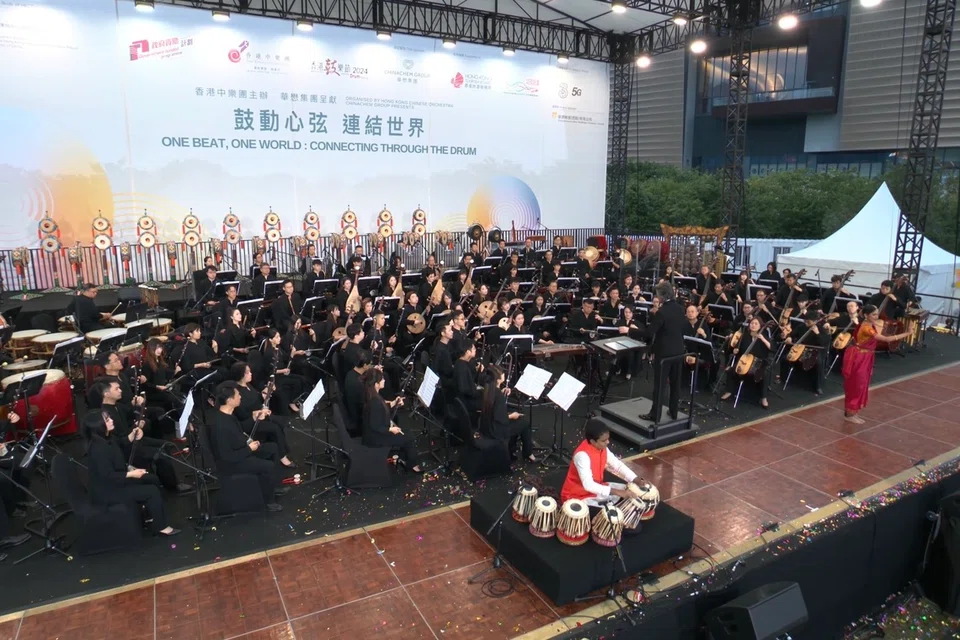
Nawaz has collaborated with internationally-acclaimed musicians such as Rakesh Chaurasia, Wu Tong, Louis Banks and Sivamani, and Singapore’s leading arts organisations including the Singapore Chinese Orchestra, Ding Yi Music Company, Siong Leng Musical Association and Flamenco Sin Fronteras.
One of his more unusual early achievements was in 2001 – a 27-hour non-stop drumming marathon in Singapore, which earned him a Guinness World Record.
Singapore Indian Fine Arts Society president K.V. Rao believes Nawaz’s ability to make traditional music accessible to contemporary audiences distinguishes him.
“Nawaz is a talented young Singapore-based tabla exponent who blends Indian classical traditions with Chinese, Western and folk genres,” Mr Rao said. “His innovative collaborations and experiments have made the tabla fresh, contemporary and particularly appealing to younger audiences.”
Ms Sarita Alurkar, Head of Global Indian Cultural Centre, who has known Nawaz for more than 25 years and worked with him on several productions, has watched that musical evolution at close quarters.
“Nawaz has enriched Singapore’s arts scene by bringing Indian classical traditions together with Chinese, Malay and Western art forms,” she said. “His Young Artist Award from the National Arts Council and now this recognition from Bhaskar’s Arts Academy are richly deserved. He continues to inspire through his performances, workshops and multi-ethnic fusion music.”
Teaching has become an equally important part of Nawaz’s contribution.
He is Head of the Tabla Department and Senior Tabla Guru at the Temple of Fine Arts, Artistic Director and Resident Conductor of the NUS Indian Instrumental Ensemble, and adjunct faculty at the School of the Arts (SOTA).
He also founded Swarhythm Singapore and Yuva Swar, creating platforms for emerging musicians to experiment and develop their own artistic identities.
“For me, teaching is not simply transferring knowledge. It is transferring possibilities,” he said.
That philosophy also informs his approach to keeping Indian classical music relevant.
“I believe tradition should have roots, but it should also have wings,” Nawaz said.
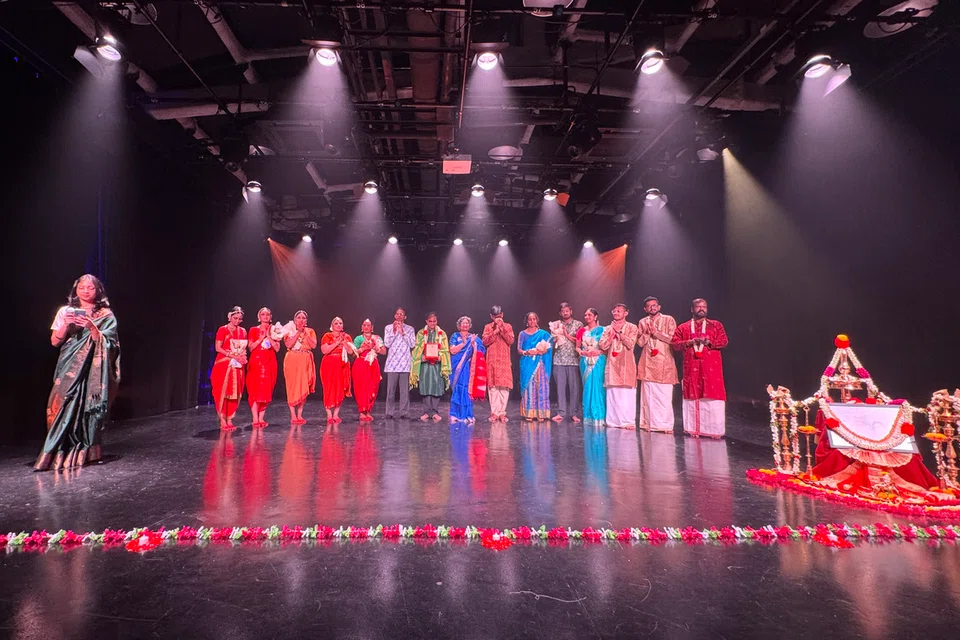
His journey as a performer, composer, conductor and educator was recognised when he received the Sangitha Kala Nipuna Award 2026 from Bhaskar’s Arts Academy on Aug 14.
The award was presented during the Bhaskareeyam 2026 festival at the Stamford Arts Centre Black Box, following an evening of music and dance performances.
His journey as a performer, composer, conductor and educator was recognised when he received the Sangitha Kala Nipuna Award 2026 from Bhaskar’s Arts Academy on Aug 14.
The award was presented during the Bhaskareeyam 2026 festival at the Stamford Arts Centre Black Box, following an evening of music and dance performances.
His journey as a performer, composer, conductor and educator was recognised when he received the Sangitha Kala Nipuna Award 2026 from Bhaskar’s Arts Academy on Aug 14.
The award was presented during the Bhaskareeyam 2026 festival at the Stamford Arts Centre Black Box, following an evening of music and dance performances.
His journey as a performer, composer, conductor and educator was recognised when he received the Sangitha Kala Nipuna Award 2026 from Bhaskar’s Arts Academy on Aug 14.
The award was presented during the Bhaskareeyam 2026 festival at the Stamford Arts Centre Black Box, following an evening of music and dance performances.
Rather than dilute classical traditions for younger or multicultural audiences, he believes artists should understand their foundations deeply before finding new settings in which they can flourish.
“Singapore is an extraordinary place for this kind of exploration,” he said. “Its multicultural character constantly reminds us that music is universal, even when its languages are different.”
There is little time to dwell on his latest honour.
On Aug 21 and 22, Nawaz will perform in In Relation, a multicultural production centred on Singapore’s Nanyin tradition. And on Aug 29, he will conduct Yuva Swar, a multicultural youth ensemble, for the Red Dot August Festival at the Esplanade Concourse.
The award, he said, has made him more determined to explore new musical territories and mentor another generation.
“My instrument may be the tabla, but my canvas is much larger,” he said.
“I want to continue using rhythm, melody and collaboration to build bridges between people and cultures, while creating space for the next generation to take the journey even further.”