When Harish O. Velayudhan stepped onto the Esplanade stage for the Singapore Indian Orchestra & Choir’s (SIOC) recent production, Navarasa – 9 Emotions, 1 Epic, he carried more than a musical instrument.
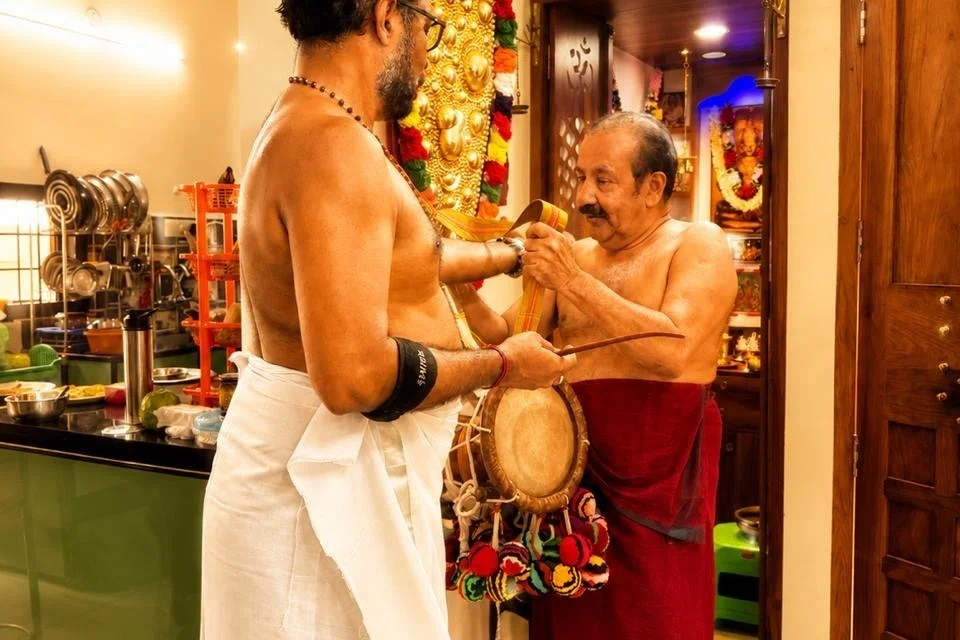
Slung over his shoulder was an edakka, a small, hourglass-shaped drum that embodies centuries of Kerala’s temple music traditions.
With President Tharman Shanmugaratnam in the audience and a large orchestra surrounding him, Harish knew this was no ordinary performance.
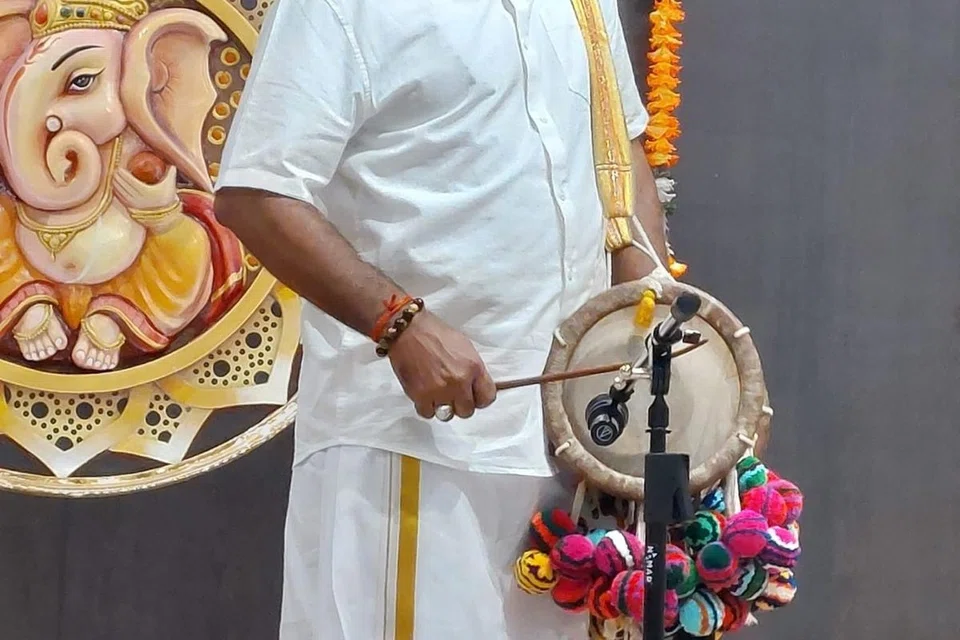
“It was a very special and emotional experience for me, especially because this was my first experience performing with such a large orchestra,” he said. “Once I stepped onto the Esplanade stage, I tried to forget the nervousness and simply focus on the music, the dancers and my fellow musicians.”
For Harish, one of the very few active edakka performers in Singapore, the occasion represented another milestone in his mission to introduce the instrument to wider audiences.
Known in Kerala as Devavadyam, or divine instrument, the edakka is unlike conventional drums.
While most percussion instruments primarily produce rhythm, the edakka can also produce distinct musical notes and melodic phrases resembling the human voice.
The musician strikes one drumhead with a thin wooden stick while simultaneously squeezing and releasing the lacing with the other hand to alter its pitch.
The coordination demands extraordinary precision.
“Even a small change in pressure can completely change the pitch and sound of the instrument,” Harish explained.
His fascination with the edakka began in 1992, when he was learning flute under his late guru Raghavan.
During a dance performance by Asha Jayaram at Sri Krishna Temple in Thodupuzha, Kerala, he watched renowned edakka maestro Tripunithura Krishnadas perform at close quarters.
“I was mesmerised, and that was the moment the desire to learn edakka first took root in me,” he recalled.
But it took another 30 years before that dream became reality.
In 2022, Harish contacted Krishnadas through a friend and began his formal training.
Learning the edakka, however, does not begin with the instrument itself.
Students must first undergo rigorous Kaimetha training, practising rhythmic patterns and striking techniques on a wooden practice board.
Harish spent countless hours progressing through increasingly complex exercises, from three to nine aksharas across four speeds.
Only after demonstrating sufficient proficiency did his guru allow him to handle the edakka.
“I still remember the day my guru said, ‘Now you are ready for the edakka’. It was a moment of pride,” he said.
Even then, the real challenges had only begun.
Producing consistent musical notes required precise control of striking pressure, hand movements and pitch.
His earlier training in flute and mridangam helped him understand the instrument’s melodic and rhythmic possibilities.
Today, much of his training continues through WhatsApp video calls with Krishnadas. Whenever he visits Kerala, meeting his guru remains a priority.
“He has even taught me how to care for an edakka – almost like caring for a baby,” Harish said.
That care is particularly important in Singapore, where humidity and air-conditioned performance venues can affect the instrument’s tension and tuning.
Harish carries water-soaked cotton, keeps the instrument covered when necessary and carefully adjusts its tension before performances.
Despite his relatively recent training, he has established himself as a sought-after accompanist for Kerala classical arts in Singapore.
He has performed with organisations including Soorya Singapore, Alapana Arts and Medasvi School of Dance, accompanying Mohiniyattam productions and other traditional performances.
His appearances have included collaborations with distinguished artistes such as Kanak Rele, Kalamandalam Sathyanarayanan and Kalamandalam Sreeja R. Krishnan.
Haritha Haridas, Indian classical dancer, choreographer and Founder Director of Medasvi School of Dance, has witnessed Harish’s artistic growth at close quarters.
“The Edakka may appear delicate and compact, but the divinity and depth it carries are truly unparalleled. It is rare and extraordinary among percussion instruments because it does not just keep rhythm, it sings swaras,” she said.
“To witness Sri Harish Velayuthan evoke that divine melody is a joy.”
Haritha said Harish had supported her school since its inception in 2020, performing at every one of its live stage productions.
“Harish has grown from a passionate art lover into an exceptionally dedicated artiste under guided mentorship,” she said.
“Today, seeing him emerge as a trailblazing Edakka vidwan in Singapore fills me with profound pride. His journey with us was just the beginning of a legacy he is steadily crafting through discipline and devotion.”
At the SIOC production, he performed alongside an eight-member percussion team, supported by artistic director and senior conductor Lalitha Vaidyanathan and resident conductor Vighneswari.
“The Edakka is a remarkable percussion instrument capable of producing a rich range of melodious sounds that delight audiences,” said Kalamandalam Biju Vanamali, head of Kathakali Vesham Department at Bhaskar’s Arts Academy. “Having undergone authentic training under Sri Tripunithura Krishnadas, Hareesh has dedicated himself to mastering the instrument.”
For Harish, taking the edakka beyond Kerala’s temples is both a privilege and a responsibility.
“When I play the edakka here, it feels like bringing two parts of my life together — my Kerala roots and my life in Singapore,” said the 54-year-old IT professional, who came to Singapore in 2000.
Although proud to be among Singapore’s few practitioners, he worries about the instrument’s future.
Its demanding training and limited exposure make attracting younger musicians difficult.
Harish hopes his performances will inspire curiosity, although he modestly insists he is not yet qualified to teach.
“I still consider myself a kindergarten student in the journey of learning edakka,” he said.
Instead, he hopes to connect interested Singapore learners with his guru.
“If even one young person says, ‘I want to learn this,’ I would feel that my journey has served a purpose.”
santosh@sph.com.sg