A.R. Rahman made history on Aug 31 by becoming the first Indian musician to perform live at the National Stadium.
But the 57-year-old double Oscar winner’s 180-minute effort left a vast majority of the 25,000 spectators fuming in disappointment.
There was a litany of gripes. From the breeze-less venue on a hot evening to the legendary singer-composer appearing tiny on a stage set in a far corner, what also irked many in the crowd was that there were far too few Tamil songs in Rahman’s repertoire; not to mention the poor acoustics.
All eyes were on Rahman as he was performing in Singapore after a decade. His last performance at Gardens by the Bay was marred by technical issues and a blackout. It was also held outdoors and not at a proper concert venue.
Organiser Maestro Productions Global had promised that the event at the National Stadium would be glitch-free. It co-produced the event with UnUsUal Entertaintainment, a local company experienced in organising big music shows here and overseas.
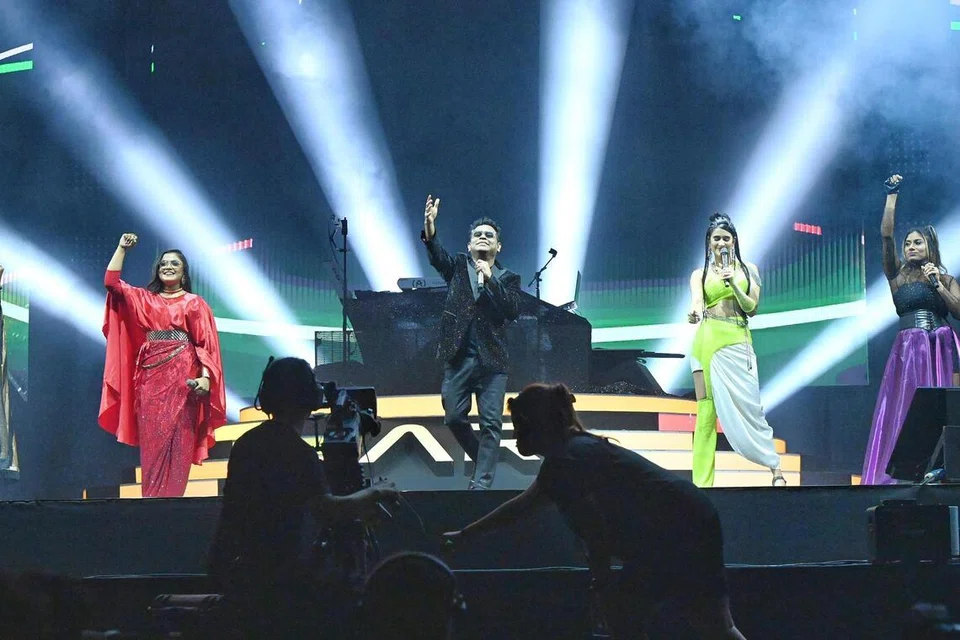
Since the artiste appeared like a speck to all those who bought lower-category tickets, many in the audience had to turn to the LED screens to catch a glimpse of him.
Indeed, problems surfaced even before the event commenced as the crowd entered the National Stadium.
With temperatures at 30 deg C coupled with high humidity levels, the affair felt unbearably hot as only a part of the stadium’s rafters was open for air.
The facility did not have the luxury of air-conditioning, unlike at the Singapore Indoor Stadium, where Maestro held successful concerts featuring Anirudh Ravichander and Yuvan Shankar Raja.
“I bought a Premium Category 1 ticket but got squeezed into a cramped, poorly ventilated section with chairs literally tied together,” complained Vidhu Vijay on Facebook. “Everything appeared so stiff.”
The organiser perhaps did not want spectators to drag chairs away and move closer to the stage. But the move drew many unhappy patrons.
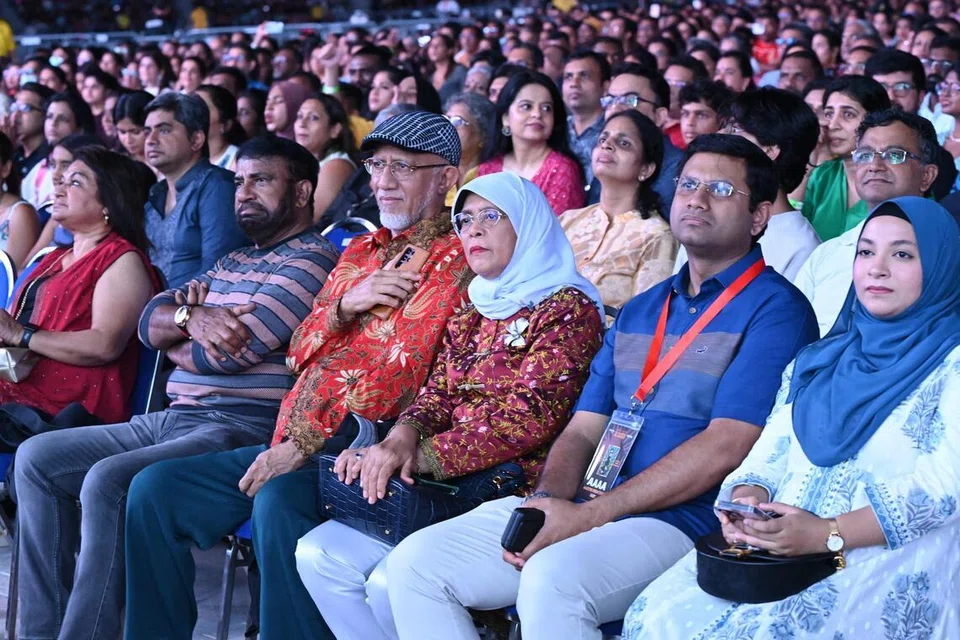
Before Rahman’s gig started, local radio deejay Joakim Gomez and actor Jay Nesh had got the audience, which included former Singapore president Halimah Yacob and her husband in the front row, excited by making them do a few moves, such as the Kallang roar and waving their handphone flashlights.
Local musician Shabir Sulthan too did a solo number that was catchy.
After a 15-minute break, Rahman appeared on stage. He was welcomed by thunderous applause, whistles and cheers.
But he made little attempt to connect with the crowd, opening quickly with Jai Ho, the theme song from the Oscar-winning movie Slumdog Millionaire (2008) that catapulted him to overnight fame in the West.
“Rahman is known to be soft-spoken but he should have done a better job of introducing his team and detailing what he was going to do,” said Avneet Prakash, a software engineer who was among the crowd.
“He lost most of the audience there itself as he continued to be indifferent to their needs and seemed focused on completing the song list.
“He described his son A.R. Ameen as a ‘shy boy raised in Chennai’, but no one could really make out who the other singers were. Some of them he was clearly promoting. But the crowd could not relate to them as their names were not highlighted.”
The 31-member team of singers, dancers and band musicians that Rahman brought along included Indian playback singers Mohit Chauhan and Rakshita Suresh as well as noted performers Srinivas and Mano.
But lost in the stream of back-up singers who made it to the stage were vocalist-composer Shakthisree Gopalan, Hriday and Shuba.
Fans got excited and sang along when Rahman and his team collaborated on the ’90s hit songs Mukkala Mukkabala and Veerapandi Kotayyile (1993), but they became visibly subdued when the musicians tried out renditions of Nadaan Parinde (2011) and Minsara Poove (1999).
“The band was ordinary, they did not do anything special,” said Geetha Venkat, a home maker.
“The organisers said it would be an evening of Rahman rhapsody and full of his greatest hits. But there were only a few of his hit numbers from the 1990s and early 2000s which made him famous.
“It is natural that he would want to play some of his latest numbers, But he overdid it, putting everyone to sleep during the middle part of the show.”
Among the crowd was a big group of North Indians, Malays and Indonesians – all fans of Bollywood film and music. To appease them, Rahman sang several Hindi songs, including his Bollywood hits such as Kun Faya Kun (2011), Tere Bina (2006) and Agar Tum Saath Ho (2015).
“But that again became counter-productive as the majority of the spectators, local Tamils, became offended,” said Ms Geetha. “They expected more Tamil songs and fell silent when the Bollywood songs were performed.”
The crowd got going again when Rahman sang 1998’s Jumbalaka with home-grown veteran Mohamed Raffee. But they could not find their groove when rappers like India’s Blaaze, Malaysia’s Sri Rascol and Sri Lanka’s ADK took the stage with Indian-American singer-musician Shuba to perform a medley of nostalgic Indian songs such as Taxi, Taxi (2008), Ponmagal Vandaal (2007) and Magudi Magudi (2012).
These were tunes that dominated the Indian charts in the early 2000s. But the audience clearly wanted to hear Rahman hits such as Vande Matram, Chaiya Chaiya and Mustafa.
Rahman abruptly ended the show with his popular number Urvasi Urvasi, but by then the audience were largely left unsatisfied, even though 35 songs were performed in total.
As many began to blast Maestro on Facebook and Instagram for the “disappointing show”, the company, in its defence, said it tried its best and could not tell Rahman which songs to sing.
Indeed, Rahman is a megastar. He has a global fan base that transcends language and ethnicity. His music is universal. But, as fan Stephen Philip put it, “the show was not worth the money”.
“However great a musician may be, he should have a rapport with the audience. Rahman had zero connect. His ignorance and ego shone throughout.”