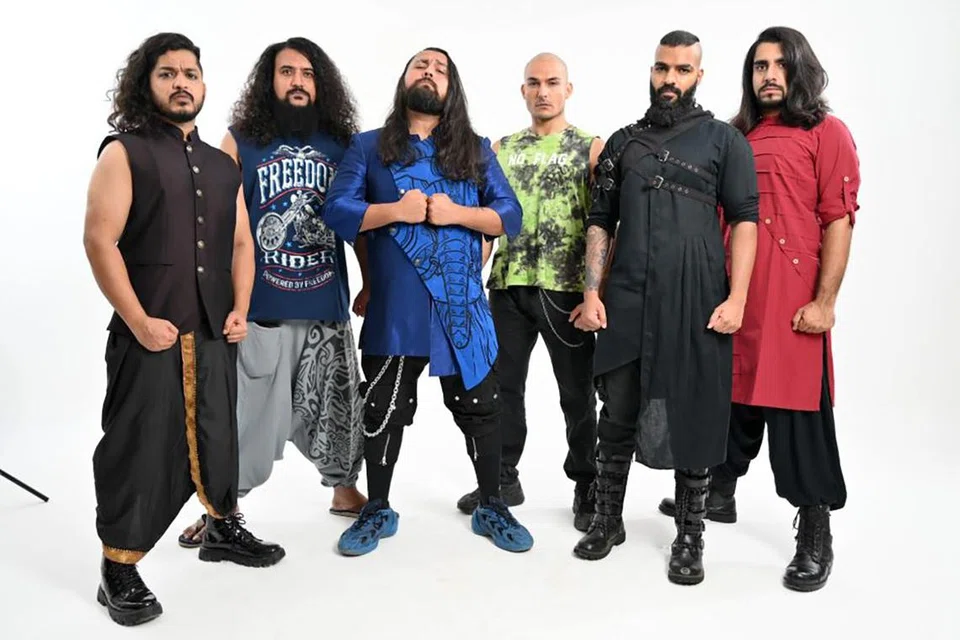
In a global music scene dominated by Western acts, Indian folk-metal band Bloodywood has defied expectations and carved a unique niche, becoming one of South Asia’s most exciting and internationally acclaimed heavy metal exports.
With a fusion of thunderous riffs, Indian folk instruments, politically charged lyrics and a commitment to cultural authenticity, Bloodywood is not just making noise – they’re redefining the genre.
Formed in 2016 by guitarist and producer Karan Katiyar, Bloodywood began as a YouTube channel uploading heavy metal covers of Bollywood hits, reported Guitar.com.
Katiyar, a former corporate lawyer, connected with vocalist Jayant Bhadula at a local gig, and rapper Raoul Kerr soon joined, forming the trio that would take Indian metal global.
Later, Sarthak Pahwa (dhol), Roshan Roy (bass) and Vishesh Singh (drums) joined the band.
Their viral breakthrough came in 2018 with a metal version of “Ari Ari”, which fused Punjabi folk with headbanging metal, launching them onto the European touring circuit.
Since then, the band has built an organic global fanbase with no record label backing.
Their debut album Rakshak (2022) cracked the top 10 of both the UK Rock & Metal and US Digital charts, and tracks like “Dana Dan” found a wider audience after being featured in Dev Patel’s action film Monkey Man.
Most recently, their single “Bekhauf” – a collaboration with Japanese kawaii-metal sensation Babymetal – became a viral hit.
Bloodywood’s music is a unique blend of nu-metal influences – drawing from acts like Slipknot and System of a Down – infused with Indian instruments like the dhol and bansuri flute, as well as Hindi and Punjabi lyrics.
Their latest album Nu Delhi, released on March 21, offers tracks like “Tadka” that joyfully celebrate Indian cuisine and “Bekhauf,” an anthem about courage, fearlessness and unity.
From their early days, the band has tackled serious issues such as depression, rape culture and ethnic discrimination, reported Telegraph India.
Katiyar is clear on the mission: “We want to bring the positive side of music to as many people as we can.”
While much of the band’s earlier work was overtly political, Nu Delhi opts for cultural storytelling. “People need to talk to each other in a more civilised manner,” he says, referencing the growing divisiveness online.
The band’s live shows are high-energy affairs, blending modern-life fury with joyful dance.
From debuting at Germany’s massive Wacken Open Air festival in 2019 to drawing massive crowds at the 2023 Download Festival in the UK, Bloodywood has proven that language and geography are no barriers to connection.
Their tracks are equally likely to be played in Delhi backstreets as they are in European arenas, reported the BBC.
While the Indian music industry remains dominated by Bollywood, the band has shown that there’s a hunger for more diverse narratives – both at home and abroad.
“It’s no pressure at all,” Katiyar says, “but one thing that does nag us sometimes is that we can’t represent our whole country. There are so many languages, cultures, instruments – it’s impossible to do it all. But we try.”
With their second full-length album out in early 2025 and a world tour dubbed Return of the Singh taking them across Japan, the UK and Europe, Bloodywood is poised for another breakthrough.
They’ve topped Spotify’s global metal playlists and gained endorsements from icons across the genre, while building bridges between East and West through music.
Ultimately, what makes Bloodywood stand out isn’t just the pounding beats or cultural fusion – it’s their unshakable optimism and belief in music as a tool for empathy and empowerment.
“What’s more metal than standing up for the people you love?” asks Katiyar.