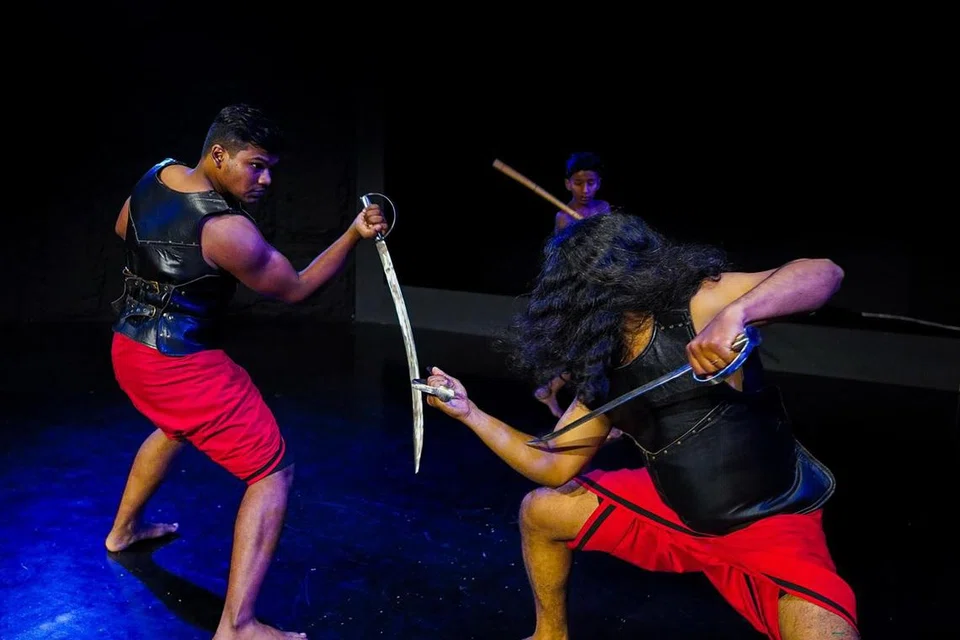

Martial arts and theatre may be two separate disciplines. But one academy has managed to marry the two.
Kalari Academy, a local academy that teaches the ancient martial arts of Kalaripayattu, Silambam and Adimurai, pushed boundaries when it staged a martial arts-themed English play, Immortal, at the Stamford Arts Centre on Sept 20 and 21.
With the aim of bringing ancient Hindu mythologies closer to a modern-day audience, the play revolves around the journey of the immortal warrior Parashurama (referred to by his lesser-known name Bhargava Rama in this play) and how his quest for vengeance leads to a turn of events that makes him question his choices. The play also includes the major fight sequences of the Hindu epic Mahabharata.
As the actors brandish real weapons – spears, axes and swords – amid 11 fight sequences, the audience were at times on the edge of their seats. In one scene, the inch-perfect choreography stopped a sword mere centimetres from the protagonist’s chest.
“That is the level of trust we have in one another,” said E. Reuben, 29, who plays the lead role of Bhargava Rama and choreographed the fight scenes.
“We have practised so many times together, so I knew the sword would stop precisely at that point.”
The academy had to apply for a permit from the Infocomm Media Development Authority to use weapons during the show. It also obtained a police permit to bring the weapons into Singapore.
As a precaution, Reuben said some of the weapons, such as the axe, were “made blunt”.
“But it’s still painful if the weapons make contact,” he said, revealing scars on his hand as a result of rehearsals and training.
The realistic fight scenes took time to perfect – nine years, said director Vedagiri Govindasamy, who is also the co-founder and main instructor of Kalari Academy. He first thought of the play in 2015, when the academy was formed.
Vedagiri, 44, who also plays the Hindu god Shiva, said: “We needed to train our students until they could use real weapons and fight aggressively without hurting one another, so it took nine years of training.”
Those nine years spanned several drafts of the script as Vedagiri expanded the play from his initial 15-minute concept – of a sequence involving Bhargava Rama, Bhishma and Amba – to a full 90-minute show, re-enacting several scenes of the Mahabharata from Bhargava Rama’s perspective.
In Vedagiri and Reuben, the cast, comprising actors from eight to 50 years old, had two experienced martial art practitioners as coaches.
Vedagiri learnt traditional martial arts at the age of eight, and started teaching them at the age of 28.
Reuben, who started learning Kalaripayattu and Silambam at the age of 16, trained with Vedagiri at the same school.
The play also weaved in dance sequences from two Kalari student-dancers, while live instruments added to its harmony.
While the play is rooted in Hindu mythologies, its English medium invited a highly multiracial audience. Each member of the audience was given a booklet with some context on the lineage of Parashurama.
Audience member Rajkumar applauded the play: “Presenting Hindu mythologies in the form of a martial arts play is something new. Normally, we experience such tales only in the form of books and television shows.”
Vedagiri said the tale of Immortal is “not over yet”.
“This play is just the first part of a Vedic trilogy. I’m currently working on the script for the sequel.”