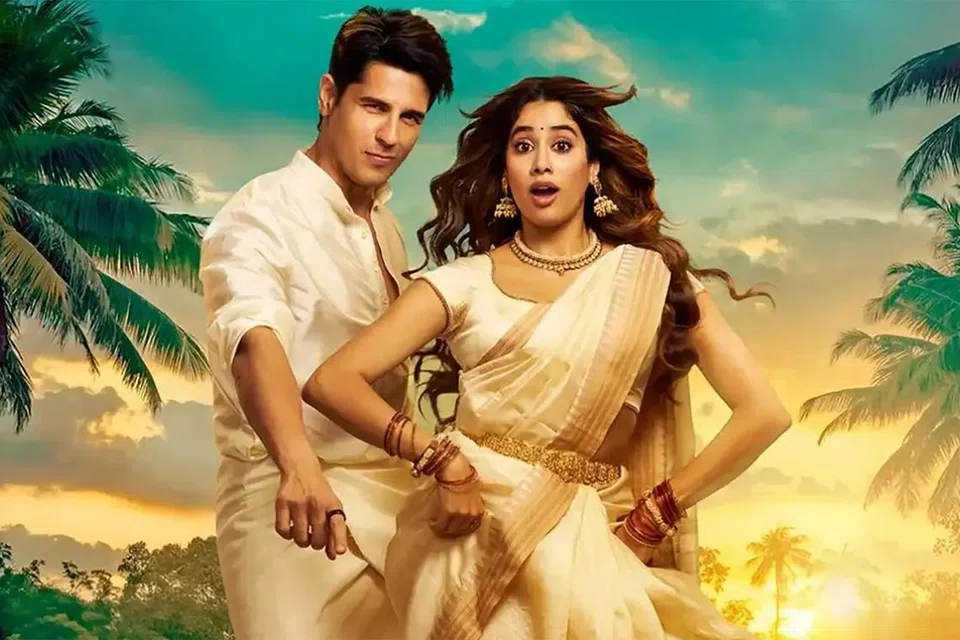
Bollywood’s latest romcom Param Sundari, starring Sidharth Malhotra and Janhvi Kapoor, was meant to be a breezy love story about cultural clashes between Delhi and Kerala. Instead, it has reignited long-standing debates about stereotyping in Hindi cinema and its representation of India’s diverse regions.
The film follows the romance of Param, a North Indian man, and Sundari, a woman from Kerala. After initial clashes, the two overcome cultural differences and fall in love.
Bollywood has long used cross-cultural love stories to explore India’s diversity, from Chennai Express (2013) to Qarib Qarib Single (2017). But this time, audiences from Kerala and beyond say the filmmakers crossed a line.
Sundari, played by Janhvi, is depicted with jasmine flowers permanently in her hair, climbing coconut trees as a hobby, and even “communicating with elephants.” Her Malayalam is unconvincing, despite being portrayed as someone who has lived in Kerala all her life.
Critics say these tropes reduce Malayalees to caricatures, reinforcing clichés rather than capturing authenticity.
The backlash began even before release, when the trailer revealed Janhvi mispronouncing her character’s name, Thekkepaatil Sundari, as “Thekkapetta Sundari”. In Malayalam slang, this translates to “betrayed woman” – an unintended insult that drew widespread trolling online.
Influencers parodied the film by exaggerating “Malayali stereotypes” with wigs, coconuts, and Mohiniyattam costumes.
The parallels with The Kerala Story (2023) – another film criticised for misrepresentation – were quickly drawn. In both, female leads living in Kerala spoke broken Malayalam, raising questions about why Bollywood avoids casting native actors in such roles.
Once the story shifts to Kerala, the narrative becomes a checklist of clichés: backwaters, elephants, toddy, Onam festivities, and endless coconut jokes. One critic called it “a feature-length ad for Kerala tourism” that “bulldozes cultural nuance”.
“Every time Sundari got angry, she plucked coconuts. Param confessed his love from atop one. By the end, coconuts felt like a character,” joked film critic Sowmya Rajendran, who found the film “exhausting and offensive”.
For some viewers, cultural accuracy isn’t essential. “I’m from Bihar, and I enjoyed the film as a fun window into another culture,” said Rajiv Kumar, a student in Delhi. “Maybe it’s exaggerated, but chasing authenticity can make films boring. This much artistic freedom is fine.”
But for many Malayalis, the film’s treatment of culture stung. “We don’t object to outsiders acting in our roles,” writer Cris noted. “It’s when characters become caricatures that people take offence.”
Similar criticisms were made when Priyanka Chopra was cast as Manipuri boxer Mary Kom in 2014, or when Tamil accents were exaggerated in classics like Padosan (1968).
In an era of pan-India streaming successes like Axone (2019) or All We Imagine As Light (2024), audiences are increasingly vocal about inauthentic portrayals.
Facing trolling, Janhvi defended her role in interviews, saying her character was written as “half-Malayali, half-Tamilian”.
She added that she grew up admiring Malayalam cinema and saw Param Sundari as a chance to explore that culture. “I am a huge fan of Malayalam films and actors. It was a challenge, but also a privilege,” she said.
Her clarification, however, did little to calm critics. Singer Pavithra Menon, who released a video slamming the portrayal, claimed her video was taken down by Instagram after a copyright complaint. “Happy Independence Day to everyone who has a voice,” she wrote in response, sparking another debate on silencing criticism.
Despite the backlash, Param Sundari, released on Aug 29, grossed Rs46.75 crore (S$6.8 million) in 11 days. Its performance is steady but modest compared to the runaway success of Lokah, a Malayalam superhero film celebrated for its originality.
Observers note that the contrast shows shifting audience preferences, with regional cinema often outshining Bollywood in cultural authenticity.
Film analysts argue that Bollywood must rethink its approach to representing India’s diversity. Casting local actors, using dialect coaches, and involving writers from the portrayed communities are suggested solutions.
Poet Aleena, commenting on the debate, said: “This is about power dynamics. When a story portrays a community without its voices, it risks distortion. Communities must be participants in telling their own stories.”
Some examples already exist. Malayalam film Godha (2017) authentically handled a Punjabi-Kerala romance, while Axone addressed northeastern experiences in Delhi with wit and empathy.
Bollywood, critics argue, has the resources but often defaults to stereotypes.