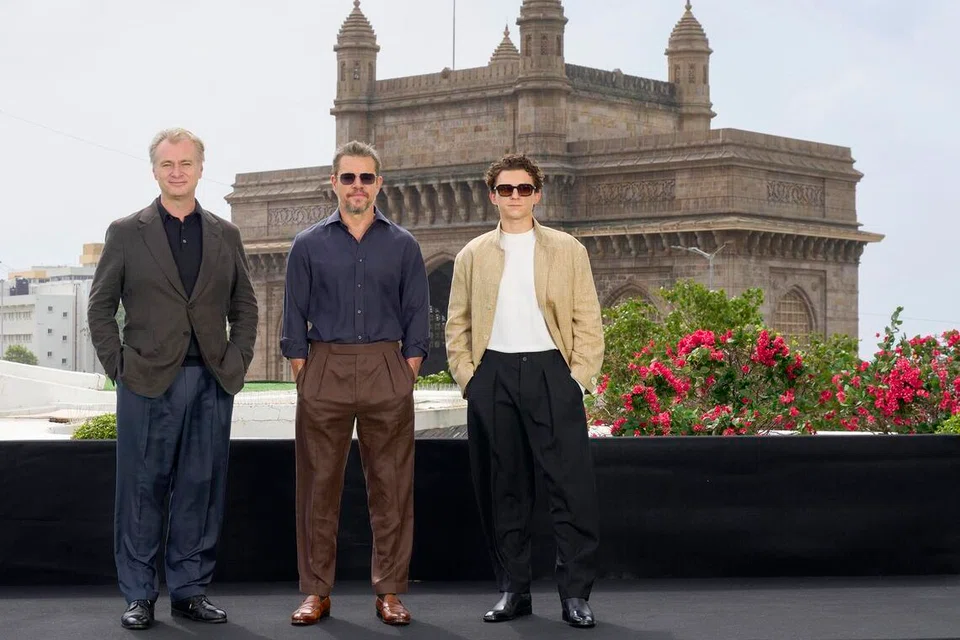

Hollywood celebrities Matt Damon, Tom Holland and Christopher Nolan sip chai at the iconic Olympiad Coffee House in Mumbai, ahead of The Odyssey Mumbai Premiere. But where was Indian origin Himesh Patel on this press tour?
Himesh plays Eurylochus, second-in-command to Damon’s Odysseus - the novel’s eponymous hero. He literally has the same number of scenes as Anne Hathaway’s Penelope, Odysseus’ Queen. But somehow, there is barely any discourse on Himesh’s performance, even by Indian audiences. The only discourse is on why an Indian is in a Greek epic, as if any of the main cast are Greek anyway.
The film is based on Homer’s ancient Greek classic, where Ithaca’s King Odysseus embarks on a tumultuous journey of war and wonder.
Eurylochus fights alongside Odysseus through almost all of the trials they face on the journey, and his relationship with the king bends and twists in one of the few satisfying character arcs here. He takes on the city of Troy, one-eyed giants called Cyclops, Greek enchantress Circe, the army of the dead, and the man-eating monster Scylla, to end in a heartbreaking demise.
Aside from screentime, his portrayal of the character should give him abundant praise, especially when the script can be lacking. His faltering loyalty to Odysseus is also enamouring to watch and Himesh plays the hesitation and fatigue excellently. Even when he stages a mutiny against the King, who makes a few arrogant decisions which kill several soldiers, he never antagonises Odysseus to a point of hatred.
This problem with Himesh being under-rated is not really on Nolan’s shoulders as he has done decent representation in his filmography. Himesh also had a role in Nolan’s earlier film Tenet which was set mainly in Mumbai.
Rather, the online backlash towards Nolan’s representation of the Odyssey has been fuelled by the casting of Himesh, Lupita Nyong’o as Helen of Troy, and Elliot Page as a soldier Sinon.
It’s not like Himesh hasn’t gotten press. He is on the cover of Men’s Health and he’s gone for several major press junkets, and some social media posts online have already started getting tuned to this discrepancy.
The fault really falls on the audience’s perception. If his character was played by a bigger star, perhaps he would likely be receiving the praise Zendaya or Charlize Theron’s characters are getting (despite having a fraction of Himesh’s screentime). And also perhaps, the visual of Damon, Nolan, and Holland eating Bun Maska may just be more “viral” than if Himesh did it.
One can only hope that critics recognise his performance as a true “supporting” actor, especially in comparison to Holland’s Telemachus - Odysseus’ son, or Robert Pattinson Antinous - a villainous suitor for Odysseus’ wife, who played similar roles before. It can be argued the role of Eurylochus is more challenging and less straightforward.
As for the film itself, the editing and writing is not up to par with what we’ve come to expect from the Oppenheimer director.
The first altercation between Telemachus and Antinuous had at least thirty cuts, back and forth between close-ups of the two after every sentence or even word spoken. Because of this, the already choppy dialogue seemed even more disjointed, as if it was a mistake. A mistake that lasted for nearly 10 minutes.
I’m uncertain what the message of the astringent dialogue really is. Aside from the frustrating “Mom” and “Dad” usage by Holland’s Telemachus, the writing feels so cold and distant. Nolan has stated in interviews that this film is meant to be a “modern” film, but I don’t think modernity means stripping of the words, especially juxtaposed to the grandeur and whimsy of scenes with the Cyclops or with Circe turning the men into pigs.
I don’t think we needed astounding vocabulary, but could we have gotten meatier sentences. The delivery of these lines by the actors feels even more jarring. You have them mumbling, speeding, under-enunciating, as if this is not a cast full of Oscar nominees.
The repetition in the film also gets exhausting, especially with a shot of Odysseus sitting in the carnage of Troy. The shot was probably used five times. Some could say that this was representative of the conqueror’s shattered memory but it felt more like a filler to reach Nolan’s usual lengthy runtimes.
People should still watch this film for the sheer cinematic achievement of filming and commitment to practical effects in an age of artificial, lifeless “art”. Nolan filmed every shot on IMAX cameras, a feat never done before, and it shows. Every shot is blocked, illuminated and colour-graded breath-takingly. The Trojan attack, for its suspense and action, and Circe’s island, for its disgusting transformations, especially are absolute masterpiece sequences.
As to which type of screen you should watch it in; IMAX or 35mm or regular, revert to the social media discourse on that.