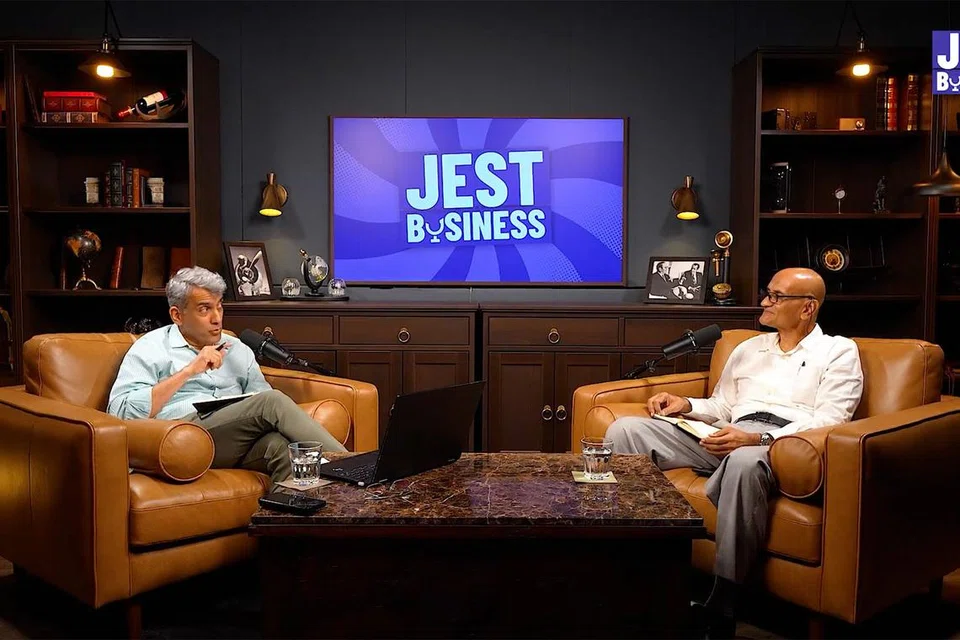

Alumni events are usually a mix of fund-raising or ego-checking. Not for the co-founders of Jest Business, a two-man company that runs corporate workshops on humour for leadership and a satirical business podcast of the same name.
Mr Rahul Phondke, 55, an independent consultant, first crossed paths with Mr Paddy Rangappa, 64, a columnist and retired chief executive, at the Indian Institute of Management – Ahmedabad’s (IIMA) alumni association talent night event in 2012.
“I was running the alumni association at the time, and Paddy came down to read excerpts from his recently published book called Been There Bungled That,” Mr Rahul said.
Mr Paddy and Mr Rahul, who earned their MBAs from IIMA in 1988 and 1995, respectively, formed a long-standing friendship over their shared sense of humour and corporate careers.
In 1995, Mr Rahul moved to Singapore to work for a local IT company after stints in Germany and the United States. He later headed APAC sales for Fortune 500 companies, and is a humour columnist at the Times of India.
A 35-year corporate veteran, Mr Paddy held senior marketing roles at P&G and McDonald’s. He relocated to Singapore in 2000 and was the CEO of Pizza Hut Singapore from 2018 until his retirement in 2024.
“I always emceed the award ceremonies at McDonald’s, where I weaved humour into my speeches. If you ask my colleagues, they still remember the humour part, even if they don’t remember my business contributions,” Mr Paddy quipped.
In January 2025, Mr Rahul pitched the idea of Jest Business to Mr Paddy over a phone call.
“I liked the idea, but I was sceptical about it at first. Is there a market for this? Is humour for leaders an established concept?” Mr Paddy said.
He did his research, which included a study of the 2021 book Humor, Seriously that drew on behavioural science to demonstrate how effective humour can be when developed as a powerful communication tool.
Mr Paddy also noted that the concept was relatively new to Asia, where leaders often remain emotionally distant to not appear weak or vulnerable, and organisational structures tend to be hierarchical.
“People are afraid to speak up because you’re either criticised, ridiculed or sidelined. Humour is one of the tools that make a workplace psychologically safe. It also helps with team dynamics, and makes leaders be more approachable,” Mr Paddy explained.
“Designing the workshop around the research was easy, but the challenge is convincing people that you need this,” he added.
The company conducted its inaugural workshop in May 2025 and has since held six more sessions across Singapore and India. These in-person workshops range in scale from intimate groups of four to larger cohorts of 25 participants.
In one instance, the CEO of a consumer goods company attended a workshop in June and subsequently engaged Jest Business to train his leadership team in September.
The chief executive sought the follow-up session after receiving feedback that the use of humour had significantly improved his presentations during his company’s strategy meetings, Mr Paddy noted.
“People don’t like to work for individuals who are unempathetic and don’t have a sense of humour. If you believe in and enjoy humour yourself, you can also believe that others will also enjoy it when you use humour,” Mr Rahul said.
To build credibility on this proof of concept, the duo decided to launch a namesake podcast in tandem with the workshops. The first episode titled “Why do corporate people talk like this?” dropped on Apple Podcasts, Spotify, and YouTube on May 13, 2025.
They sought advice from fellow IIMA alumnus Amit Ray of CrazyTok Media, the agency that stages and produces the Jest Business podcast. To heighten the comedic appeal, Mr Amit suggested guests portray exaggerated versions of archetypes from the corporate world.
“The podcast is essentially workplace satire. Every office has its own idiosyncrasies, absurd situations and lack of logic that lend themselves to humour. By enacting a script and changing out the names and context, we can call out the silliness at work and make a show out of it,” Mr Rahul explained.
A total of 15 episodes with a runtime of about half an hour have been uploaded on a bi-weekly basis thus far. Organically, the Jest Business YouTube channel has attained 932 subscribers as of Jan 28.
A dedicated Jest Business website was launched in mid-January to consolidate all the workshop details, podcast episodes, and articles the duo have written over the years in one space.
“The aim is not to make this go global or to become YouTube stars. If it does, great. The idea is for both of us to do what we enjoy and do a few gigs here and there,” Mr Paddy said.