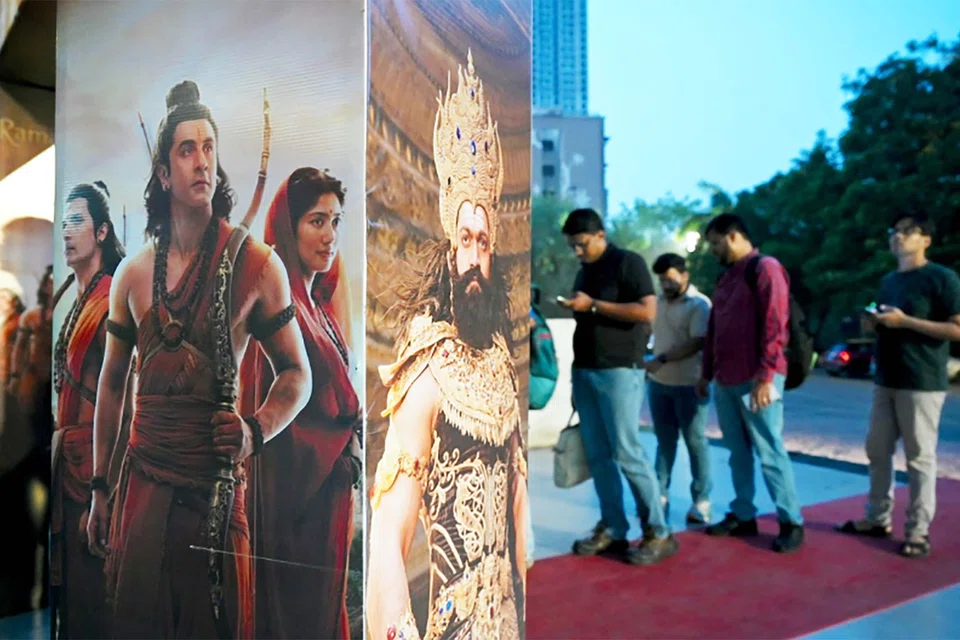
India’s most ambitious cinematic project, Ramayana: Rise of a Legend, is being hailed as a potential game-changer for Indian cinema, bringing together Bollywood superstars, Hollywood technicians and Oscar-winning composers in an unprecedented global production.
With Part 1 out worldwide on Nov 5, the two-part epic reportedly costs US$420 million, making it the most expensive production in Indian cinema history.
More than a decade in the making, the film is based on the ancient Hindu epic Ramayana, which recounts Lord Rama’s battle against demon king Ravana to rescue his kidnapped wife Sita.
Bollywood star Ranbir Kapoor plays Rama, Kannada cinema superstar Yash portrays Ravana, while Sai Pallavi takes on the role of Sita.
Producer Namit Malhotra has described the project as India’s answer to Hollywood’s Star Wars and The Lord of the Rings franchises.
“It’s the largest production in the history of Indian cinema,” Malhotra told AFP.
“The story and the scale and the spectacle is something that the world, I think, is ready to consume.”
Directed by Nitesh Tiwari, the film combines Indian storytelling with cutting-edge visual effects, elaborate battle sequences and massive sets constructed in Mumbai.
Malhotra’s visual effects company DNEG, which has won eight Academy Awards for films including Inception and Dune, played a central role in creating the spectacle.
Oscar-winning composers Hans Zimmer and A.R. Rahman have collaborated on the soundtrack.
The film premiered in Los Angeles last week and has reportedly been dubbed into nearly 40 languages to reach international audiences.
Artificial intelligence was also used to synchronise characters’ lip movements with translated dialogue.
“East and West have come together in a true sense,” Yash told AFP, describing the release as an important moment for Indian cinema.
Unlike conventional Bollywood productions, Ramayana largely avoids elaborate song-and-dance sequences, focusing instead on storytelling, action and visual spectacle.
Despite its international ambitions, Malhotra insisted the film remains authentically Indian.
For Tiwari, the objective was to introduce the epic’s timeless values and emotions to global audiences.
With its extraordinary budget, international talent and worldwide distribution, Ramayana represents one of Indian cinema’s boldest attempts to establish itself as a major force in global filmmaking.
AFP