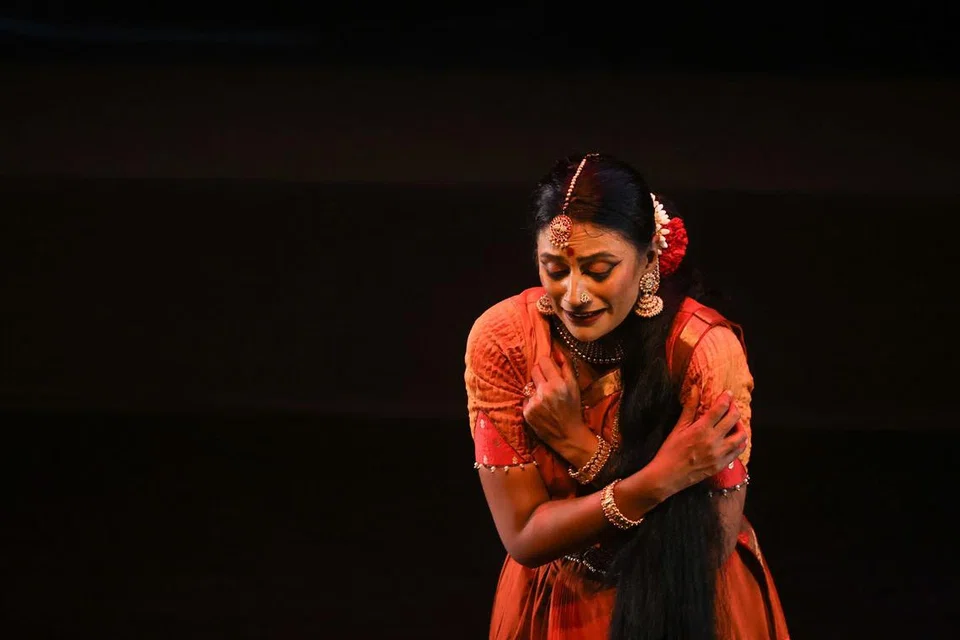

The stage is pitch black and silent when a spotlight suddenly falls on an unsuspecting audience member.
Startled by this, she glances left and right. From the stage, Draupadi locks eyes with her and in a loud and enraged voice accuses her of being a cowardly bystander: “Bhishma, how dare you stay silent while you allow this to happen to a woman!”
The audience member gulps as the attention of 200 theatregoers falls on her. Thankfully, a second spotlight shines on someone else in the right corner of the theatre, and Draupadi redirects her rage towards them.
On Feb 14 and 15, the theatre stage at School of the Arts (Sota) transformed into an ancient Indian court in 3000 BC as it played venue to Yajnaseni – The Eternal Flame, starring renowned bharatanatyam dancer Meera Balasubramanian.
It is a dance-drama that narrates the extraordinary life of Draupadi, the fierce heroine of the Indian epic Mahabharata. The word Yajnaseni means “a woman born out of fire” and is another name for Draupadi.
Meera, who runs the Kalpavriksha Fine Arts Academy and recently represented Singapore at the Asean Performing Arts Festival in Cambodia, plays the protagonist as well as other characters, often in the same scene. The cast also includes an ensemble of six supporting dancers.
The two-hour show unfolds across five acts, covering the birth of Draupadi and her unorthodox marriage to the five Pandavas. The story concludes with the mourning of her children who died in the Kurukshetra War and her ascension to heaven.
Told through Draupadi’s point of view, the production is a bold and modern feminist interpretation of the Mahabharata. In the classic Indian epic, Draupadi, though a significant character, is typically portrayed as a supporting role in relation to the male characters. In Yajnaseni, she is front and centre.
In Act 3, after being the object of a lost bet to the Kauravas, Draupadi confronts the antagonists in court for their inaction, and chastises her husbands for not defending her honour. Meera demonstrates her prowess as she switches between three characters – Duryodhana, Karna and Draupadi – seamlessly.
Her gestures and facial expressions encapsulate the antagonistic Karna when he ridicules Draupadi for her polyandrous marriage. Yet, she is able to play the righteous Draupadi with a nuanced sense of strength and vulnerability.
The show ran for two nights – a Tamil version was staged first – to sold-out audiences.
The music, which included songs specially composed for the production, was scored by O.S. Arun and Eswar Ramakrishnan, while the dance sequences were choreographed by Meera along with senior dancer Hari Padman.
For the English version, the show drew an audience of both young and old. Student Anupama, 18, said she thought the dialogue was particularly engaging.
“The facial expressions, lighting and display of exposition (story text) on the projector made the plot easy to follow,” she added.
“I definitely liked the part where the spotlight shone on the audience and Draupadi confronted them. At one point, I was so afraid it would fall on me.”
Sakti Singaravelu