Although billed as a stand-up comedy show, Zakir Khan’s Papa Yaar, performed at the Esplanade Concert Hall during Kalaa Utsavam, was nothing short of a masterclass in storytelling.
The 1.5-hour show was a carefully structured evening of humour, poetry, and uncomfortable honesty, reflecting both Zakir’s evolution as a performer and his willingness to sit with emotional complexity.
Before Zakir Khan took the stage, the audience was warmed up by local comedian Sharul Channa, whose sharp wit and confident presence set a lively, energetic tone. Clad in a bright red sari and performing in Hindi, she explored the contrasts between Indian Gen Z and Millennials, making humorous jabs at the former, sprinkling in cultural quirks that resonated with Singaporean audiences.
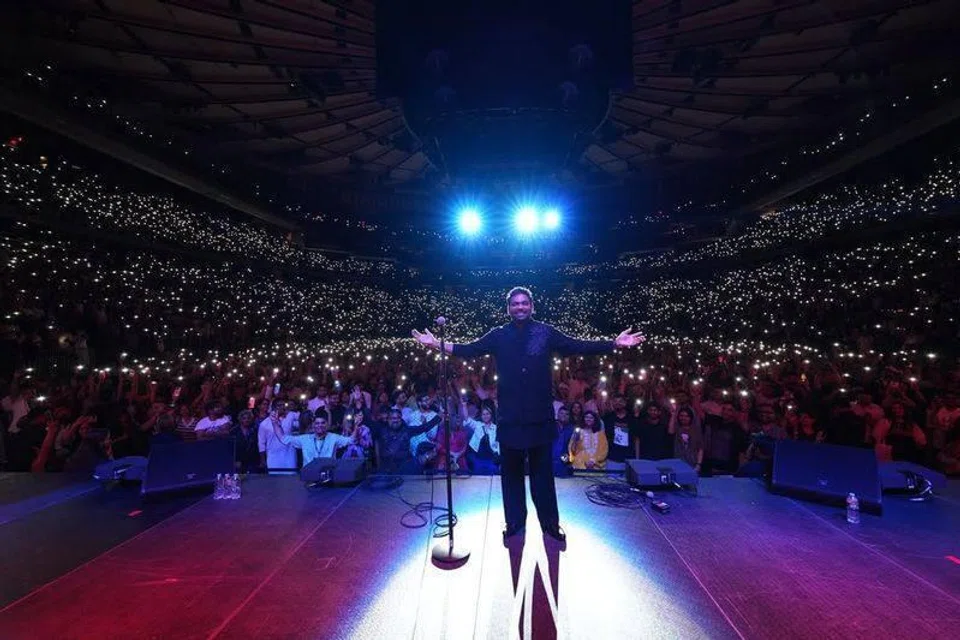
It was a perfectly timed opener – light, engaging, and seamlessly preparing the crowd for the main act. She then introduced Zakir Khan, fresh from his American tour (where he had headlined the iconic Madison Square Garden in New York).
When Zakir Khan appeared on stage, the shift in atmosphere was immediate – whistles erupted and continued unabated, until he took it upon himself to hush the audience. Known for his conversational style and Everyman persona, he eased into Papa Yaar. He began by requesting his audience to refrain from conversing with him, or in other words, heckling him – admitting, “I know the tickets are expensive, so I just want to give you a good show.”
The show revolved around his relationship with his father, but it quickly becomes clear that it is not a string of ‘dad jokes’ or nostalgic anecdotes designed for laughs. Instead, the 38-year-old weaved humour through grim and often unspoken realities of parenthood – financial pressure, emotional restraint, generational gaps, parental trauma, and the road to forgiving them.
Many critics and audience members have praised the special for its emotional depth, describing it as a comedy that feels deeply lived-in. At the same time, some viewers have felt that the laughs are more restrained compared to Zakir’s earlier, punchier specials. Watching the show live, this trade-off felt intentional. There were moments when the hall grew quiet, not because a joke of his didn’t land but because his sombre reflections threw the audience into introspection.
Zakir spoke candidly about the distance that can exist between fathers and sons, especially in traditional households. He acknowledged their limitations, their exhaustion, and the emotional vocabulary they were never taught, which then spills over to their children. These moments added weight to the show and distinguished Papa Yaar from conventional stand-up shows and his own prior specials. The comedy flowed in waves – laughter followed by reflection, humour followed by pause.
Another defining feature of the performance was Zakir’s use of poetry. Long known for blending ‘shaayari’ (poetry) and verse into his stand-up, he leaned heavily into it here. The audience swooned at his buttery rhymes, breaking into rhythmic ‘wah-wah’s in return.
The show built steadily toward its conclusion, charting his relationship with his father, culminating in a poignant poem. While the show is called Papa Yaar and presents the idiosyncrasies of a typical father-son relationship, he dedicated his final poem of the night to mothers, whose “prayers for their children have the strength to right every wrong”.
The poem read (translated):
Every path I lost myself on still unfolded into a destination.
I gave her sorrow along the way, yet love was what I was given.
And whenever a curse set out to stop me before I could go on,
my mother’s prayers reached me first.
Some fans describe Papa Yaar as deeply moving, particularly when watched with parents, while others felt it leaned closer to a monologue or spoken-word performance than a conventional stand-up set. Both perspectives are valid – and perhaps expected – as Zakir, with five officially released comedy specials to his name, continues to evolve his craft, curating cinematic and emotionally resonant experiences through his masterful storytelling.