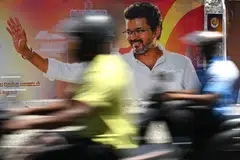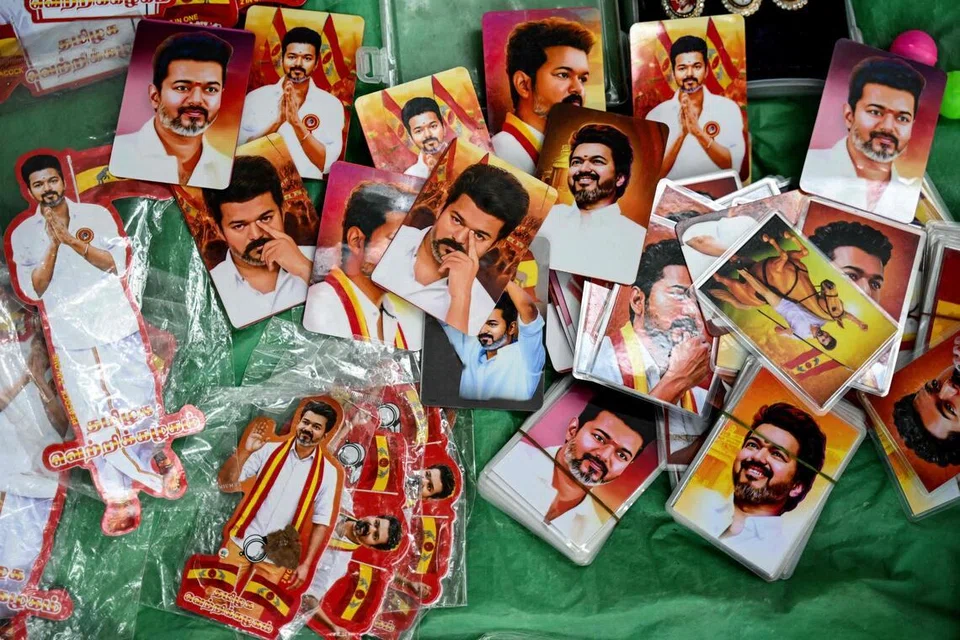
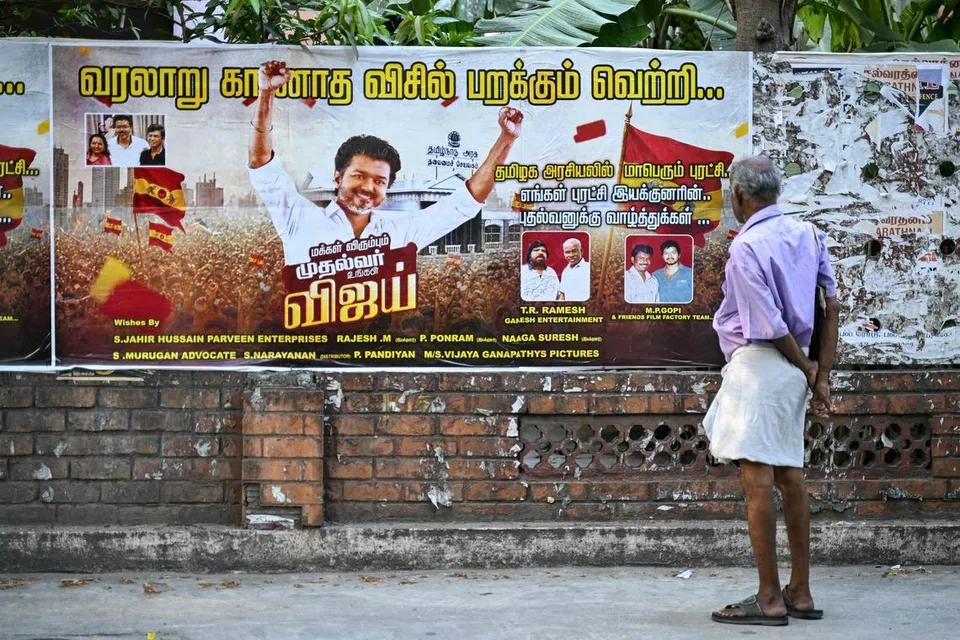

Ms Theresapriya Chidambaram, 22, a hardcore Vijay fan, foresaw the actor-turned-politician would sweep the polls at the Tamil Nadu state elections when she scrolled through her Instagram feed two weeks before voters headed to the ballot box.
“I think he made a good impact on social media, and the youths out there were on his side,” she said, explaining that all the posts on Indian politics she came across were about the superstar and his nascent Tamilaga Vettri Kazhagam (TVK).
The Edinburgh Napier University student even made a S$100 bet with her father, who was not a fan, on whether “Thalapathy” would become the chief minister. However, the wager is still on as TVK only secured 108 seats – 10 short of the 118 seats needed to form a government in the 234-member Tamil Nadu assembly. Its leaders are in talks with the Congress and smaller parties to make up the deficit and form the government.
Nevertheless, Mr C. Joseph Vijay’s performance delineates a watershed moment in a state, which has for decades oscillated between two established regional parties: Dravida Munnetra Kazhagam (DMK) and All India Anna Dravida Munnetra Kazhagam (AIADMK).
“I expected TVK to diminish AIADMK’s vote share, but didn’t expect Vijay to defeat the incumbent DMK,” said Dr Darinee Alagirisamy, deputy head of South Asian Studies at the National University of Singapore.
Though the two Dravidian parties have resorted to populist tactics at various points, both are ultimately driven by ideology – one characterised by the pursuit of inclusive growth, social justice, and welfare-driven development.
A fatigue for Dravidian politics, combined with “corruption” being a major talking point in this election, worked in TVK’s favour, Dr Darinee noted.
“Especially for a political party that does not have concrete policies of its own to rally, raising corruption charges simultaneously presents an opportunity to discredit the opposition and divert attention away from what exactly it proposes to do differently,” she added.
Another factor is the state’s history of electing film stars. “Through his movies, Vijay has cultivated a boy-next-door vibe,” observed Ms Sandhya Karthigeyan, 22, a psychology major.
She added that towards the end of Vijay’s film career, he chose projects that critiqued social injustices and painted him as a “knight in shining armour”. This tendency to relate reel life with real life could be a potential concern.
“His reach is global, and I have some young friends in Singapore who are TVK supporters,” Ms Sandhya said. “However, they have not read up on the party’s manifesto and are in it purely for Vijay.”
Mr Suresh Devadoss, 46, a product manager in the tech industry, acknowledged the younger generation’s “misguided desire” to see their favourite cinematic hero in a position of real-world power.
“When I was a teenager, during the 1996 elections, Rajinikanth was the superhero, and I wanted him to come into power,” said Mr Suresh, who relocated to Singapore 21 years ago and has been keeping up with Tamil Nadu politics through news channels.
“The younger generation doesn’t know what is good and what is bad yet,” he added. “They have to go through life’s struggles before they know what a real hero is all about.”
The increased involvement of youth in Tamil Nadu politics is still an encouraging trend, noted Mr John Ramamoorthy, 54, an IT professional, who worked with and helped to develop the webpage for former Indian President A. P. J. Abdul Kalam.
He views Vijay’s political debut with optimism, highlighting how TVK’s vision is in tandem with Dr Kalam’s stance on interreligious harmony. “It is important that politics should not rely on any one religion,” Mr John explained.
Mr P. Arumai Chandran, 51, director of 8 Point Entertainment, is a little less certain about the next five years. “There is no modern precedent for what comes next, given that the state has been governed exclusively by Dravidian parties for the last 60 years,” he said.
TVK’s lack of political experience is another source of concern for businesses, as Vijay’s advisors and many of the party’s elected candidates are first-timers. “To what extent they will be able to further develop Tamil Nadu on a national and global scale remains to be seen,” Mr Arumai added.