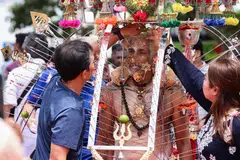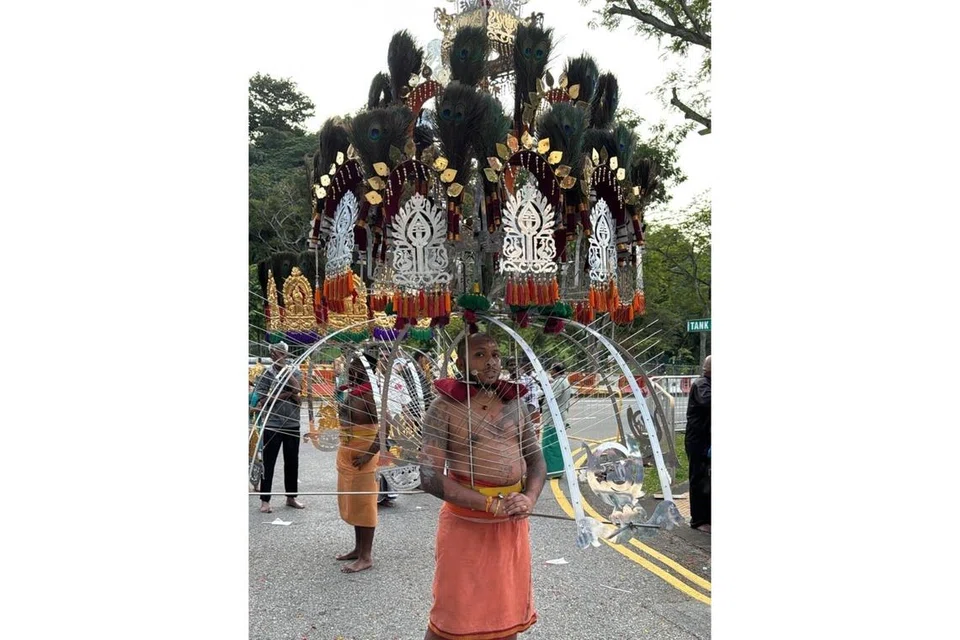
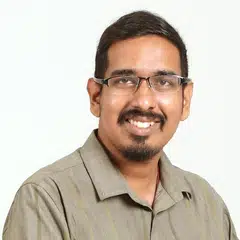
For nearly 3 decades, Mr Thachna Murari Balakrishnan, 39, a Chetti Melakan, has been carrying the kavadi (often a decorated canopy or an ornate wooden arch) as a ceremonial sacrifice and an act of devotion.
Since he was eight years old, he has been carrying the paal kavadi, an arch-perched wooden rod with small milk pots at each end. His penance later progressed with piercings on his tongue, across his cheeks and on his upper body.
This year marks a departure from his usual practice: he did not carry the kavadi because his father passed away last year. As per custom, family members of the bereaved are prohibited from making piety vows for a year.
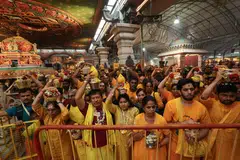
Observed annually by Hindus, Thaipusam is a spiritual festival where devotees carry milk offerings or bear ornate kavadis in acts of devotion.
Mr Thachna decided to make the best out of his situation, moving from piercings to podium, by sharing his experiences at the Indian Heritage Centre (IHC) with a group of largely non-Indians on Jan 31, the eve of Thaipusam.
The session, attended by about 35 members of the public from diverse backgrounds, granted a rare peek into personal devotional space.
“Does the piercing hurt?” “Do all kavadi bearers manage to finish the route?” – These were some of the questions participants curiously asked.
Mr Thachna’s replies were honest. He highlighted the importance of careful planning and fortitude required to brave the 3.2km procession walk, and that not all kavadi bearers complete the gruelling journey.
“Fasting makes the skin soft for the needles to pierce through. The rest is devotion and mind over body,” he noted. “The moment I am ready to walk, there is a sudden burst of energy and joy that comes over me—not a trance, but a sense of enlightenment”.
Mr Thachna also referred to his YouTube channel, Kavadi TV, where he documents his experiences.
“Preparing the kavadi takes about two weeks. Since I have a day job, I work from 6am to 5pm, come home, pray, and then work on the kavadi until 9pm,” Mr Thachna pointed out. “Living in an HDB flat adds a logistical struggle. If you live on the 20th floor, you have to disassemble the structure just to fit it into the lift, then reassemble it at the bottom on Thaipusam day at 2am to be ready for the 5am start.”
Mr Thachna’s kavadi – which usually adorns the roof of his prayer altar – is on display at the IHC until Feb 8.
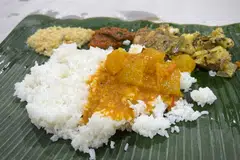
The display at the IHC recreates the arrangement of an alagu (spike) kavadi during pre-procession temple prayers, just before it is carried; it can be seen alongside a Chetti Melaka-style padaiyal (food offering) offered by devotees during Thaipusam to seek the blessings of Lord Murugan.
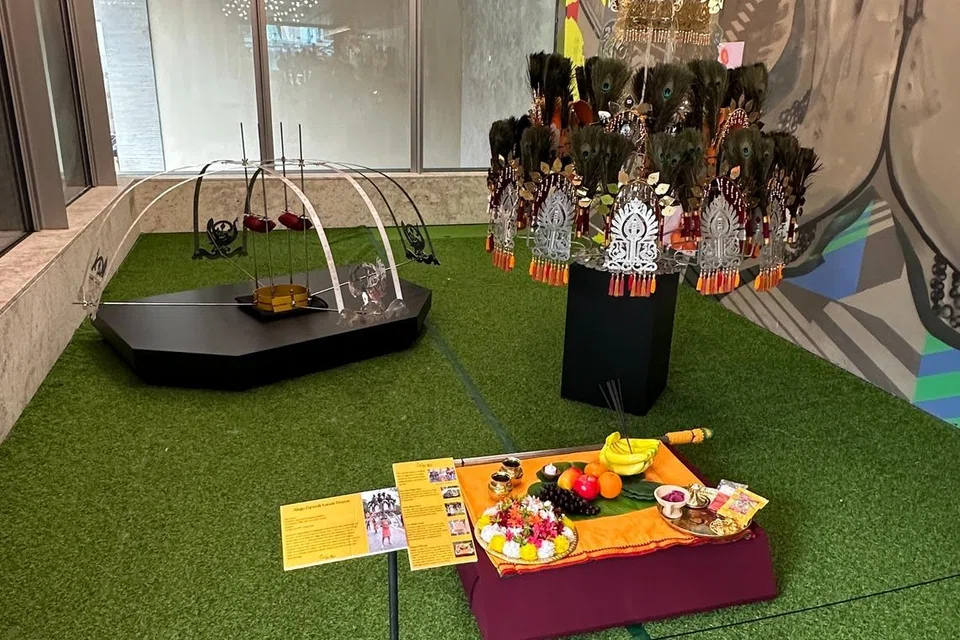
Mr Thachna explained the unique simplicity of his community’s tradition: “Unlike the usual offerings of flattened rice and puffed rice used by others, our padaiyal is focused on fruits, flowers, and betel leaves.”
Among the listeners was Ms Sunita Abraham, a retired financial journalist who moved to Singapore three years ago.
“I’ve seen Thaipusam a few times, but I never had the chance to speak with a kavadi bearer. His sharing made me realise the human emotions – the exhaustion, the pain, and the sheer grit – that intermingle with devotion,” she noted.
Similarly, Abha Kaul, a volunteer museum guide who has lived in Singapore for 25 years, appreciated the opportunity the session offered. “I have never spoken to someone who could talk so candidly and honestly about the intersection of pain, devotion, and faith,” she said.