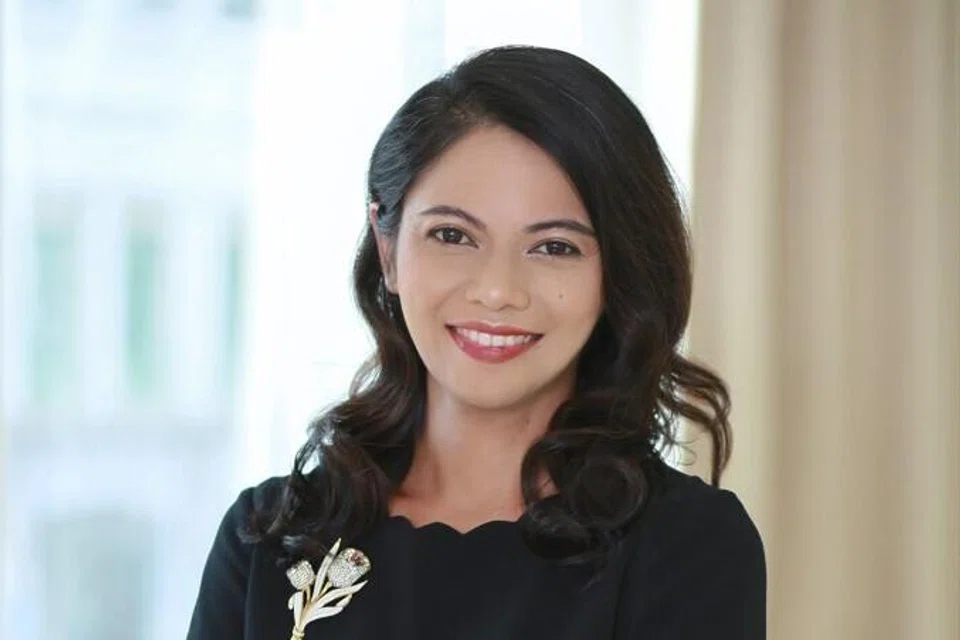

The arc of Usha Chandradas’ career reveals a practitioner who has evaded pigeonholing herself in one professional box. Her trajectory has been described as a “portfolio career” by her younger colleagues, much to her amusement.
Ms Usha, 45, co-founded Plural Art Mag, a digital platform focused on Southeast Asian modern and contemporary art. Before pivoting to the arts, she spent 12 years practising tax law, beginning at the Inland Revenue Authority of Singapore and later in private practice.
She is an adjunct associate professor at Nanyang Technological University and has served on boards including the Intellectual Property Office of Singapore, and has been a consultant for the International Monetary Fund. In 2023, she was appointed a Nominated Member of Parliament (NMP) representing the arts sector for a term that recently ended in 2025.
The turn toward the arts was a natural expansion of interests. While practising law, she began pursuing an art history degree – as an avid museum lover with an equally enthusiastic love for studying, it made sense to do so. “I do have a lot of degrees,” she said with a laugh.
Now, she balances multiple commitments simultaneously. “A typical day for me involves some combination of all these jobs. You can’t control when e-mails or questions come in. So it’s really about being open and available to whatever comes in.”
On Visual Arts in SG
Her pet project, Plural Art Mag, which is on the cusp of turning 10, grew out of conversations with classmates and friends. “We started a little blog writing about the things that we were seeing in art school,” she recalled. They were frustrated by inaccessible academic writing and by a lack of sustained publicity for the many visual art exhibitions and pop-ups taking place locally.
“Value is often attached, mistakenly I think, to inaccessibility. We wanted to undo that,” Ms Usha said.
The impulse to widen access and participation also shaped how she thinks about the broader arts ecosystem in Singapore. Regarding the viability of an arts career here, “I think things have definitely evolved,” she said, pointing to the Singapore Renaissance City Plan (an initiative launched by the Singapore government in 2000 to develop the arts and culture sector) and the formation of the National Arts Council as markers of change. Compared to decades past, there are “a lot more opportunities for people than there were before.”
At the same time, she resists romanticising the economics of creative work. “It’s definitely possible to make money, but like any industry, not everybody will,” she said. There are artists and organisations that do well. The arts are not uniquely precarious, she argues, as the distribution of success mirrors other professions. “You see this in law, in accounting, in banking – not every banker is the top earner,” she said.
Still, opportunity does not erase tension. Across the world, Ms Usha observes, artists grapple with the pull between experimentation and crowd appeal. Work that is “crowd-pleasing” can generate revenue because audiences readily buy into it. But creative growth often demands risk and risk does not always pay. “To grow as a creative, you also want to do experimental things,” she said. The question then becomes – who supports the experimental work? That, she believes, is where the government has an important role to play.
Ms Usha noted that Singapore’s level of public arts funding remains significant compared to many countries where subsidies are shrinking. This awareness of the structural support for the arts naturally informed her own advocacy.
On Her Time in Parliament
Her advocacy extends beyond publishing. As a Nominated Member of Parliament for just under two years, she focused on arts policy and viewed the appointment as substantive work. “It’s a very precious position and if we have one, I think there’s a duty to make some noise,” she said.
Beyond the walls of the Ministry of Culture, Community and Youth (MCCY) – the traditional home for arts policy in Singapore – Ms Usha reached out to ministries whose work might not seem directly related to the arts at first glance. She lobbied the Ministry of Finance on tax incentives for the creative industries, drawing from her own expertise in tax law.
She engaged the Ministry of Education to discuss the role of arts in shaping young minds and working conditions for art teachers. She even spoke to the Ministry of Health about the potential of art therapy in mental health care, and to the Ministry of Trade and Industry about support for the creative economy and the role of the arts in tourism. “The arts are connected with everything,” she said.
Public service runs deep in Ms Usha’s family life. Her father, S Chandra Das, was a former Member of Parliament, and she grew up observing the commitments of life in politics up close.
At home, she credits her husband, also a lawyer, for being a constant source of support amid her demanding schedule. “He’s hugely supportive,” she said, especially during the long hours that come with juggling multiple roles can be physically exhausting, making that support invaluable.
The couple often attend performances and exhibitions together, something Ms Usha sees as an extension of both her professional and personal interests. She recalled bringing her husband, who is Chinese, to a Tamil theatre production by Agam Theatre Lab. “I think he was the only Chinese person in the audience,” she said, amused, adding that she herself had come to Tamil theatre relatively late despite her cultural roots.
As she continues to navigate her “portfolio career”, Ms Usha remains a pivotal figure in shaping the dialogue around the arts.