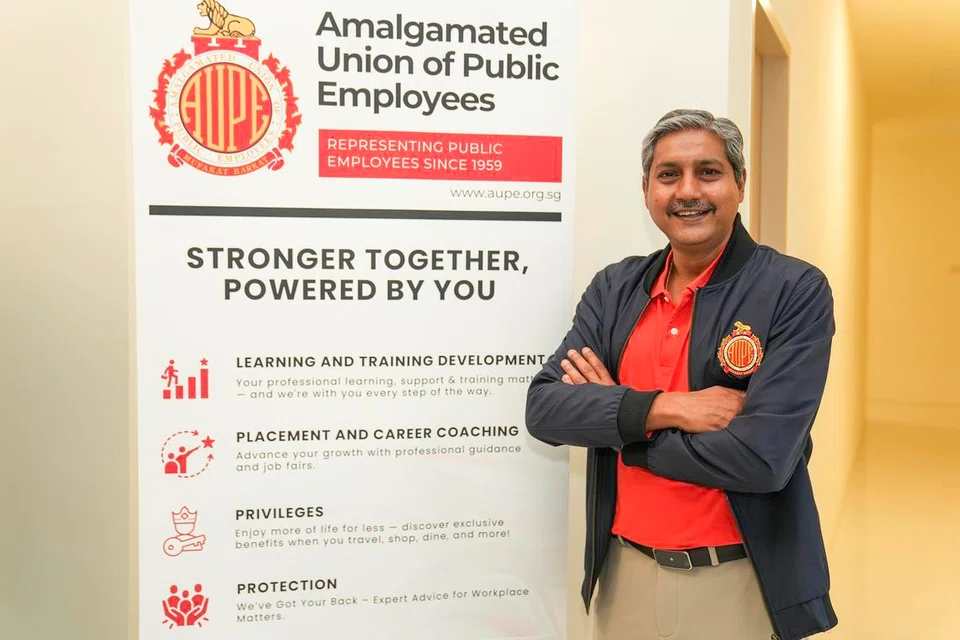

As the General Secretary of the Amalgamated Union of Public Employees (AUPE), Mr Sanjeev Kumar Tiwari spends his days navigating high-stakes negotiations with stakeholders and commanding the attention of policymakers.
Yet, at his core, the 48-year-old confesses that he is actually an introvert. “I never knew that one day I would be working for a trade union, or be a union leader,” he said with candour.
Though he did not set out to become an advocate for Singapore’s workforce, Mr Sanjeev’s modest upbringing inadvertently provided the scaffolds for his eventual appointment as the current Nominated Member of Parliament (NMP).
Typical 80s Family
Growing up as the third out of four brothers in a single-income Singaporean Hindustani family of six, Mr Sanjeev learnt firsthand the value of financial readiness and gainful employment.
His father worked as a travel consultant by day and as a security guard at night to make ends meet, while his mother was a housewife. “Things were a lot simpler, but life was a lot harder,” Mr Sanjeev recalled.
He grew up primarily in Jurong before the family relocated to Holland Drive, where he spent the bulk of his formative years. Mr Sanjeev described his childhood home as a noisy one, filled with all boys who were four years apart and quite a handful.
“Everybody was very different in personality and was trying to sort life out. There were a lot of fights and arguments as my parents were trying to make sure that we ended up straight and did not get into any kind of trouble,” he reminisced.
Each weekend, the family would visit the Siddh Peeth Sree Lakshminarayan Temple at 5 Chander Road. “It created a social, get-together atmosphere so a lot of times the (North Indian Hindu) community will meet up at the temple itself.”
On weekdays, Mr Sanjeev’s mother ensured her children had their proper meals and finished up their school work, “though we found ways to go around that,” he quipped. His father was the main disciplinarian, who instilled in him the importance of a good education.
“Education is the bedrock for a better life and a better career,” Mr Sanjeev noted.
He completed his diploma in Accountancy and Taxation from Nanyang Polytechnic in 1998, though his main area of interest was Information Technology (IT). Mathematics was not his strong suit, and after a failed appeal attempt to change course, the future union leader was disheartened.
However, his second-oldest brother, now a chartered accountant, agreed to guide him. “I took it as a challenge, and surprisingly, that’s when I realised maths is not so bad after all,” Mr Sanjeev said.
To earn extra pocket money while studying, he worked as a retail associate at 7-Eleven and as a temporary security guard at factories and offices. These jobs drove him to work harder for a purpose, as it made him ponder, “is this how you want to spend your life?”
Full-Circle Moment
After his national service, Mr Sanjeev worked in the private sector for about a year before taking up the role of administrative manager in a school under the Ministry of Education (MOE) from 2001 to 2007.
He utilised his downtime to pursue a concurrent bachelor’s and master’s degree in Business Administration at the University of Southern Queensland, which he funded himself.
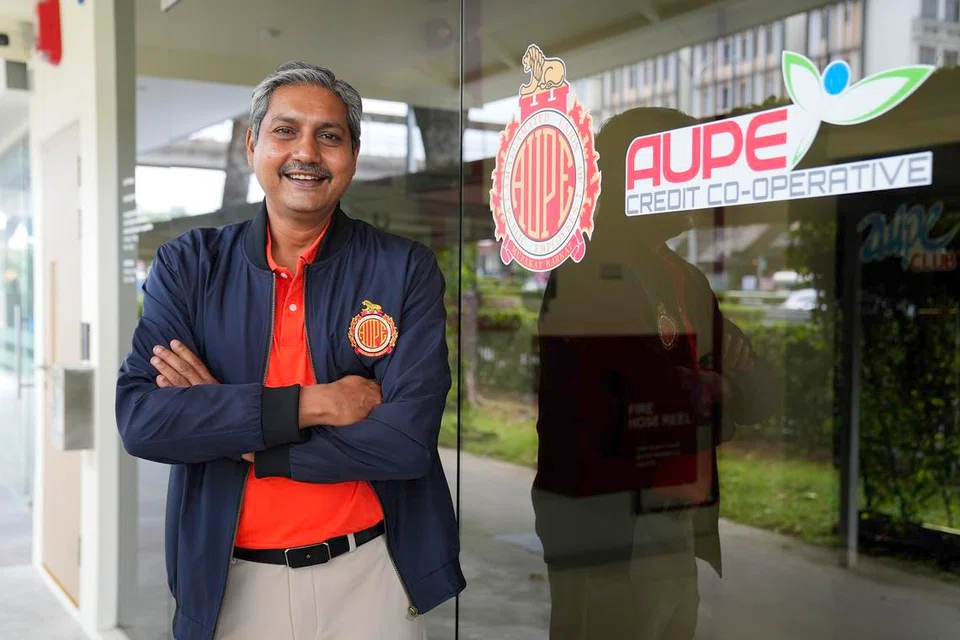
In a twist of fate, the union that represented MOE at the time for non-teaching staff was AUPE, the largest public-sector union.
“I actually joined AUPE without knowing what AUPE is,” he recalled. “I remember there were two forms. One for the union membership and one for the co-operative, and I joined both, but had no inkling of what they do.”
It was only when he joined the National Trades Union Congress (NTUC) as an industrial relations officer that he saw the whole works of what trade unionism is and why it exists.
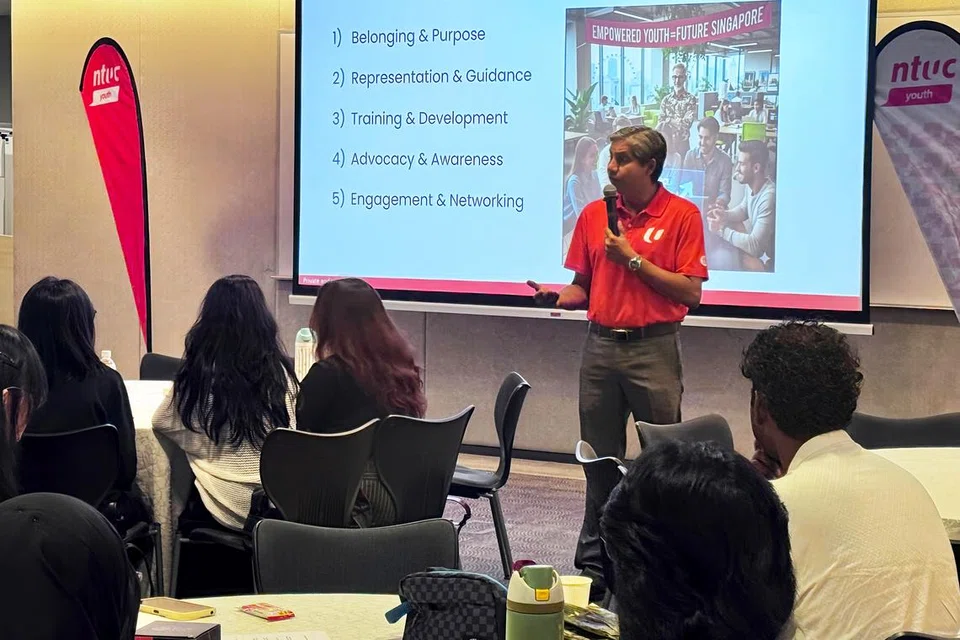
He also discovered that he thrived when he was active on the ground rather than behind a desk, interacting with union members and management, which brought Mr Sanjeev’s more extroverted and conversational side to the fore.
As an outgoing person who, in his own words, is not exactly tuned to the rules and enjoys solving challenges, he found the role well-suited. This was evident across his 10-year stint at NTUC, where he rose up the ranks to become an executive assistant secretary.
In 2016, he assumed the role of deputy director for industrial relations at AUPE, and three years later, he was elected as the union’s general secretary, a position he has since held for a second term.
Relativising Unions
A common misconception is that unions mostly cater to “rank and file” or blue-collar workers, Mr Sanjeev noted.
Unions are considered more relevant in yesteryear when workers were concerned with bread-and-butter issues such as gainful employment and better wages, he added.
“I think the younger generation doesn’t see the relevance because a lot of it is already there, but it didn’t drop by chance,” the unionist said, citing the example of annual leaves. “It was not given by the management just like that, and is the evolution of many decades of hard work by the leaders.”
The majority of Singapore’s workforce today comprises professionals, managers, executives and technicians (PMETs) or white-collar workers.
Workers’ aspirations have also become individualised, making it a harder task for unions whose strength lies in the collective. “Some people may be looking at progression, some may be looking at enlightenment.”
Unions have evolved too and now offer multiple specialised pathways, such as subsidised courses for members looking to upskill or networking opportunities across many industries for those keen on a career switch, Mr Sanjeev said.
The Bigger Picture
Nevertheless, cost-of-living will always be a perennial issue across generations, he noted. As a Labour NMP, Mr Sanjeev hopes to address this concern in Parliament alongside transformation or skills upgrading.
“When you upgrade yourself, you get better wages, better outcomes. Then you can manage the cost of living,” he said.
However, it is an unavoidable paradox, as the cost of having better wages is rising costs again. “If you get the first one right, then the second one will be manageable,” Mr Sanjeev added.
He also observed that workers don’t just work for themselves; they work for their families and loved ones. And as workers level up their skills, their loved ones are uplifted in tandem, creating a broader positive impact.
“There’s always a bigger picture,” Mr Sanjeev explained. For him, that picture includes his wife, a real estate agent, and their three children: two daughters, who are currently pursuing a degree and a diploma respectively, and a 12-year-old son.