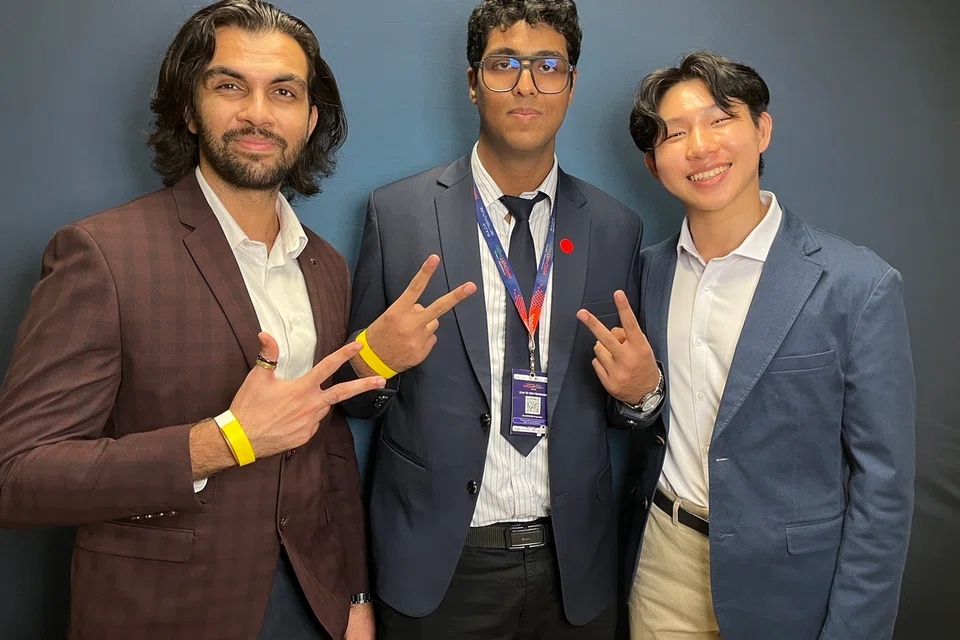

The dopamine rush from being able to build something out of nothing in a short span of time is what propels students like Ansh Bajaj, 20, a third-year student at the Maharaja Agrasen Institute of Technology in Delhi, to compete in hackathons.
Although his background is in information technology, Mr Ansh was intrigued by hardware and participated in his first hackathon – a state-level hardware-only competition – during his second semester of university.
“I had no clue what I had to build. I just went to a hardware shop, and I just got some random confidence and built something out of it – and we got first place,” Mr Ansh said.
He went on to win the Smart India Hackathon (SIH) Hardware Edition in December 2025.
Mr Ansh told tabla! that he found the experience of having to build something and then pitch it to a judging panel “addictive”. When the invitation to enrol in this year’s Singapore-India Hackathon showed up in his mail, it was a no-brainer.
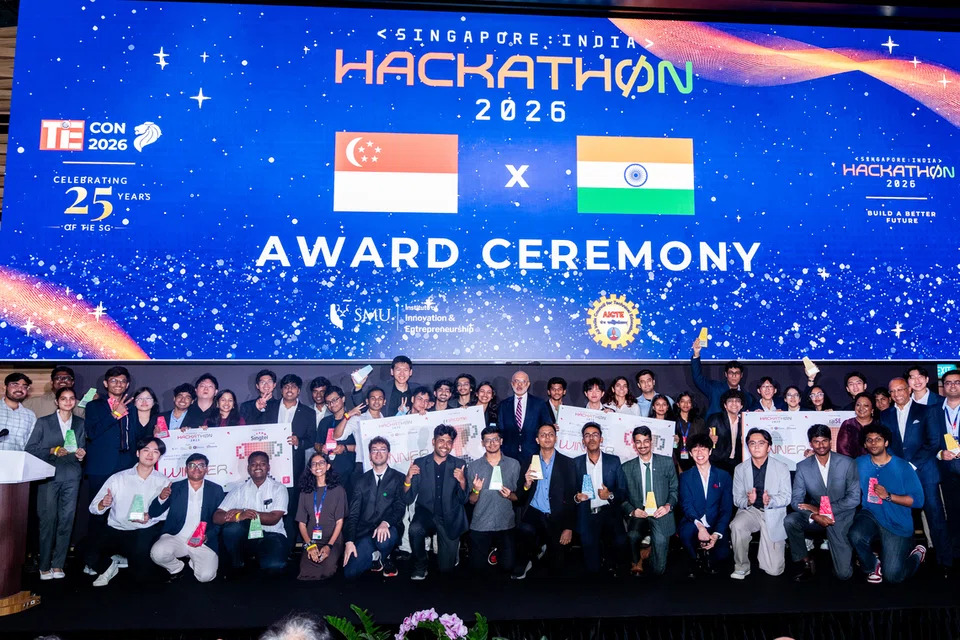
The three-day event took place at Singapore Management University (SMU) from Nov 15 to 17, and saw 20 mixed-country teams comprising 120 tertiary students from Singapore and India work together to tackle real-world challenges.
Over 36 hours, the youths developed practical solutions to everyday problems, which were categorised into four tracks: Emerging Technologies, FinTech and InsurTech, Sustainability and Climate Action and Social Innovation and Inclusive Development.
Hackathons a catalyst for real-world solutions
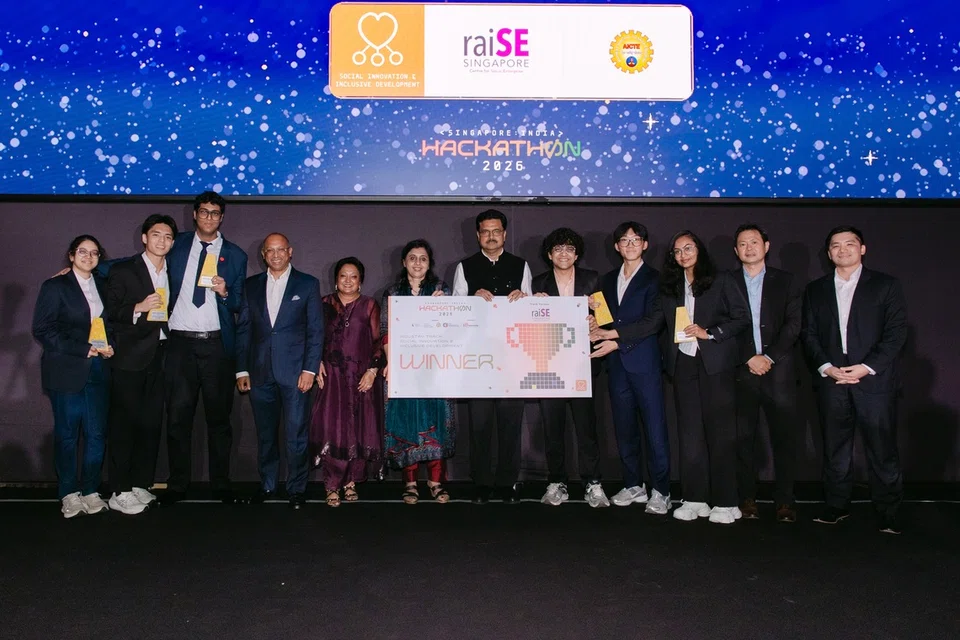
Mr Ansh and his teammates chose the Social Innovation track, sponsored by the Singapore Centre for Social Enterprise (raiSE), which challenged students to find ways of supporting disadvantaged and lower-income seniors in Singapore and India to age well.
In response, the team adopted the name Kawan or “friend” in Malay, and developed a digital platform that connects seniors with meaningful, flexible work opportunities, and helping them remain economically active and socially engaged.
Kawan was announced as the track winner on Nov 17 at the hackathon’s awards ceremony, which was held alongside TiE Singapore’s 25th anniversary gala dinner.
Only eight teams made it to the finals. The winners received a total of S$88,000 in prizes, comprising S$13,750 for the winning team of each track and S$8,350 for each runner-up.
Nathan Yong, 20, was a part of Kampong-lahh – the runner-up team for the Social Innovation track. He is currently serving his National Service and will pursue economics at Cambridge University thereafter.
“There was definitely a lot of learning from each other and seeing where each other shine. But, I think also for me, the interesting part was being able to step back,” Mr Yong said.
“I did come in with the builder mentality, but the moment I see these guys got it way better than me, then you got to be like: Let’s be honest, I’m not there,” he explained. “Where am I better suited? So, I handled the business side and did all the pitch decks.”
It was a similar learning experience for Mudit Gupta, 21, a second-year software engineering student at SMU, whose team of six competed in the Emerging Technologies track, but was not selected for the finals.
“On the first day, they were already like: What are we going to build? They are brilliant, they are hungry, and I respect the hustle. I want to steal that, not just for the hackathon, but for life too. It motivated me,” Mr Mudit said.
He moved from India to Singapore in 2013 when he was eight years old, and speaks both English and Hindi fluently, allowing him to be a cultural bridge between his teammates.
He also leveraged his oratorical skill to lead his team’s pitch with a skit, which helped to hook the audience and set themselves apart from the competition.
“It’s not that I don’t understand the tech. I had to step back to do this other thing that’s also needed, which I know I can do better in. That’s the beauty of collaboration,” Mr Mudit noted.