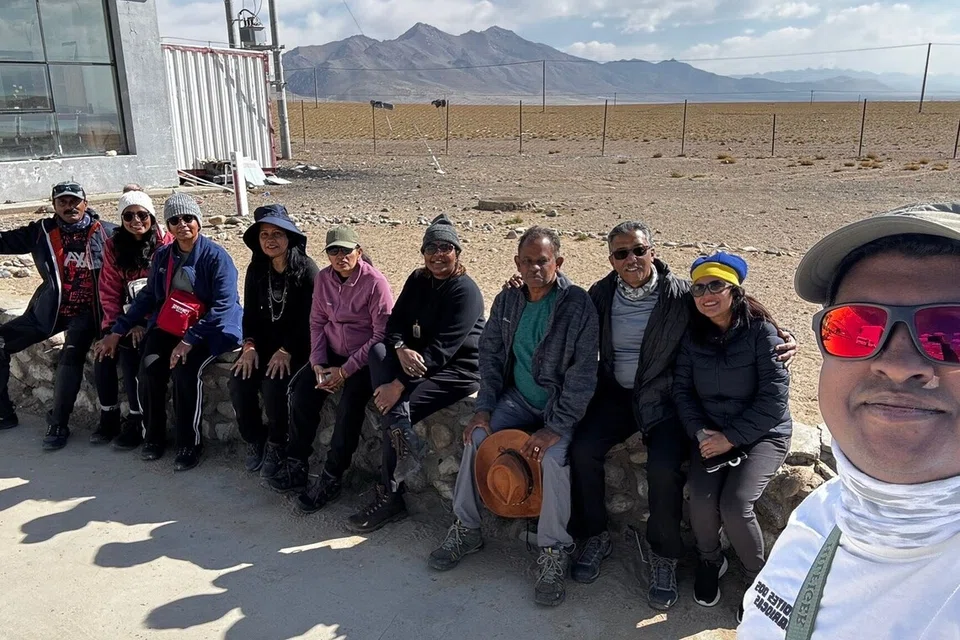

A Singaporean family recently undertook a sacred pilgrimage to Mount Kailash, a towering peak in the remote western reaches of Tibet. Revered as the Hindu deity Shiva’s abode, Mount Kailash is honoured not only by climbing it, but also by a 52-kilometre circumambulation – a journey known as Parikrama in Sanskrit or Kora in Tibetan.
For Ms Magha Sandarjan, 24, along with her parents, Ms Vignesvary Kalimuthu, 57, and Mr Sandarjan Sokalingam, 61, this sacred mountain was “more of a calling”. Alongside nine close friends, Ms Magha and her family stepped into a place where time feels slower, the sky feels closer, and every breath feels earned.
The pilgrimage is far from a simple walk. The terrain is steep, rocky, uneven, and at high altitude, making it a true test of endurance. On June 6, 2025, the family set out on a 17-day journey from Singapore to the high altitudes of Tibet, which would test not just their bodies and breath, but their faith.
Leading up to their journey, they trained by climbing Bukit Timah Hill, walking daily, meditating, and undergoing medical checks, doing everything they could to feel ready for the journey.
They took nine days to reach Tibet, and then over the next six days, the family journeyed through Tibet to acclimatise themselves before beginning the three-day parikrama.
Horses are often chosen during the parikrama as a practical option to help pilgrims cope with high altitudes, fatigue, and challenging terrain.
“We were counting on getting a horse, but there just weren’t many available. We ended up walking nearly 18km until Drirapuk before getting one,” the parents recalled.
“We’re so used to the fast-paced life in Singapore, but during the parikrama, we were forced to slow down. Even simple tasks like breathing took so much energy,” Ms Vignesvary said.
On the second day of the parikrama, things took a turn for the worse as soon as they reached the highest point, Dolma La Pass. The low oxygen levels began to take a toll, with Mr Sandarjan even experiencing hallucinations.
“I thought I was going to die. Every breath felt as precious as gold, though the pain was sharp and piercing at times. I had to sit down after every few steps, and I had no appetite to eat,” Mr Sandarjan recalled. “It felt like there was some divine force waking me up each time I drifted off. You could sense the presence of souls around you, but it wasn’t scary like a haunted place.”
Ms Vignesvary pointed out that the difficulties of mountain trekking are rarely discussed, and through her experience, she hopes to raise awareness of just how demanding the journey truly is.
“My oxygen levels dropped, and I was taken away in an ambulance. We never regretted the journey, but we realised it was much harder than we had imagined,” Ms Vignesvary shared.
“Mount Kailash offers an ancient way of life that strips you down to your most basic self. With no proper sanitation, it’s a test of endurance,” Ms Magha said. “Despite this, we would still go back because of the energy we experienced.”
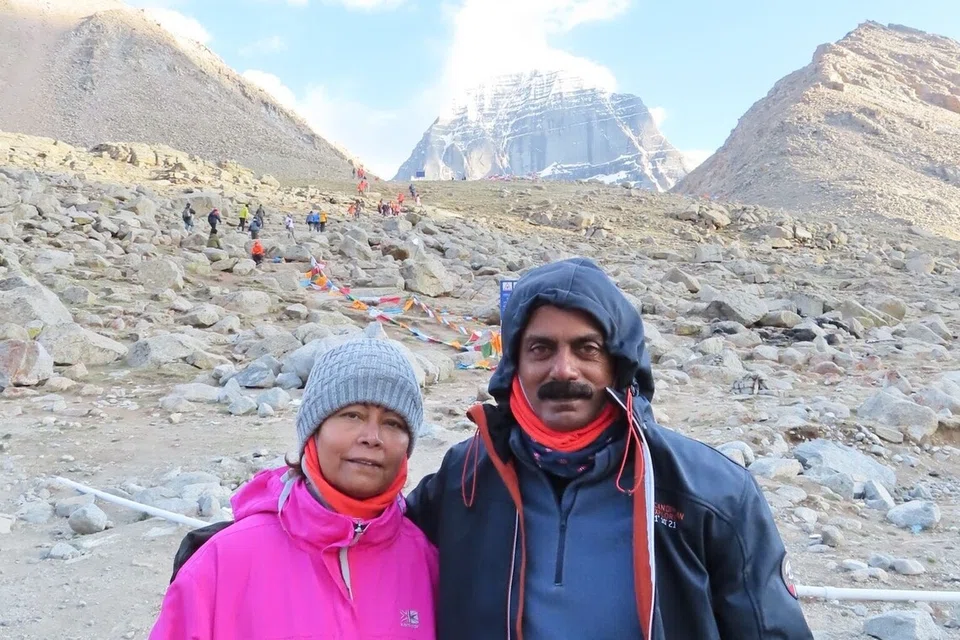
Though they felt blessed to experience the spiritual energy of Mount Kailash, they also expressed sadness over how poorly the sacred site is being treated.
Recalling her experience, Ms Vignesvary mentioned witnessing some people misusing the sacred water from Lake Mansarovar, a sight that left her feeling saddened.
How to prepare for high-altitude expeditions?
In conversation with Dr Kumaran Rasappan, 41, associate consultant in orthopaedic surgery at National University Hospital, the first Singaporean doctor to summit Mount Everest and a holder of an international diploma in mountain medicine, the answer to high-altitude success goes beyond physical readiness.
While he advises beginners to start with smaller climbs, which helps develop a personal routine to train and acclimatise, Dr Kumaran acknowledges that even the best-laid plans have their limits.
Even for those meticulously prepared, he warns: “No matter how Type A you are, or how much you’ve planned to mitigate risks, you will realise that nothing is truly in your hands.”
“The least fit person can sometimes perform remarkably well at high altitudes, while the fittest can fall ill.”
“There are two potentially fatal illnesses at high altitudes, High-Altitude Cerebral Edema (HACE) and High-Altitude Pulmonary Edema (HAPE),” Dr Kumaran noted. “The safest and most effective course of action, if someone shows symptoms, is immediate descent to a lower altitude.”
Dr Kumaran also stressed the importance of understanding personal objectives, as that clarity ultimately determines how far you are willing to push yourself.
“Leaving it entirely in the hands of God, like bungee jumping without equipment, is basically a death wish,” he said. “So prepare yourself as best as you can, but understand that once you’re up there, not everything is within your control.”