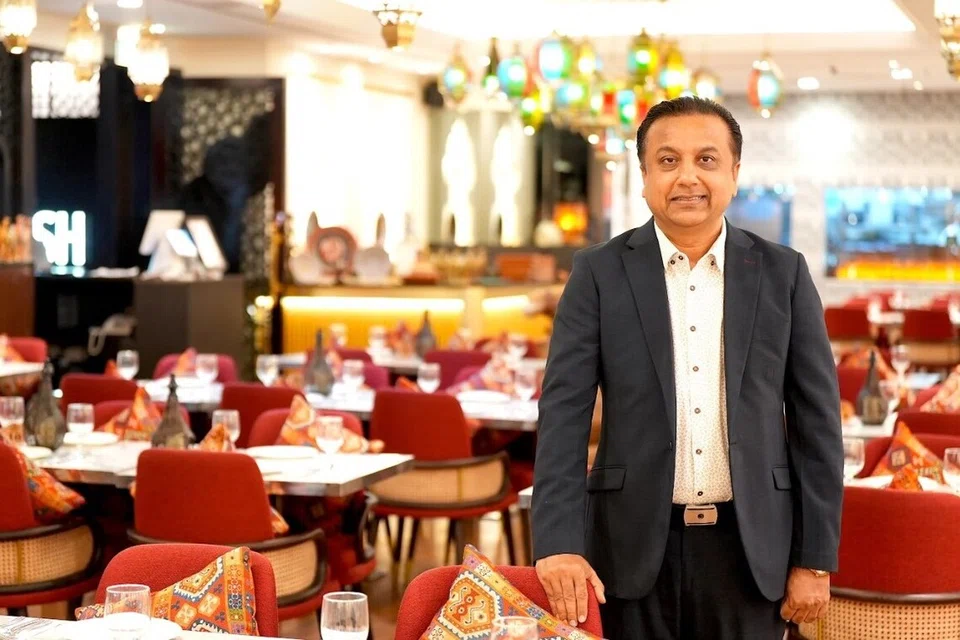

Landmark Restaurant owner Singapore Hospitality Group (SHG) - founded and led by Chief Executive Officer Ali Abbas, 56 - is growing its presence in the food and beverage industry through diversification, strategic growth and investment in food manufacturing both in Singapore and beyond.
With more than two decades of hospitality experience, Mr Ali has developed a diversified business encompassing restaurants, international halal buffets, catering, banquets, corporate events and food production.
The group operates five established hospitality brands: The Landmark Restaurant, Royal Palm Restaurant, Tarboush Restaurant, Bukhara Restaurant and Rasa Catering, across various locations in Singapore.
The Landmark at Village Hotel Bugis and Royal Palm at Orchid Country Club specialise in international halal buffets. Tarboush, operating at Village Hotel Bugis and Orchard Rendezvous Hotel, serves Turkish and Lebanese cuisine, while Bukhara at Orchard Rendezvous Hotel offers North Indian cuisine.
Rasa Catering provides corporate, institutional, wedding and social event catering services.
Beyond its restaurant portfolio, SHG manages 12 ballroom and event spaces across Singapore, including venues at Orchid Country Club, Downtown East, Chui Huay Lim Club and Furama City Centre. Its largest ballroom at Orchid Country Club can accommodate more than 1,000 guests. SHG Group has done more than 5000 weddings so far in Singapore.
How Strong Corporate, Government and International Clientele Help?
Over the years, SHG has established relationships with leading financial institutions, multinational corporations, government agencies and diplomatic missions.
It has served both past and present senior political leaders, including President Tharman Shanmugaretnam, as well as visiting heads of state and other distinguished guests.
Its corporate clientele includes the Big Three local banks as well as Standard Chartered and Citibank alongside educational institutions and businesses from other sectors. The group has also provided hospitality and event services involving major international corporations, such as Reliance Industries, Tata Group, Aditya Birla Group, Adani Group and Saudi Aramco.
With halal-certified operations, SHG has been positioned well to serve Singapore’s multicultural population and international clientele while accommodating diverse dietary requirements.
“Our success is built on trust, consistency, affordability and long-term relationships. We are grateful for the continued support of our customers, from local families to government institutions and multinational corporations,” Mr Ali said.
Adapting to a Changing F&B Landscape
Mr Ali believes Singapore’s F&B landscape has changed significantly since the COVID-19 pandemic over 2020 to 2023.
“If I compare the industry before COVID with today, I believe business volumes in certain segments have declined by more than 30%. Consumer behaviour has changed, while manpower, rental and operating costs have increased significantly,” he observed.
Despite these changes, SHG continues to focus on affordability, authentic cuisine, operational efficiency and diversified revenue streams.
Rather than relying exclusively on restaurant dining, the group has developed a business model supported by catering, banquets, hotel food services and manufacturing.
Food manufacturing is next strategic growth area
Through Rasa Foods Manufacturing, the group operates a central food manufacturing facility in Tampines, Singapore, producing a variety of cuisines to support its restaurants, catering, banquet operations and corporate clientele.
The facility is expanding from approximately 4,000 to 8,000 square feet, strengthening production capacity, operational efficiency and opportunities to supply a broader market.
“After many years in hospitality, I believe this is the right time to expand further into food manufacturing. It complements our existing businesses and creates opportunities for sustainable long-term growth,” Mr Ali said.
Mr Ali has also expanded into dairy manufacturing in Pakistan - where he originally hails from and is familiar - through two brands, Farm Fresh and Five Fingers.
The dairy operation has a stated production volume of approximately 70,000 litres of milk per day, with a diversified portfolio of around 28 stock-keeping units (SKUs).
Its product range includes mozzarella and cheddar cheese, plain and flavoured yogurt, bottled milk and flavoured milk, salted and unsalted butter, and desi ghee (clarified butter).
The business focuses on value-added dairy manufacturing, product quality, innovation and expanding market distribution.
Long-Term Vision and Succession
While Singapore remains the group’s principal hospitality market, Mr Ali is also exploring business expansion opportunities in Australia, Malaysia, Thailand, and the Middle East.
He sees food manufacturing as a complementary business pillar that will support long-term growth, operational sustainability and succession planning.
“Hospitality remains at the heart of our business, but diversification is essential. Our vision is to build a sustainable, professionally managed food and hospitality group with a strong foundation for future generations,” Mr Ali said.
Reflecting on his experience, he believes success in the F&B industry requires commitment, industry knowledge and a genuine passion for customer satisfaction.
“The F&B industry is extremely demanding. Success requires discipline, consistency, innovation and the ability to adapt to changing market conditions,” he concluded.
Amid his busy schedule, Mr Ali finds time to serve on industry boards to share his knowledge and expertise with the sector. As a board member of the Restaurant Association of Singapore (RAS), he works with other senior industry leaders to address structural sectoral challenges and transition towards digitalisation.
He is also active in philanthropy, often partnering with mosques and welfare associations to fund and host community iftars (breaking fast) during Ramadan and sponsoring weddings for lower income and less privileged couples.