While working on his final year project on the removal of microplastics from water bodies, Mr Sistla Satya Satvik found himself cooped up in his school’s lab from 8am to 6pm every day for months on end.
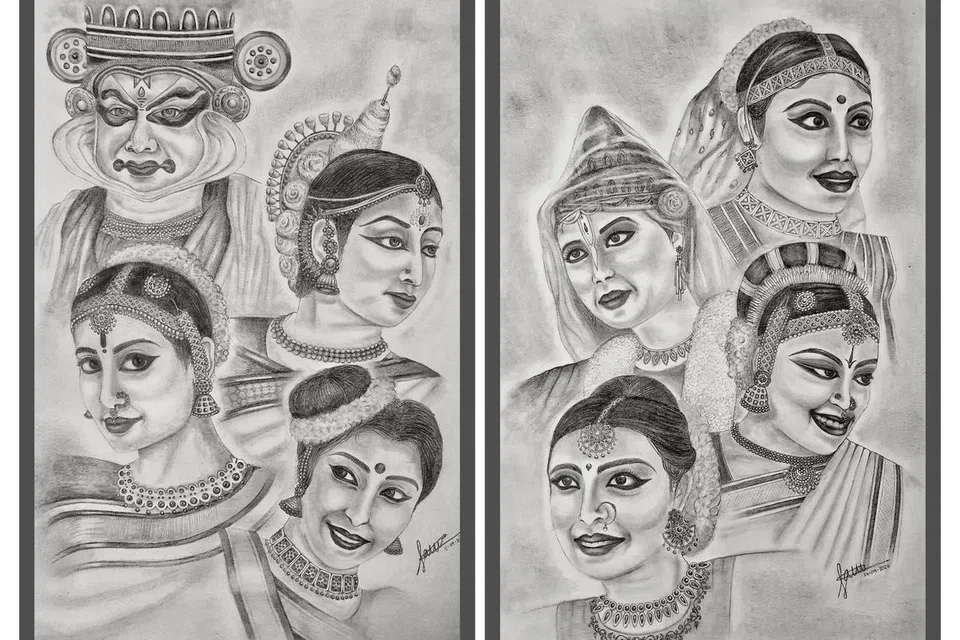
The 20-year-old chemical engineering student from Singapore Polytechnic desperately needed a distraction, which materialised into an A2-sized pencil sketch that celebrates eight Indian classical dance forms.
From Kerala’s Kathakali to Tamil Nadu’s Bharatanatyam and Manipur’s Manipuri to Assam’s Sattriya, the piece encapsulates both the diversity of the different Indian sub-ethnic cultures and their shared grace, appreciation, and discipline for dance.
Titled Nritya Rasa: The Essence of Dance, the artwork took Mr Satvik three months to complete. He spent a month on research and another two to sketch out the dancers during his free time after school from Dec 2024 to Jan 2025.
He found inspiration in his batchmates’ dance performances staged by his school’s Indian Cultural Society, where he had volunteered to be a photographer for a handful of events.
“When you take a picture, it freezes the dance in time. There are concepts like Nritya Bheda in Indian classical dance, the way dancers position their eyes to convey emotions, which a photograph is able to capture,” Mr Satvik explained.
He wanted to do the same, except with a pencil. “Dance needs colour, but I don’t use colour. It was a challenge to myself, to force myself to bring out the same essence without colour,” Mr Satvik added.
While he has experimented with art styles such as acrylic painting and soft pastels, he has gravitated towards pencil sketches in the past two years. “I was fascinated by how a single colour could still depict different shades and details,” Mr Satvik said.
His artistic journey started at the age of six, during a visit to the Sri Vadapathira Kaliamman Temple at Serangoon Road. He was awestruck by the paintings of deities on the temple’s ceiling.
“The way they matched the colours, the jewellery, the sarees, and the foldings made me really excited,” Mr Satvik recalled.
However, his earliest attempts at art were far from perfect. “The face wouldn’t come out exactly as I had pictured, or the necklace, one part would be bigger than the other,” he said.
He did attend neighbourhood art classes for about two years in lower primary, but felt dissatisfied as the lessons focused largely on nature and architectural sketches, while Mr Satvik was more drawn to temple-style art.
“I decided to look up pictures on Google and learn it on my own,” he said.
He also turned to YouTube tutorials, and Instagram accounts dedicated to traditional Indian art, such as @maha_art_95 and @vishnuprabhanc, for tips and techniques.
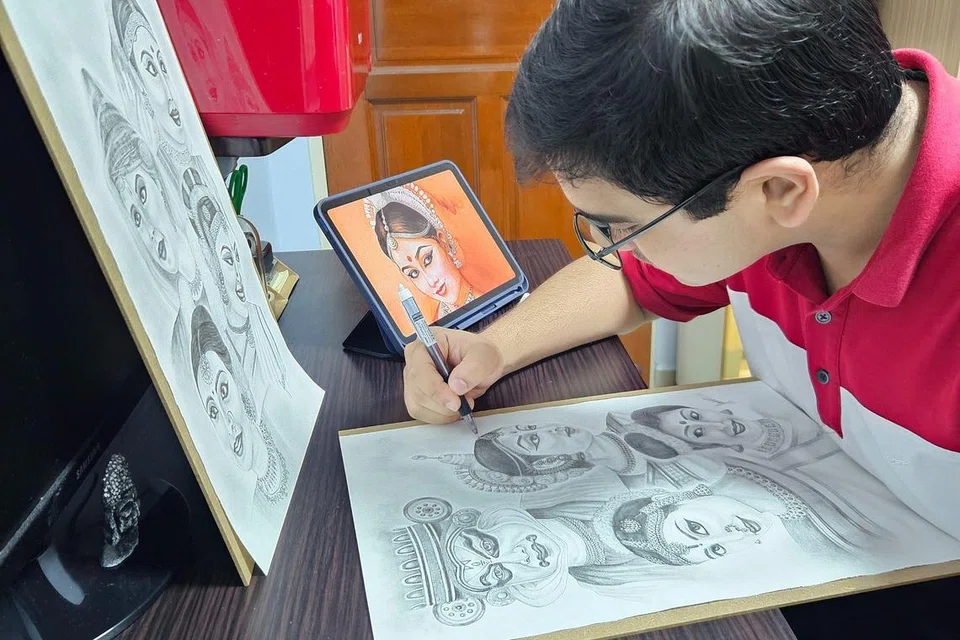
Mr Satvik’s Nritya Rasa features eight dancers, each embodying an Indian classical dance form. His personal favourite is the Kuchipudi dancer (third from the top on the right), a dance form that traces its origins to his home state of Andhra Pradesh.
His family relocated to Singapore when he was two years old. His father is a chemical engineer while his mother is a housewife, who often guides and gives feedback on Mr Satvik’s artworks. He also has an older brother, who’s an electrical engineer.
“A misconception is that Kuchipudi and Bharatanatyam are very similar in terms of outfits and movements. The thing that sets them apart is the Sikha, a traditional headpiece arrangement only worn by Kuchipudi dancers,” Mr Satvik explained.
From the headpieces and ornaments to the makeup and facial expressions, each detail is factually accounted for, demonstrating the self-taught artist’s reverence for the dance forms.
“This piece is especially close to my heart, and I created it to inspire cultural pride and curiosity among the younger generations,” Mr Satvik said.