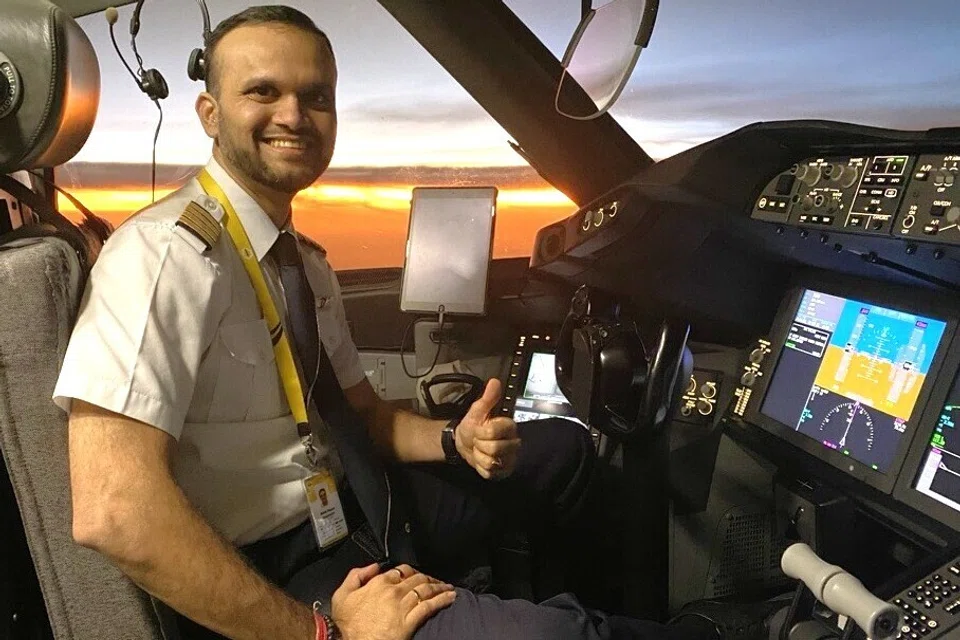

After soaring the skies for nearly two decades, Captain Nikhil Hegde Nagarajan has decided to give back to aviation by helping to train new pilots in a more managerial, mentorship role.
Captain Nikhil, 43, is a Scoot B787 captain, the top of the hierarchy of command on a Boeing 787 Dreamliner flight, and has been with the airline since 2015. He now also holds the title of Associate Management Pilot (AMP), Flight Operations Training and Standards (FLT Ops Training & Standards).
This new role allows him to continue flying while also being more involved with training new pilots in Scoot’s fleet, among other operational responsibilities.
Being a pilot wasn’t always in the skyline of his life, as he graduated from the National University of Singapore with a Bachelor of Computing (Honours) in Computer Science and spent his first few years managing a start-up.
When some of his entrepreneurial endeavours failed, he came across a Singapore Airlines cadet programme and decided to apply with his parents’ support.
“Having always been fascinated by vehicles since my youth, be it bicycles, motorbikes, cars, aviation felt like a natural extension of that interest and the next step in pursuing my passion,” he said.
Aspiring pilots can get their Commercial Pilot Licences through two routes: train from the start with an airline like Scoot, which partners with Singapore Flying School to train its applicants, or train independently first and then apply to an airline.
Flight school wasn’t as “romanticised” as people think, with long hours of physically demanding and mentally strenuous training.
But just studying and knowing how to handle the control panel isn’t the only skill that makes a good pilot.
“While much of our work takes place in the cockpit, at its core this profession is people-centric,” he said. “Every passenger on board has somewhere important to be, and it is our job to get them there safely and comfortably.”
Seventeen years of flying later, he continues to keep all his learnings to heart, but eventually realised he wanted to pass on this knowledge.
“I wanted to experience a different role, and when the management opportunity came up, I decided to take it,” he said, “At the same time, I felt a genuine desire to give back to the next generation of aviators.”
He said more Singaporeans should aspire to be pilots as the island is one of the world’s busiest air hubs and therefore they would be contributing to a “cornerstone” of the local economy.
At the Singapore Airshow 2026 in February, Deputy Prime Minister Gan Kim Yong said that the aviation and aerospace sectors will be the twin, reinforcing engines of growth for Singapore’s economy, as reported by The Straits Times.
Changing roles has also improved Captain Nikhil’s time with his family, as compared to the hectic rostering of flight schedules, he now follows regular office hours. “This shift has made it easier to be consistently present at home and spend more time with my family.”
More time with his family means that he’s able to switch off from the job, improving his mental well-being.
“My older son attends martial arts lessons, and accompanying him to his classes gives me dedicated time with him,” said Captain Nikhil. “I enjoy watching him train, encouraging him from the sidelines, and sometimes sparring lightly with him after class to share in his progress.”