India has a vast market and an enormous talent pool. Singapore has capital, infrastructure expertise and ambitions to expand internationally.
For Mr Piyush Gupta, Chairman of Keppel and Singapore Management University (SMU) and former DBS Group CEO, the economic partnership between the two countries is a natural fit.
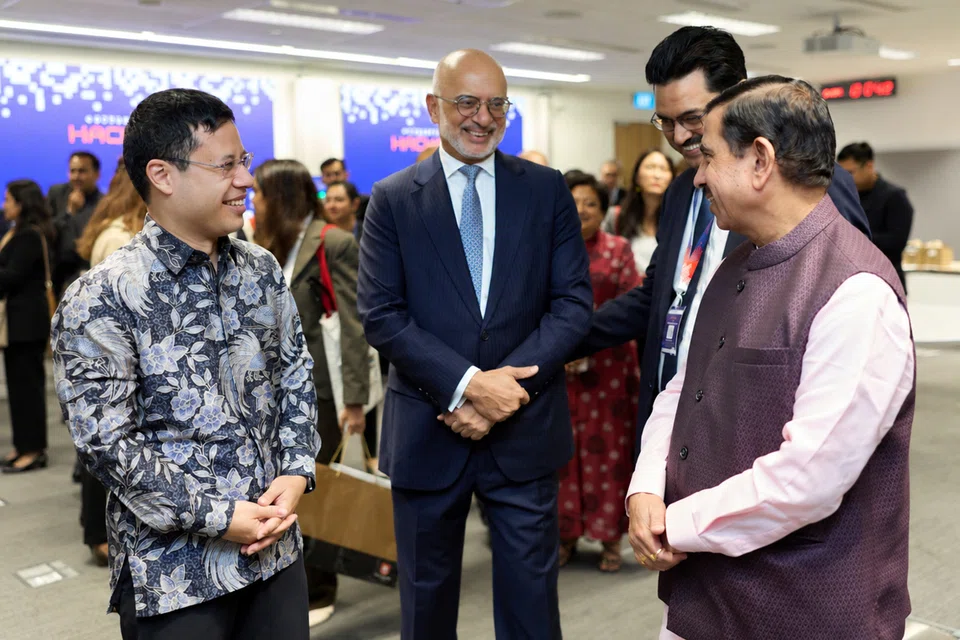
“In some ways, it’s a match made in heaven,” he told tabla! in an exclusive interview on the sidelines of the Singapore-India Hackathon and TiEcon SG 2026 at SMU on Nov 17.
However, despite considerable progress in bilateral investment, trade and government-level cooperation, Mr Piyush believes much more needs to be done to encourage the movement of entrepreneurs, professionals, and students between the two countries.
“Mobility is the best input driver for economic success and growth,” he said.
Having witnessed the evolution of Singapore-India economic relations over several decades, Mr Piyush is particularly encouraged by the warmth between the two governments today.
He compared the current environment to the period when former Singapore Prime Minister Goh Chok Tong championed an “India fever” among Singapore businesses.
“The trust between the senior ministers in India, the ministers in Singapore... they talk freely and openly,” he said.
Initiatives emerging from the India-Singapore Ministerial Roundtable and bilateral business dialogues are also gaining traction, particularly in skills development.
Singapore companies, meanwhile, are expanding their Indian operations across telecommunications, aviation, ports, logistics, commercial property, renewable energy, and banking.
Singapore was India’s largest source of foreign direct investment in FY2025–26, contributing US$19.8 billion, while cumulative investment inflows from Singapore since 2000 have exceeded US$194 billion.
Mr Piyush identified infrastructure as a particularly promising area, given India’s development requirements and Singapore’s expertise in managing real assets.
For Keppel, opportunities include sustainable real estate, waste-to-energy plants, district cooling systems, data centres, and subsea cables. Energy infrastructure is another area the company could explore.
He acknowledged that doing business in India has become considerably easier over the past decade, although regulatory challenges vary across states.
His biggest concern remains retrospective policy changes, which create uncertainty for investors.
“As long as the rules are defined going forward, then you can play by the rules,” he said.
Bridging the talent gap
Mr Piyush believes insufficient cross-border mobility is preventing both countries from fully capitalising on their complementary strengths.
Indian entrepreneurs need international exposure and a better understanding of global markets, while Singapore entrepreneurs must appreciate India’s cultural nuances and business practices.
Singapore, he said, offers Indian start-ups an excellent starting point for international expansion.
Short-term exchange programmes are relatively straightforward, but longer-term mobility presents challenges involving employment and residency requirements.
Mr Piyush pointed to Singapore’s Complementarity Assessment Framework (COMPASS) as a mechanism through which suitably qualified Indian talent could access opportunities in the Republic.
He stressed the importance of expanding exchange programmes beyond students to entrepreneurs and working professionals.
Education beyond classrooms
As SMU chairman, Mr Piyush sees considerable scope for educational institutions in both countries to collaborate in preparing future-ready talent.
Traditional classroom learning, he said, must increasingly be complemented by internships, apprenticeships and practical exposure.
He also advocated greater collaboration in applied research, particularly in artificial intelligence, technological development and understanding changing human behaviour.
SMU has established an India advisory council and developed partnerships with Indian institutions, including the Indian Institute of Management Ahmedabad.
However, Mr Piyush described existing initiatives as merely “a drop in the ocean”, emphasising the need to scale up academic cooperation substantially.
The Singapore-India Hackathon, which brought together 120 students from both countries from Nov 15 to 17, exemplifies the kind of collaboration he wants to encourage.
Stepping outside comfort zones
Drawing on his own career, Mr Piyush urged young professionals from both countries to venture beyond familiar environments.
His experience working with Citibank in Singapore, Indonesia and Malaysia helped him develop a deeper understanding of the region.
During his tenure at DBS, he encouraged Singaporean employees to undertake assignments in India.
Many returned with significantly broader perspectives, describing their experiences as among the most valuable of their careers.
“There is no substitute for hands-on practical experience because otherwise it’s all theoretical,” he said.
For Mr Piyush, the next chapter of Singapore-India relations must be built not merely on government agreements and corporate investments, but on enduring relationships between people.
The greater the exposure young Singaporeans and Indians have to each other’s countries, the stronger that partnership will become.