An online relationship between a Singaporean Malay woman and a Turkish man eventually led to the formation of a close-knit cross-cultural family of six.
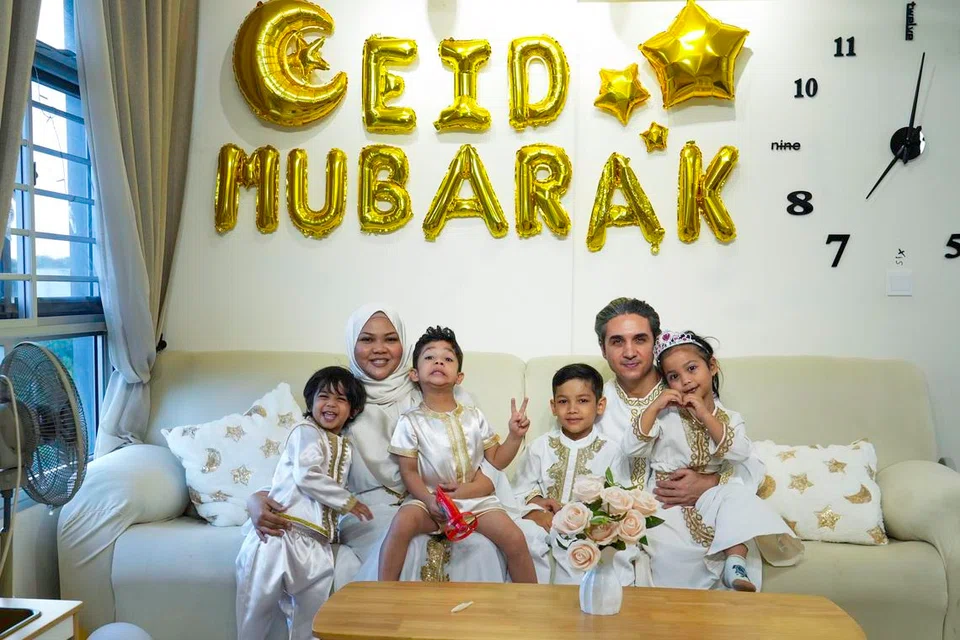
As Ramadan, the holy month of fasting, draws to a close, the family gears itself up for a joyous celebration with family and friends this Hari Raya Puasa.
Family visitors popping by over at the flat of couple Yasmin Balik and Burak Balik at Upper Jurong Road would be greeted by gales of laughter, play and joyful shouts.
Their journey began in 2016, when Mr Burak moved from the Turkish coastal city of Izmir to Singapore after a two-year online courtship and his family’s blessing.
“Initially, we had a long-distance relationship. My brother managed to come to Singapore earlier and met my then-girlfriend. After their interaction, I came shortly after. Our relationship progressed quickly within a few months into a decision to marry,” the 37-year-old operator said.
The couple acknowledged that the rapid marriage came with its challenges. Along with personal habits, the cross-cultural differences were huge.
For starters, the simple act of eating became a cross-cultural hurdle early in their marriage.
Mr Burak was initially taken aback by the Singaporean custom of eating with the hands, a practice he found difficult to reconcile with his upbringing in Izmir, where hands were considered unclean for dining.
“He’ll be like, ‘can’t you just eat with a spoon?’ And I’m like, ‘no, it’s nicer with hands’,” Yasmin, who is also 37 years old, recalls their lighthearted but honest friction. “Sometimes I’m eating with my hands still.”
Beyond the dining table, the couple had to harmonise their temperaments and social expectations.
Mr Burak observed that Turkish men are often more “hot-tempered,” frequently fighting in traffic over simple things, whereas he finds Singaporeans much calmer.
He cautiously noted that the independent thinking and behaviour of women in Singapore was a “good thing”, and something he had to get used to.
“I thought to myself that we are a family now, and that God had put us together to care for each other no matter what. So we had to make it work,” he said.
And so they did. Their eldest son, Bilal Balik, is eight years old, followed by six-year-old Meryem, four-year-old Hud Balik, and three-year-old Yunus Balik.
“We are family now. We have merged our lives and how we have to accept each other. We are mature enough to accept that.”
While the Malay community in Singapore largely follows the Shafi’i school of thought, Mr Burak’s Turkish roots are grounded in the Hanafi tradition. Both are schools within Sunni Islam.
Cultural practices in Turkey differ significantly from those in Southeast Asia.
Even observing Ramadan brought surprises; Ms Yasmin was shocked during a visit to Turkey to see people eating and drinking freely during the fasting month.
“I completely did not expect that,” she said, with a bemused chuckle. Mr Burak explained that while this was true for the urbanised areas in Turkey, there are conservative parts of the country that are strict in their religious observances.
In Singapore, Mr Burak said he was deeply moved by the thoughtfulness of his non-Muslim Chinese colleagues who avoid asking him to buy them lunch out of respect for his fast.
As the family prepares for Hari Raya, the celebration serves as a beautiful synthesis of their identities.
Ms Yasmin said she finds this year is particularly special because Mr Burak, who usually wears westernised clothing like collared shirts, has finally decided to embrace the local Malay tradition of wearing a matching family colour and a traditional costume.
While Mr Burak still finds local spices “overwhelming” and misses the natural, separate ingredients of Turkish cuisine – like fresh cheese and Sujuk – he has found a different kind of nourishment in the island’s social fabric.
He is moved by the safety he feels in Singapore. “Everybody respects each other, professes their beliefs, and practices their religions freely,” he said.
For Ms Yasmin, the beauty of their relationship lies in how her community has embraced Mr Burak as one of their own.
She watches her children bridge the gap daily, using Turkish words like ‘Abi’ for big brother and ‘Abla’ for big sister, even when it confuses local Singaporeans who use ‘Abi’ to mean “father” in Arabic.
“I’ve never seen any discrimination or any bias towards him throughout my marriage. For this, I would like to thank all Singaporeans for accepting all cultures and all races,” Ms Yasmin said.