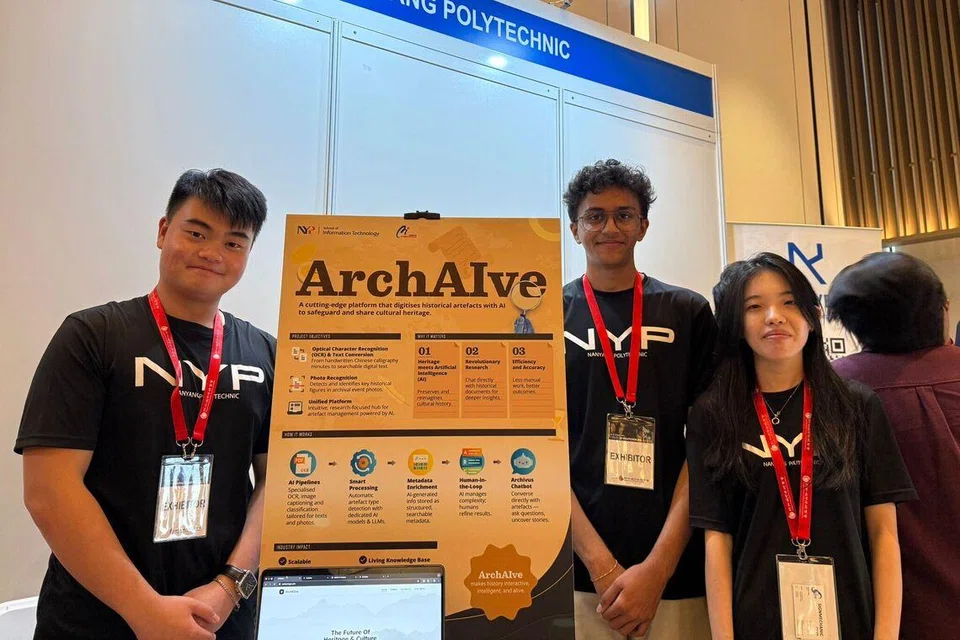

When 20-year-old Prakhar Trivedi first began working on a school project to help digitise historical artefacts, he did not expect it would evolve into a startup with the potential to transform how people access and experience cultural heritage.
Today, the Nanyang Polytechnic Information Technology graduate is one of three co-founders behind ArchAIve, an AI-powered platform that is helping heritage institutions bring centuries-old records and artefacts into the digital age.
Founded by Mr Trivedi together with fellow students Joon Jun Han and Toh Zheng Yu, ArchAIve offers an end-to-end solution that digitises, organises and presents historical collections through interactive online galleries and artificial intelligence-powered tools.
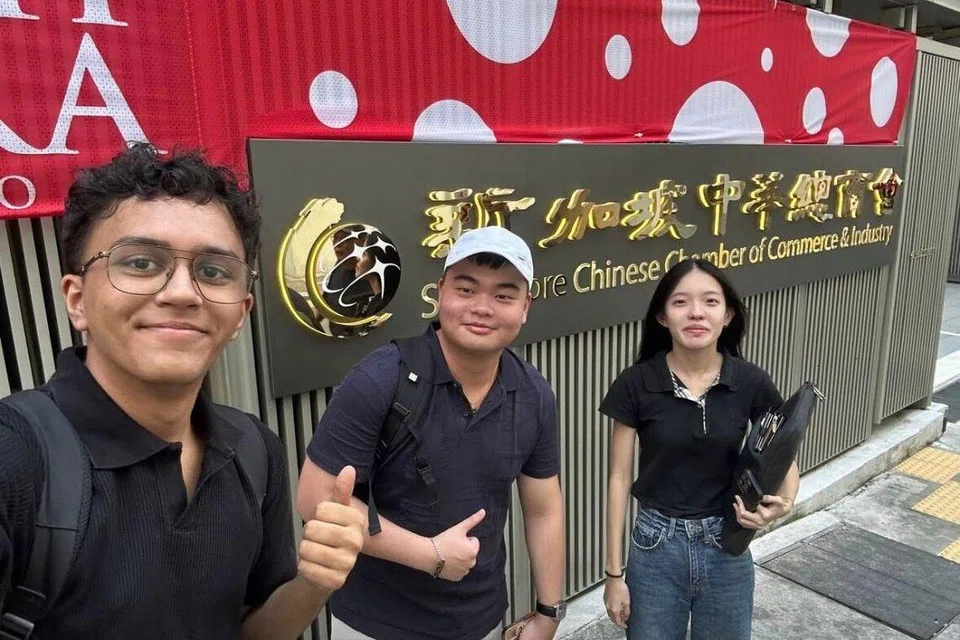
The startup is already conducting a pilot deployment with the Singapore Chinese Chamber of Commerce and Industry (SCCCI), where it is helping digitise historical documents, photographs and artefacts that date back more than a century.
For Mr Trivedi, whose parents migrated to Singapore from Ahmedabad in the Indian state of Gujarat in 1998, the project represents more than just a technological achievement.
“It made me appreciate how technology can bring cultures together,” he said, noting that the platform enabled him, despite his Indian heritage, to gain a deeper understanding of Singapore’s Chinese history through translated and digitised records.
ArchAIve began as a proof-of-concept project developed during a school module after the team took up SCCCI’s challenge of digitising up to 2,000 historical artefacts.
What started as an academic exercise soon revealed a wider opportunity.
The trio discovered that many heritage institutions possess valuable archives that are preserved physically but remain largely inaccessible to the public due to language barriers, fragile materials and the labour-intensive nature of cataloguing and research.
“We saw a sizeable gap between innovation and the demanding needs of heritage preservation,” said Mr Trivedi. “We realised ArchAIve could make culture far more accessible to younger generations who are comfortable with technology but may know little about history.”
Using artificial intelligence, the platform streamlines three key stages of heritage management – digitisation, curation and public education.
Its technology can analyse handwritten documents, generate metadata, categorise artefacts, assist with research and create public-facing digital galleries. The system also features an AI-powered chatbot called Archivus, which allows users to interact with historical collections conversationally and explore artefacts based on their curiosity.
The platform leverages Alibaba’s Qwen visual language models and can process historical scripts, recognise faces in archival photographs, generate translations and summarise content.
According to the founders, AI can reduce processing time and manual effort by up to 90 per cent, while still maintaining a human-in-the-loop approach to ensure accuracy and verification by heritage professionals.
One of ArchAIve’s most promising future applications lies beyond Chinese-language archives.
Mr Trivedi said preliminary experiments involving Malay Jawi and Sanskrit Devanagari scripts have produced encouraging results, raising the possibility of digitising and preserving heritage materials in Indian and other Asian languages.
“As visual language models continue to improve, we are confident the platform can support more Indian languages and scripts in the future,” he said.
The founders believe this capability could help unlock vast collections of historical records across South Asia and Southeast Asia while making them accessible to younger generations through translation and interactive storytelling.
Looking ahead, the trio plans to expand ArchAIve beyond archival storage and create richer public experiences through immersive online galleries, AI-guided exploration and multilingual access.
They are already in discussions with additional heritage institutions and clan associations in Singapore and hope to bring the technology to museums, cultural organisations and archives across the region.
For Mr Trivedi, the ultimate goal is simple.
“AI has the power to democratise access to culture,” he said. “If people from different backgrounds can learn about each other’s histories and traditions more easily, it can help bring communities closer together.”