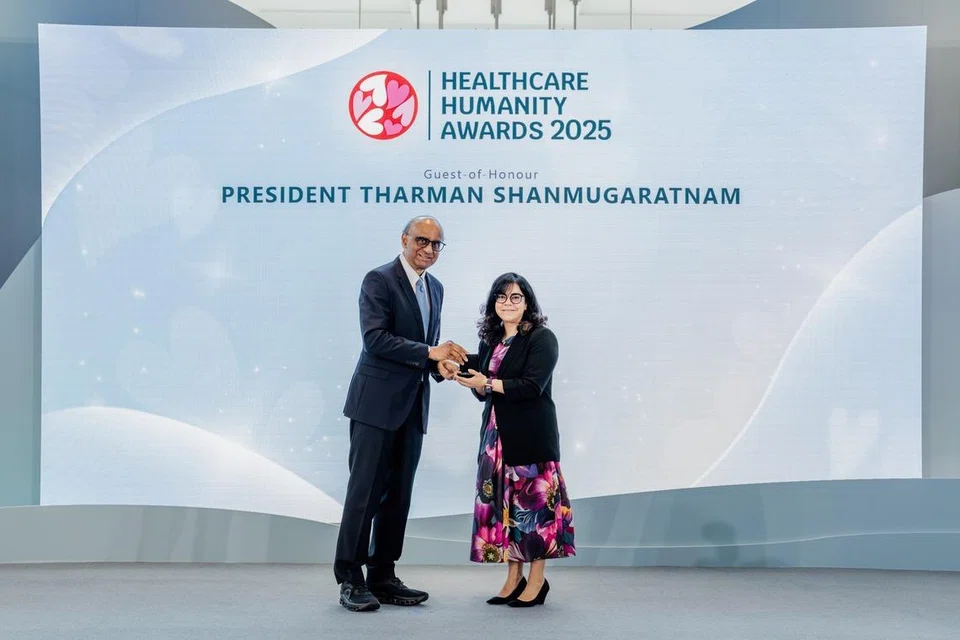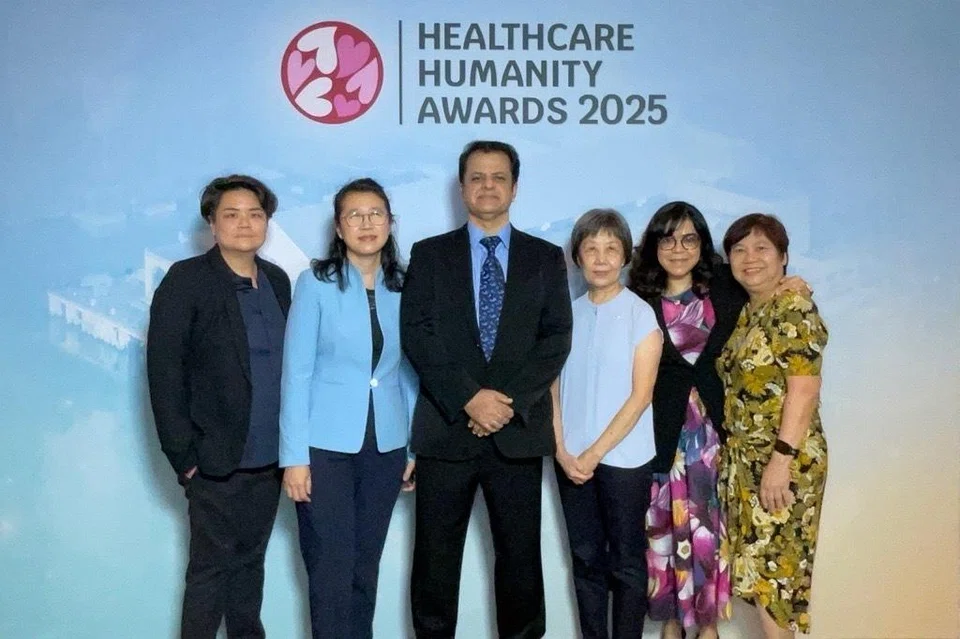
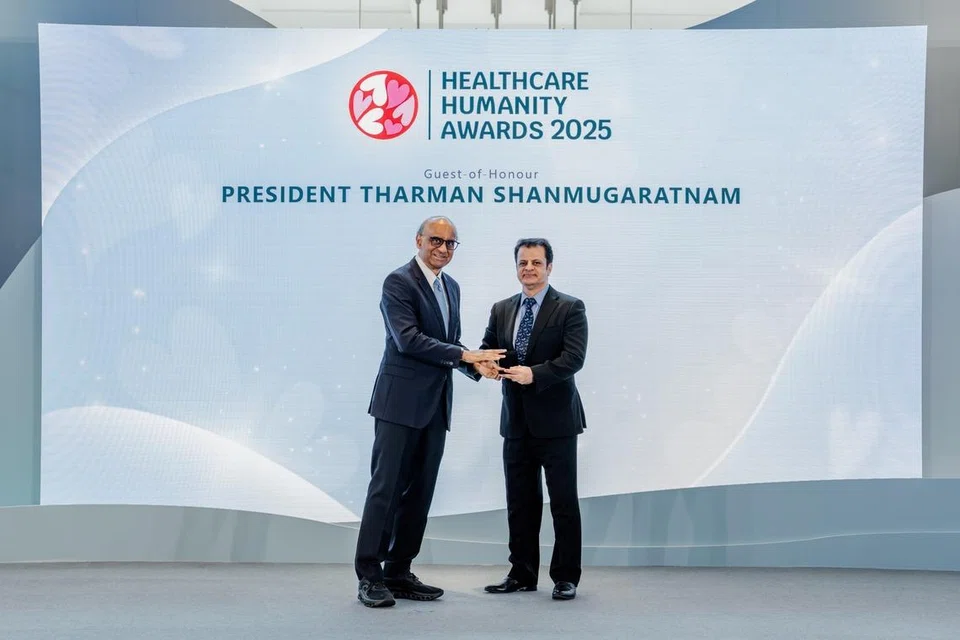
Hundred recipients, including 17 individuals and six teams from NHG Health, were recognised at the Healthcare Humanity Awards 2025, which honoured those who go above and beyond the call of duty to provide care and comfort.
“Our healthcare professionals meet people when they are down and help them find strength again. It is deeply human work,” said President Tharman Shanmugaratnam in a press release on the awards ceremony, which was held at The Clifford Pier restaurant on Nov 6, 2025.
The recipients included Dr Surendra Kumar Mantoo, 55, a colorectal surgeon, and Dr Mansha Khemlani, 48, a palliative care specialist, from Khoo Teck Puat Hospital (KTPH).
Dr Surendra was drawn to medicine from a young age, influenced by a family friend who was also a doctor that the community highly regarded. “Everyone would address him as sahab, which means sir in Hindi. It made me think that being a doctor means you are doing a respectable job,” he recalled.
As a Kashmiri, he started his first year of medical school in the Kashmir Valley, but due to political unrest in 1990, he migrated to Madhya Pradesh to complete his education. He then moved to Delhi for his surgical training before relocating to Singapore in 2003.
“When I was a surgical trainee, we used to see a lot of patients with colorectal cancer. I wanted to help them get rid of these cancers and live a long, fulfilling life, so I decided to pursue a career in colorectal surgery,” Dr Surendra said.
He has performed over a thousand surgeries in the past 20 years, and currently undertakes four to five major operations each week at KTPH, such as colon resections, with a team that typically consists of a senior and junior trainee surgeon, and a specialist when needed.
Dr Surendra also teaches as an adjunct associate professor at the medical schools of the National University of Singapore and Nanyang Technological University.
“Being a surgeon is a tough job, as you need to focus. You need to prepare yourself mentally, especially when it comes to complex surgeries,” he noted.
There was a past incident when a fellow senior surgeon was mentally and physically worn out after a long, hard day at work. Though his shift had ended, Dr Surendra stepped in to perform an emergency operation on a patient with obstructive colorectal cancer at his colleague’s request.
“It was my daughter’s birthday, so we had a family dinner planned, but I said yes, I will do it, without hesitation. I had to message my wife because I didn’t dare to call her, but she understood my situation,” he explained.
Colorectal cancer is the most common cancer in Singapore and can affect patients for up to 10 years after surgery or treatment, Dr Surendra pointed out.
To address this, he introduced colorectal cancer follow-up clinics at KTPH that follow a structured protocol that trainees refer to, reducing wait times and ensuring nothing is overlooked, so patients can live longer, cancer-free lives.
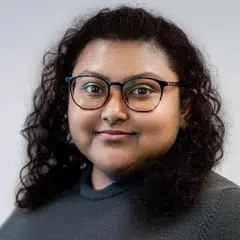
His passion is echoed by Dr Mansha, who has spent the past 25 years as a palliative care specialist. She describes palliative care as an approach where the focus is on the quality of care for patients who have been diagnosed with an advanced or terminal illness.
“Palliative care was a relatively new speciality, so I only got exposed to it when I started work as a doctor. It is not about fame and fortune because my patients are all going to die, but it is humbling and very meaningful. I think that’s why I wanted to pursue it,” she explained.
Born into a fourth-generation Sindhi family in Hong Kong, Dr Mansha speaks Cantonese and graduated from the University of Hong Kong’s Faculty of Medicine in 2000. She worked in Hong Kong for 13 years before relocating to Singapore in 2013 to join KTPH as its only full-time palliative care specialist.
During the Covid-19 pandemic, she developed safe ‘Compassionate Discharge’ pathways with KTPH’s Infection Control team, enabling patients to spend their final moments in their homes or with loved ones. In 2024, 57 patients were compassionately discharged.
“Sometimes, younger doctors don’t see the bigger picture. Not all patients are worried about fixing things; they just want to be made comfortable and be in an environment where they’re at peace,” Dr Mansha noted.
Her youngest patient was 18 years old, while her oldest was over a hundred years old.
“You can imagine the difference when an 18-year-old is told they have very little time versus someone who’s lived a good life,” she said. “Their needs are different, their families are different, so it requires a lot of exploration and communication to try and understand how best we can help them.”
These needs can be physical, psychological, social, and spiritual, so Dr Mansha and her current team of four full-time specialists, two junior doctors, four full-time nurses and trainees, also work with social workers, dieticians, therapists, and pharmacists to provide holistic care for about 40 to 50 patients at any given time.
“As much as this award is mine on paper, it really is teamwork,” Dr Mansha said.