Mdm Ajmer Kaur, 64, speaks six languages. The eldest of four children, she and her siblings, like many in their generation, learned conversational Punjabi at home through their parents.
This informal education continued through regular visits to the gurdwara, where their proficiency in the heritage language increased over time with the recitation of Sikh hymns and prayers.
In school, Mdm Ajmer studied English and took Malay as her mother tongue subject. She also picked up basic Tamil, having grown up immersed in the local Indian community.
Her past employment at a Japanese firm, combined with her current role as an assistant project manager at a Korean train manufacturing company, allowed her to acquire a working knowledge of both languages.
Yet the language Mdm Ajmer identifies with most is English. “Why? Because it’s our first language and the most used and spoken,” she explained.
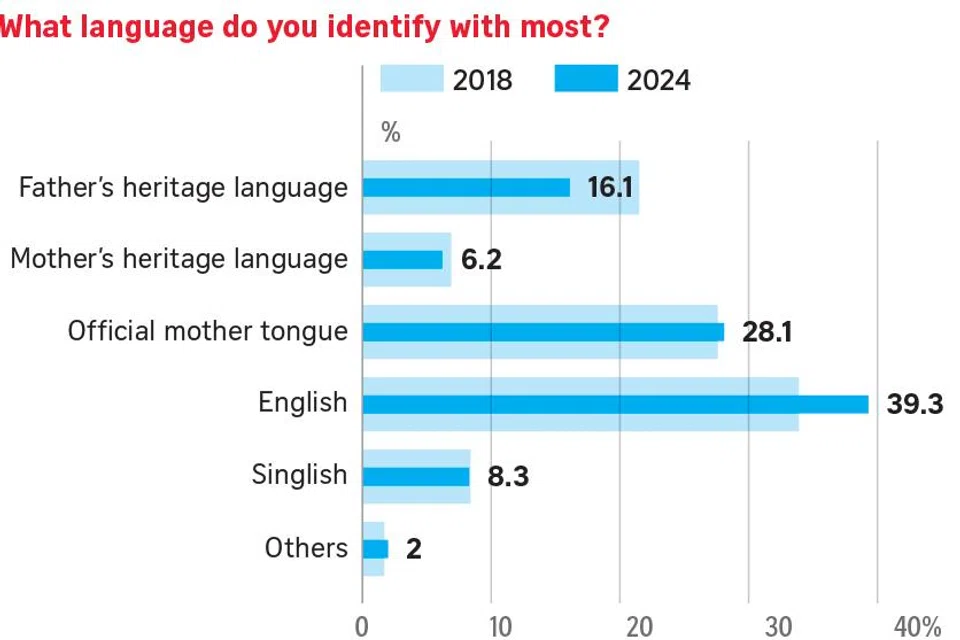
Her stance aligns with the views of the majority of the 4,000 respondents in the latest Institute of Policy Studies (IPS) survey. The Language Identity and Management in Singapore study conducted in 2024 found that English was the language most commonly identified with, at 39.3 per cent.
It included a booster sample of 1,000 Indian and Malay respondents to support finer-grained comparisons with previous iterations of the IPS study on race, religion, and language. The results were published on May 25, 2026.
Consequently, the proportion of the population identifying most with mother tongue or heritage languages decreased from 65.1 per cent in 2013 to 50.4 per cent in 2024. However, there was a renewed interest in using heritage languages with friends or in social settings.
In 2024, 61.4 per cent of respondents reported they could speak their heritage language at least well, up from 53.7 per cent in 2018. The number of people using heritage languages “often or very often” more than doubled, from 10.5 to 23.5 per cent in the same period.
Compared with other racial groups, Indians were more likely to use their heritage languages among their peers. Although this is more common amongst older people, Mr Sunith Sunil Mani, 22, is an encouraging exception.
The undergraduate at the National University of Singapore (NUS) is trilingual. He is fluent in English and Tamil, which he chose as his mother tongue in school, as his heritage language, Malayalam, was not offered as an option at that time.
“Tamil resembled Malayalam the most. My father had also picked up Tamil when he was working in Chennai for a while, so it was the natural choice,” Mr Sunith said. “I speak Malayalam at home mostly, interspersed with English depending on the scenario.”
He added that Malayalam allowed him to form stronger bonds with his grandparents and older relatives, a point echoed by Mdm Ajmer regarding the importance of learning and using one’s heritage language.
In more formal environments, such as at school or work, he prefers English. However, in his daily conversations, Mr Sunith code-switches between Malayalam and Singlish, as he identifies with both languages equally.
“I was raised until the age of 3 in Kerala before moving to Singapore. Having spent the better part of my life here, I believe that Singlish has embedded itself into my life,” he noted.
The IPS study ultimately outlined an overall shift towards the increased identification with Singlish, and its everyday use in both social and workplace environments, with 80 per cent of those who are younger saying they speak the colloquial language well.
In contrast, the Singlish proficiency amongst Indian respondents was much lower compared to other racial groups, with 18.1 per cent unable to speak or perform tasks in the language.
“One potential reason could be the relatively heavier incorporation of Chinese vernaculars and Malay vocabularies and syntax in Singlish, compared to Tamil,” the IPS study noted.
Ms Christina M, 30, a management professional, confessed that she identified more with Singlish when she was younger, as her friend group were mostly Malay and Chinese.
She studied both English and Tamil in school, the latter being her mother tongue. Her family actually has some Telugu roots.
“No one speaks it at home, and I never learnt it, so it got completely lost after my grandparents’ generation,” Ms Christina said. “Now that I’m older, I have started to appreciate Tamil and Indian culture so much more.”
She also observed that being a multicultural and multilingual society, “we sometimes struggle to identify what’s uniquely Singaporean that all our ethnic groups can relate to”.