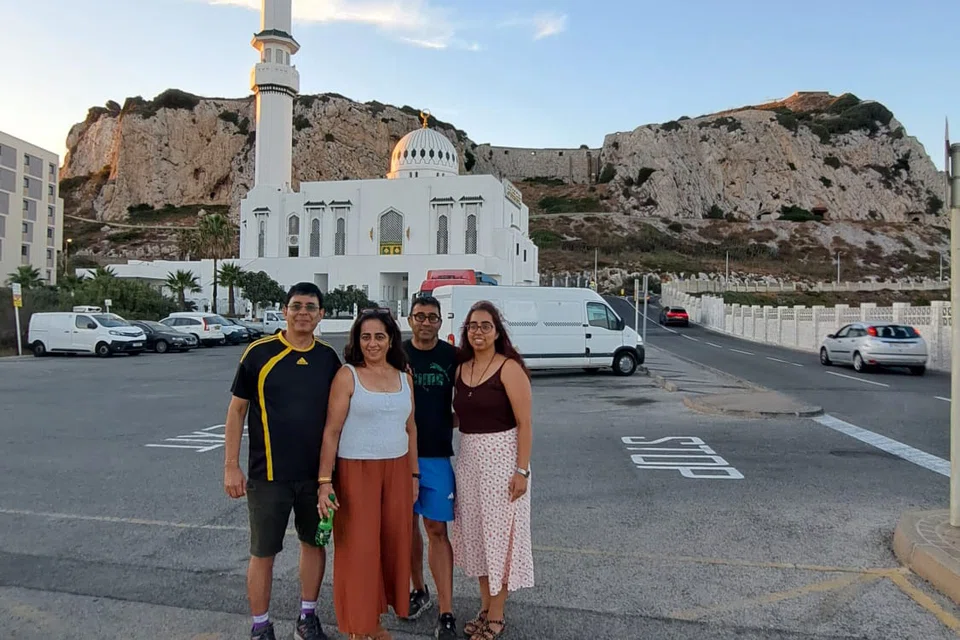

One of the first things that strikes Indians from Gibraltar when they arrive in Singapore is how familiar it feels.
Both islands are small territories at strategic maritime crossroads, shaped by trade, migration and the challenge of making people of different cultures feel at home.
Ms Sonia Bhojwani, who moved to Singapore from Gibraltar in 1998 as a 26-year-old bride, said: “Growing up Indian in Gibraltar also meant negotiating a cultural cocktail that would be perfectly understandable to a Singaporean.”
Gibraltar’s multicultural identity incorporates British, Spanish, Genoese, Portuguese, Maltese, Jewish, Moroccan and Indian influences.
While English is the official language and the medium of education, Spanish permeates everyday life in Gibraltar. There is also Llanito, a lively blend of English and Spanish that, like Singlish, reflects the mixing of languages in daily conversation.
Yet, Gibraltar, measuring just 6.53 sq km, is no Singapore. It has no world-famous skyline. Instead, it has the Rock, an enormous limestone formation that dominates the landscape.
And, for more than 150 years, Indians have been part of its distinctive community.
Their story began around 1870, following the opening of the Suez Canal, when traders from Sindh, now part of Pakistan, arrived to establish businesses as merchants and craftsmen.
Like their counterparts in Singapore, these pioneers recognised that a strategically positioned port was not merely a place to trade, but somewhere to build businesses, raise families and establish roots.
Further migration followed, especially after the 1947 Partition.
Today, family-owned Indian businesses remain a familiar presence along the territory’s famous Main Street, dealing mainly in electronics and luxury goods.
Meanwhile, newer Indian expatriates and the younger generation have found opportunities in the finance and technology sectors.
Seventeen-year-old Rishi Hariramani, who has lived in Gibraltar since 2018, offers a glimpse into everyday life.
He said: “Like many young Indians here, I don’t speak Hindi or Sindhi fluently; these aren’t used widely outside family settings. Even so, our Indian heritage never feels far away.
“Gibraltar’s multicultural spirit also makes blending in feel completely natural. We might join in local Gibraltar festivities one evening, cross the frontier into Spain the next morning, and then gather with the Indian community for a get-together all within the same week.”
He added: “What makes life here so special is that no one has to choose one identity over another: we can be Indian and Gibraltarian simultaneously.”
The Gibraltar Hindu Temple, opened in 2000, remains an important spiritual and cultural centre and the annual Deepavali Ball is now an established fixture on the island’s social calendar.
Yet, as in Singapore, the young Indian generation is increasingly willing to marry outside the community or leave Gibraltar in search of better opportunities.
There are, of course, important differences between the two places.
Singapore’s much larger population and diverse food culture reflect a different scale of multicultural interaction.
Gibraltar’s Indian community has developed within a smaller territory, where local traditions, European influences and Indian heritage meet in distinctive ways.
Ultimately, Gibraltar’s Indian experience is its own.
Yet, the most striking connection between the two places is the willingness to inherit a culture, while embracing the society in which one lives and feeling at home in both.
Gibraltar may have the Rock, while Singapore has its own familiar landmarks. But what gives either place its real character is not its size or skyline. It is the people who call it home.