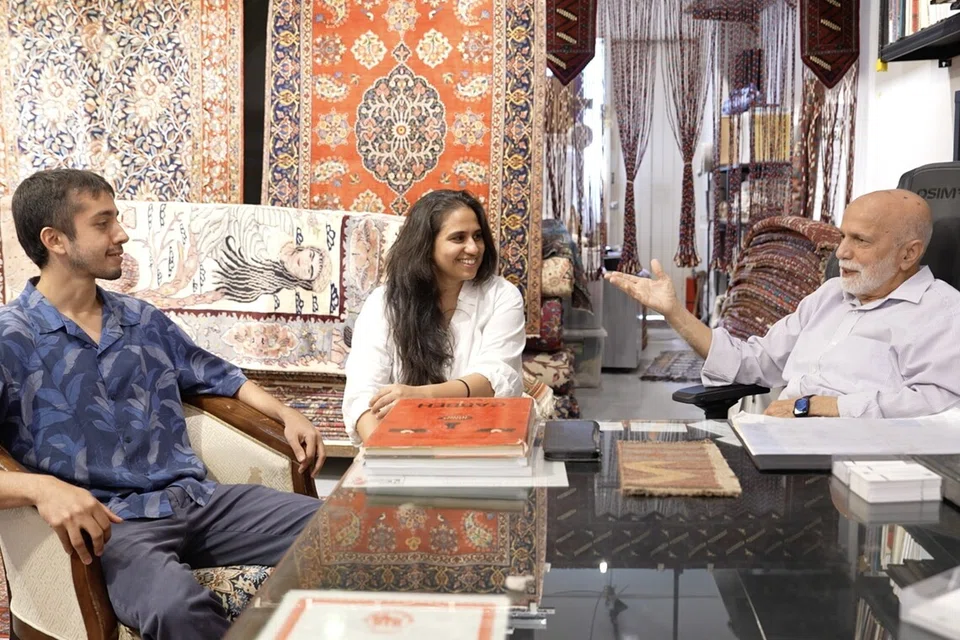
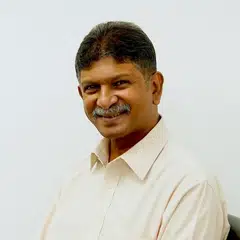
In school, Hassan’s Carpets owner and ex-ACS boy Suliman Hamid’s favourite subject was history.
For the charming, youthful-looking 78-year-old grandfather, the carpet business is a lifelong passion which aligns with his interest in history. He chose it over potentially higher-earning paths and has no regrets.
Antique Persian carpets demand deep expertise in origin, age and value.
“On a collectable basis, the customer will want to know the background of the rug, even to the extent of what kind of materials were used, what kind of dyes were used, which town it was made in. To sell those hand-knitted carpets, you need to be knowledgeable about your product.
“The more knowledge you have, the easier it will be for the customer to realise what he is buying. I like to educate my customer to tell him what he is buying and, in fact, may even suggest he read up a bit on something. The more knowledge he has, the more confidence he will have to buy,” Mr Suliman explains.
And so Mr Suliman is able to share historical context, knotting techniques and care guidelines of each individual heirloom piece in a showroom that is more like an educational workshop and less like a high-pressure retail store.
As a measure of the scale of the task, the showroom at Tan Boon Liat Building is massive and tightly packed, organised into stacked layers and hanging displays of intricate textiles. The scent of aged wool and natural dyes creates a timeless, workshop-like environment.
Pieces in their collection range from antique and authentic tribal rugs to fine city-woven Persian carpets and contemporary custom luxury designs. Every piece is crafted by master artisans from core historical weaving regions, including Iran (Persia), Azerbaijan, Turkey, Afghanistan, India and Pakistan.
The business is sustained by passion, education-led sales and positioning carpets as art and cultural heritage rather than just floor coverings. Customers’ trust in Hassan’s Carpets’ knowledge and expertise has been built up over the years.
The Kashmiri family’s business roots in Singapore stretch back to the early 1930s, when Mr Suliman’s grandfather Khawaja Abdul Hamid set up shop after a language-challenged attempt in Jakarta.
After riding out WWII in India, the family came back to Singapore. It operated at Orchard Road and Raffles Place across different commercial hubs even as it evolved from Bokhara Carpet House to Hassan’s Carpets, reflecting shifting alliances and structures postwar.
Evolution over the years
Along the way, other things have also changed. In the 1970s-1980s, marketing expanded beyond referrals to print media, leaflets, newspaper and magazine ads, and high-end antique exhibitions to create a premium brand image.
Currently, younger family members such as his nephew Shezad Hassan are leading the shift to cost-efficient digital channels such as developing their website and being active on Instagram, Facebook and TikTok.
Even as marketing techniques evolved, bargaining remains key to the sales process.
“We tried to go to fixed prices many years back. We put in a big ad and said Hassan has gone fixed prices. But the market doesn’t accept that. They want to negotiate,” Mr Suliman says.
But the truth is somewhere in the middle.
“It depends on the relationship. My customers have become very good friends. They don’t negotiate. They know I’ll give them a very good price, and that’s how we are.”
Mr Suliman jokingly added that if they wanted to negotiate, then he may have to quote a bit higher.
The Hassan’s Carpets’ owner politely declined to share details of pricing as each carpet has its own complexity and was unfair to generalise.
Nonetheless, to give a rough idea, industry observers indicated market prices typically may vary between various types of carpets. Smaller antique rugs may cost S$2,000-S$6,000, while medium-sized antique or tribal carpets will be around S$4,000-S$15,000. At the higher end, large room-sized antiques with very reputable origins may cost S$15,000 to S$50,000, while museum-quality or highly collectable 19th-century pieces may well be above S$50,000, depending on rarity and origin.
For a commercial rug of contemporary design, those from India will be reasonable, along with some from Pakistan and Turkey. But for classicals, Iran (Persia) is the better choice.
Meanwhile, the market in Singapore is changing. While the city-state remains a tourism hub, less of the tourists who came to shop for carpets in the 1970s-1990s are coming.
“Indonesians, Filipinos, Thais, Cambodians, Americans and Europeans used to come. But now, Indonesia has a lot of carpet shops of its own. The Philippines have managed to get shops to be there,” Mr Suliman said.
“So, people there are now buying average pieces more locally than coming to Singapore. Now, when they come to Singapore, they want very high-end quality pieces,” he added.
Along those lines, it was the sole supplier of hand-knotted carpets during the historic restoration and redevelopment of Raffles Hotel. Their Persian and oriental rugs have featured prominently in the iconic hotel’s grand lobby.
And even at the high end, there is strategic differentiation. His daughter Dania Hassan has an adjacent showroom which focuses on modern rugs and custom orders fulfilled in months rather than years for traditional carpets.
With her team, Ms Dania has been involved in residential, commercial and hospitality projects.
These include government ministry projects, as well as bespoke floor coverings tailored for heavy-traffic luxury hospitality spaces like the Capella Hotel lobby, and a fully custom wall-to-wall design for the Main Lounge refresh of the historic Singapore Cricket Club.
Where next?
Meanwhile, Mr Suliman may have to find another suitable location as the Tan Boon Liat Building at Outram Road, where Hassan Carpets is located, has been sold to Kingsford Group for S$950 million.
But he is in no rush. “It’s sold in principle, but the buyer still needs approval from key government bodies, which is likely to take some time. Additionally, we will have one year to move out after the sale. There’s no point for me to find another location now and pay rent for another place,” he said.
Nonetheless, he is looking around to ensure Hassan’s Carpets storied legacy adds more rich chapters.