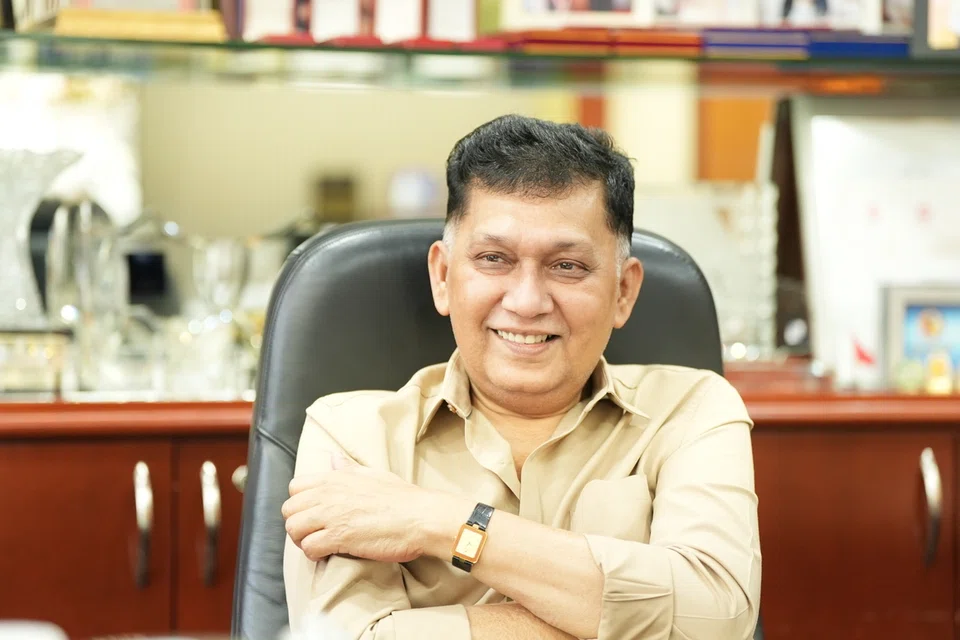
Prominent businessman and philanthropist S. Mohamed Abdul Jaleel, 68, runs a regional real estate and infrastructure organisation, with the latest moves involving developing medical centres in Malaysia to commercial high-rises in Australia and carbon-credit forestry in New Zealand.
Property makes up more than three quarters of his business. But it wasn’t always this way.
Up till COVID prompted him to pivot in other directions, his main business was MES Group (originally founded as Mini Environment Service), with primary operations focused on migrant worker housing and logistics services.
A pioneer in workforce housing, the group operated multiple large-scale dormitories housing about 23,000 migrant employees, while its logistics division largely served the construction and industrial sectors and was heavily utilised for moving raw materials, construction gear and workforce ferry services across the island.
While COVID didn’t help many businesses, it was a moment of inward reflection for Mr Jaleel. Singapore imposed a national partial lockdown known as the circuit breaker in April 2020 amid infection outbreaks. Major domestic restrictions were lifted in August 2022.
The genial Mr Jaleel reflects, “Everything was at a standstill. You can’t move forward. You can’t reverse. At that point of time, we were going through a lot of challenges.”
“The vacuum of about 22 months raised a lot of questions. We didn’t know if we were going to be in the same business, as the whole dormitory sector was going through a shakeup with many compliance issues and challenges.”
“We decided that it is better to do something outside or at least try. We slowly ventured into Malaysia first.” Mr Jaleel hasn’t looked back since.
Expansion Overseas
He diversified and moved to convert the Menara MIDF office building in Kuala Lumpur, Malaysia, into a hotel and a specialist medical centre.
The 299-room YOTEL-branded hotel with easy access to the city’s landmarks such as the Petronas Twin Towers, KLCC and Bukit Bintang is expected to be operational by December 2026. The adjoining 60-bed specialist medical centre, which will occupy seven levels, is targeted for completion by June 2027.
Healthcare expansion will remain a focus for the group. He sees potential in Malaysia due to ageing demographics and affordability, and plans to open up another three hospitals in Singapore’s northern neighbour.
In Australia, his group bought two hotels - one each in Perth and Melbourne - in June 2026 after buying one in Brisbane in September 2025.
The purchased properties were the 98-room Pensione Hotel in Perth, the 216-room Hotel Indigo on Flinders in Melbourne, and the 102-room George Hotel Brisbane (formerly George Williams Hotel). They will join his existing hotel portfolio in Singapore, Japan and the Maldives.
The group’s overseas possessions also include a 481-hectare land in Hawke’s Bay in New Zealand’s North Island, which is being converted into a large-scale commercial plantation forest with Radiata Pine (Pinus radiata) and Redwood trees to generate carbon credits.
When they convert the land into a commercial forest, those growing trees absorb tons of atmospheric carbon annually. Under the NZ Emissions Trading Scheme (ETS), the group can earn the country’s official carbon credit NZUs (New Zealand Units). They can then hold those credits as an appreciating asset or sell them on the market to major emitters, generating revenue before the timber is even harvested.
Advice to Business Newcomers
Having risen from humble beginnings, he cautions young entrepreneurs against expecting immediate profit.
“You have to learn how to burn your money first. Then you have the feeling of burning it. And then you make, then you know how to make the extra dollar again. If you make money straight away, that’s a danger for you already because you will burn it very fast.”
Going further, he suggests seeking markets with less competition and risk. “You find a niche market. If I go out of Singapore, there are many areas where I can get better returns, but there’s a lot of risk. For me, I want minimum risk and make sure that’s stable.”
Philanthropy a key philosophy
Mr Jaleel keeps his philanthropy separate from business.
“To grow myself up to this level requires support from the community and the country. Singapore has built me up. So is my or our turn, or my children’s turn or grandchildren’s turn to give back to the country and to the society and to the community, that’s very simple.
“Don’t forget where you started. So when you’re rich and you think you have the extra dollar to give, give. That should be the philosophy,” he said.
The SM Jaleel Foundation is a major donor for Singaporean Indian and Tamil language and heritage projects (including digitising historical Tamil literature) and funds regional disaster and humanitarian relief efforts.
Among other efforts, the foundation provides bursaries to tertiary students and is one of the largest single contributors to the Straits Times School Pocket Money Fund. It also provides educational endowments to Children’s Cancer Foundation to ensure children undergoing cancer treatments can keep up with their schooling.