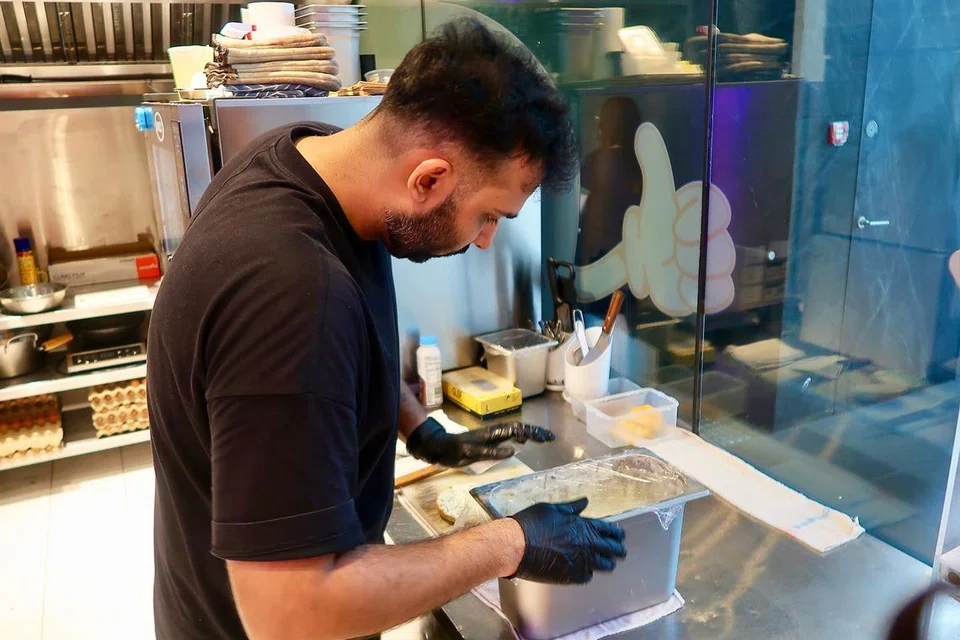
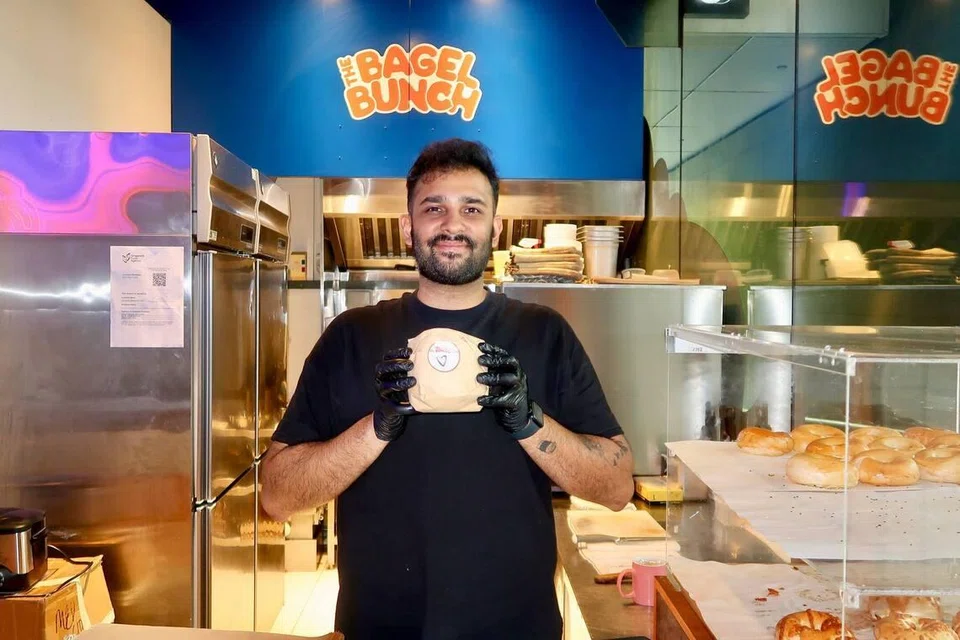

The lunch crowd thins and The Bagel Bunch’s three-person crew takes a breather. Tucked in the office-heavy stretch of Buona Vista, this afternoon pause is the favourite part of founder and co-owner Hemant Mathy’s day.
“It’s not so rushed at this time. You can actually see what the space becomes,” the 29-year-old said.
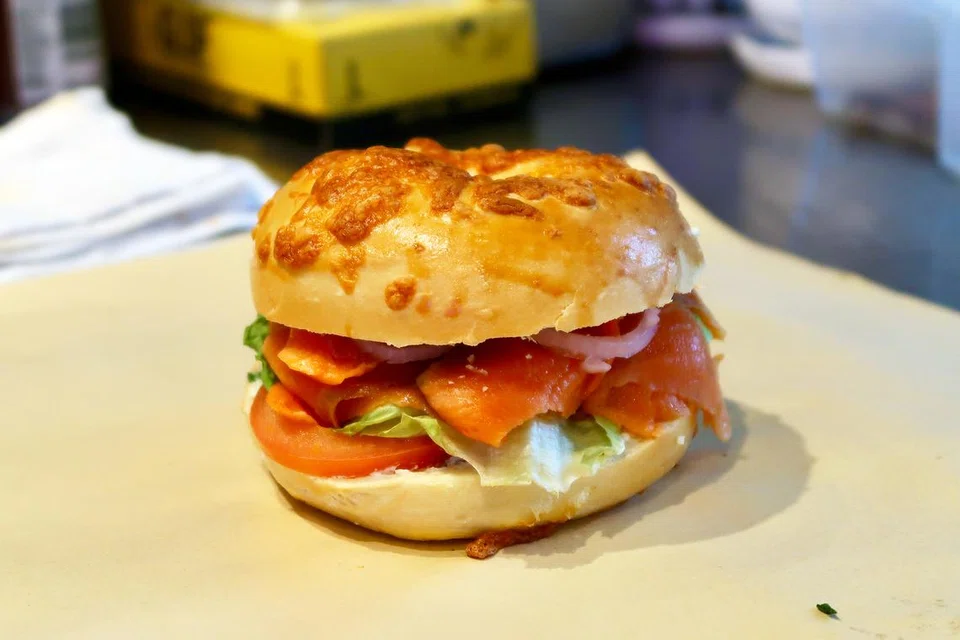
The brand was conceived in his home in 2021, which he ran as a home-based business for over three years before making the leap to a brick-and-mortar store.
Inspired by the gap in the market for bagels created for the Asian palate, Mr Hemant “wanted something that felt familiar, but more suited to us. Something you can eat easily and not struggle with.”
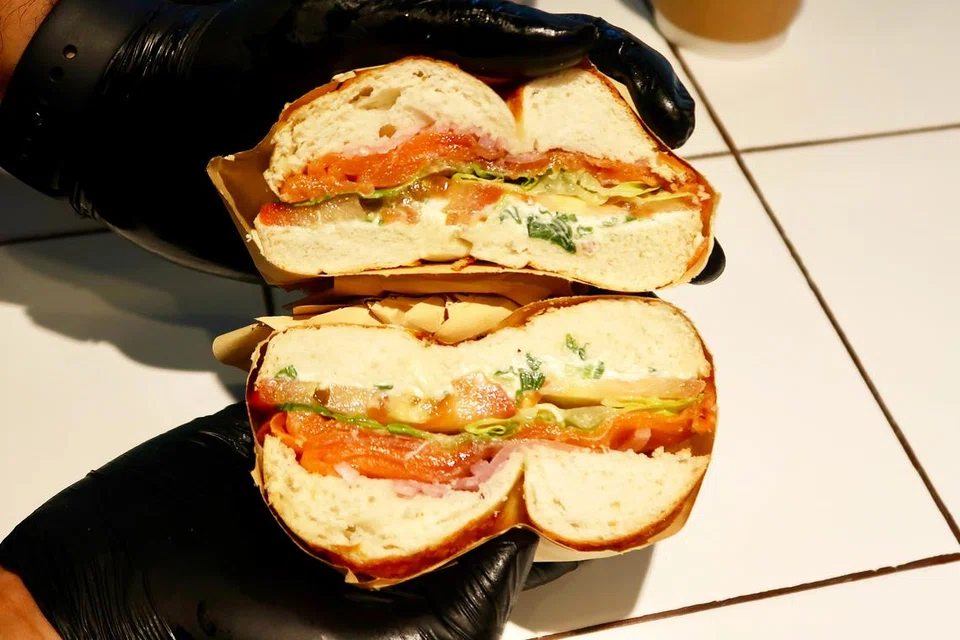
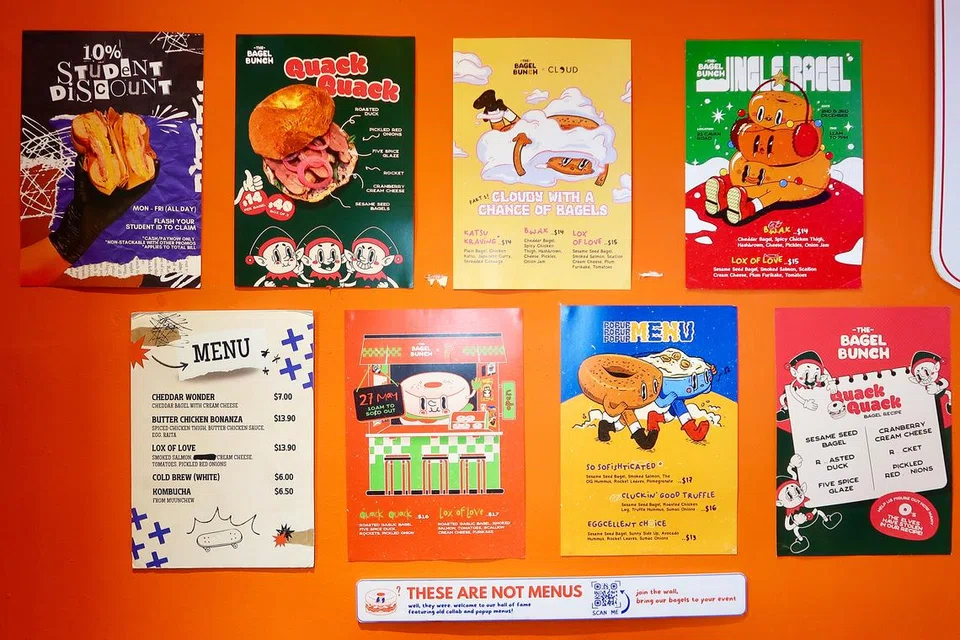
Hence, TheBagelBunch (TBB) was born. Initial flavours included Korean fried chicken, butter chicken, and five-spice cream cheese. “Our USP (unique selling point) is Asian flavours – every time I think of a recipe, I try to tie it back to my roots,” he said.
Moving from a home setup to a physical shop required heavy refinement. There were partners to bring on, a lease to secure, and personal capital to commit to the venture. It was, by any measure, a considerable risk.
“One can calculate this risk, but the jump from calculating to actually doing it is different. Sometimes you just need to go in a bit blind,” he said. “I told my partners we need to open in the west. There were no bagel shops here, and we needed an office crowd for weekday traction,” he told tabla!.
The opportunity came together quickly. By early 2024, they had secured a unit, begun renovations, and were ready for business in May that year.
Simultaneously, Mr Hemant had been working concurrently, building his career in search engine optimisation alongside the business, wary of committing entirely to an industry known for its volatility.
“I came in with the mindset that I didn’t want to risk it all on something that might not work out,” he said. “We’re still young, and I wanted to build my career as well. I think I’ve done a pretty good job on both fronts.”
That balance, he added, gave him room to move more deliberately. “Now that I’m more certain about my trajectory, I can take a bit more time to focus on the shop,” he said.
Over time, the store has become, by happenstance, a watering hole. “You see communities forming, customers becoming friends with each other. All of that is a product in itself, besides the money,” he reflected.
Still, the financial reality is never far away. Singapore’s food-and-beverage (F&B) industry has grown increasingly difficult to navigate, shaped by rising rental and labour costs, and a steady stream of closures.
Compounding these pressures is the ongoing instability caused by the Middle East conflict, which indubitably disrupts global supply chains and drives up the costs of key ingredients, fuel, and logistics.
“Given how volatile international relations have been,” he said, “business really goes up and down.”
The numbers shared by Deputy Prime Minister and Minister for Trade and Industry Gan Kim Yong in parliament in Nov 2025 reflect that instability.
In the first 10 months of 2025, 2,431 food establishments closed, even as 3,357 opened. Of those closures, 63 per cent were businesses less than five years old, and most had never turned a profit. Among Singapore F&B establishments that closed between January and October 2025, 82 per cent of those registered for five years or less had never recorded a profit.
For smaller operators, the margin for error is thin. From cost fluctuations to equipment failures, “you spend money just to figure out what went wrong and more money to make sure it doesn’t happen again,” he said.
TBB broke even roughly a year after opening, but it is not a fixed milestone. “Some months are good, some months are not great. You can’t really predict it,” he said.
There are disruptions that resist planning. Once, while he was overseas for an event, a part-time worker accidentally broke the shop’s lock just before the lunch rush.
“We had a locksmith come down 10 minutes before service to drill it open. We were taking orders on WhatsApp, sending them inside so the chef could start prep. You learn on the go,” he noted.
Regardless of the financial pressures, Mr Hemant seems to be exacting about what leaves the kitchen. “I’m very particular about the quality of the product that goes out. If it’s not right, we don’t serve it. Our customers are paying, so I am pretty rigorous about that.”
His parents, while wary of the industry’s volatility, were encouraging. “They knew I wasn’t just riding the wave. I had something else to fall back on.” His father has been particularly proud of the venture. “He always wanted to do something like this,” Mr Hemant said. “So in a way, he’s living vicariously through me.”