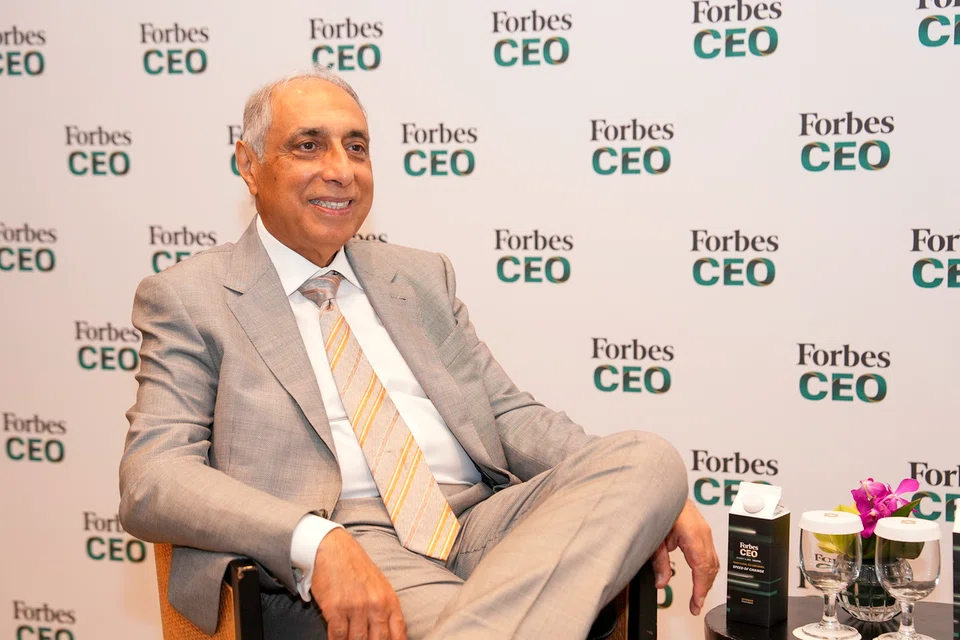

Irfan Razack, chairman and managing director of Prestige Group, is looking to expand the gamut of his companies’ interests beyond traditional real estate, with plans to develop hospitality-style senior-living assets across India as well as venture into tertiary education.
The group is already working on a pilot senior-living project, Mr Irfan told tabla!. Unlike conventional retirement housing developments that focus on selling residential units, his vision is to create hospitality-oriented assets designed around the needs and experiences of older residents.
On the education front, Prestige already operates a school but intends to go further. Mr Irfan hopes to establish a university that will leave a lasting institutional legacy.
These are among the ambitions he believes Prestige has yet to realise, he told tabla! during the Forbes Global CEO Conference held at Singapore’s Shangri-La hotel on Oct 7 and 8. The invite-only gathering that just wrapped its 24th edition drew leaders from the upper echelons of the business world.
The aforementioned projects mark a potential new chapter for the Bengaluru-headquartered group, which has expanded from its residential roots into commercial, retail and hospitality developments since its establishment in 1986.
Its origins, however, lie in a men’s tailoring shop on Bengaluru’s Commercial Street. Founded by his father, Razack Sattar, ‘Prestige House for Men’ began as a small fabric and tailoring business before evolving into one of India’s major property developers.
Today, its landmark developments, such as Forum Koramangala and UB City, are emblematic figures in Bengaluru’s retail landscape. The group’s subsequent expansion into other markets has further broadened its presence.
The results of this expansion speak for themselves as the company’s latest reported revenue reached nearly S$4 billion for the year to end-March, up 76 per cent from the year before.
Despite the success, Mr Irfan said the pace of change makes the future difficult to predict. “The world has changed so rapidly, we really do not know what is in store for the next day,” he said.
In real estate, turning an idea into a successful business takes years, billions in capital and innumerable irreversible decisions. For Mr Irfan, this makes for the most exhilarating part of setting up one of India’s leading property groups.
Sustainable growth, he said, begins with understanding the fundamentals. India’s real estate market, he noted, is far from uniform.
Dynamics and consumer expectations unique to itself, Mr Irfan said that local partnerships and an acute understanding of developmental potential are essential in a business where investments can remain tied up for years.
For him, a project’s viability hinges on multiple factors. In such a capital-intensive and illiquid business, ambition must be tempered by sound judgment. “Ultimately, if everything falls in place, then bingo, you have a project,” he said.
Yet, the appeal of real estate for Mr Irfan is greater than its commercial potential. Turning an idea into a tangible space that people can inhabit and experience is among the most gratifying aspects of the business.
India’s young population and continued urbanisation underpin housing demand, but homebuyers’ needs and wants are evolving. Open spaces, lifestyle amenities and family-friendly environments are becoming increasingly important, strengthening the appeal of integrated developments.
Technology is also reshaping the industry’s outlook, with AI and data centres emerging as prominent areas of focus. Mr Irfan noted that developers must adapt to an evolving environment, even as the sector’s long development cycles make investment decisions especially consequential.
For him, execution and credibility remain central to sustainable growth.
“When you’ve committed to something, when you promise something, even if you are at a disadvantage or a loss, you must see to it that you deliver,” he said. Away from work, Mr Irfan makes time for travel, reading and family, while prioritising his mental and physical fitness. Naturally, owing to the generation he hails from, a physical book is preferred to any screen, he said, calling himself “old-fashioned” with a chuckle.