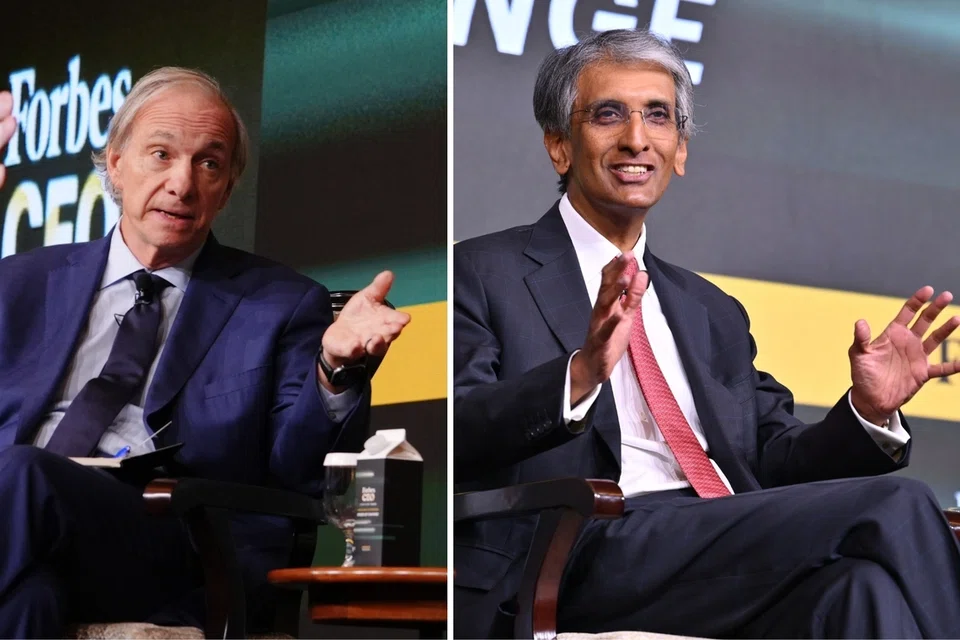

Singapore state investor Temasek Holdings’ CEO Dilhan Pillay Sandrasegara and Bridgewater Associates’ founder and billionaire investor Ray Dalio offered complementary perspectives on navigating an increasingly disorderly world – understand the risks, learn from history and remain adaptable.
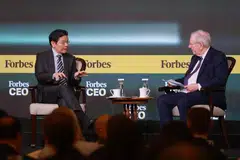
At the Forbes Global CEO Conference 2026, Mr Dilhan said the closest historical parallel to today’s polycrisis is the mid 1960s to the early 1980s, which were years characterised by a stretch of wars, social fracture, and economic shocks, when markets performed poorly.
He said four forces are now colliding: geopolitics, geoeconomics, energy, and technology. “The only thing you can do is be adaptable,” he said.
For Temasek, whose mandate is to invest primarily in equities and take risks at the higher end of the spectrum, that has meant getting nimbler. Over the past three years it has become more liquid, a lesson from the post-Covid period, when illiquidity made it harder to respond quickly to evolving circumstances.
“You can’t behave like an aircraft carrier,” he said, disclosing that about 50 per cent of the portfolio was now liquid.
Dalio’s five forces
Mr Dalio framed the moment through five forces he said recur throughout history: the debt cycle, internal political and social conflict, the geopolitical order, acts of nature such as droughts and pandemics, and technological invention.
He noted that these forces reinforce one another. Rising debt-service costs can squeeze other spending, while the post-1945 multilateral order gives way to a world where “power matters”, and the forces compound each other.
He also pointed to the prospect of an imminent Super El Nino as a climate risk, and argued that major technological advances have historically been accompanied by investment bubbles.
The result would be a “period of great disorder”, he said, one that most people have not yet experienced.
Owner versus investor
For Mr Dilhan, navigating this disorder also depends on whether one is investing in a company or owning and operating it. An investor can rotate out of an asset when risks arise. On the other hand, an owner cannot. “You own the morning after,” he said.
He cited Singapore Airlines, in which Temasek holds a substantial stake, as an example.
During the Covid-19 pandemic, the airline suffered heavy losses as its business was disrupted. Mr Dilhan recalled losses of S$4.3 billion in one year and a further S$900 million the following year, before the business turned to profitability. Such commitments are only possible with a risk-management system that maintains sufficient buffers for unexpected shocks.
The same distinction informed Temasek’s decision to sell a leading data-centre operator in Asia outside China, which Mr Dilhan said it had divested about a year prior. Expanding capacity would have required substantial capital expenditure, while rising interest rates and changing tech could undermine returns.
As an owner, Temasek had to consider the long-term financial obligations that would follow potential upside of the AI boom.
The AI investment dilemma
Mr Dilhan said AI must be treated as a “continuous business process” in companies that Temasek owns, rather than as a project with a finite budget. He cited Singapore’s power grid, where AI can help optimise the performance of critical infrastructure.
He also highlighted the tension between investing in AI infrastructure and ensuring that AI is adopted across the wider economy. With enormous sums flowing into chips, data centres, cloud computing and energy infrastructure, he asked how much capital would remain available for adoption by businesses across other sectors – and whether the investment boom could push up the cost of capital.
Mr Dalio’s answer to disorder is diversification, which he called “the free lunch.” Holding 10 to 15 good, uncorrelated return streams can cut risk by about 80 per cent without reducing return, substantially improving the portfolio’s return-to-risk ratio.
The most common error is being swept up by what is nascent and glamorous without doing homework on the fundamentals, he said.