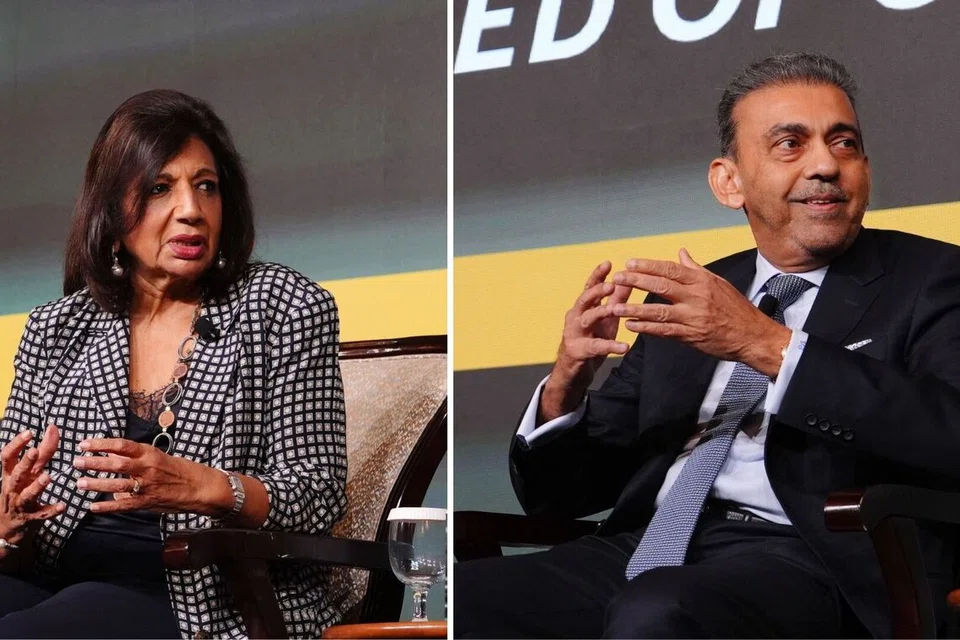

The world no longer divides neatly into camps. That was the shared message from Biocon founder and executive chairperson Kiran Mazumdar-Shaw and Gateway Partners chief executive V. Shankar, who joined a panel on Oct 7 at the Forbes CEO Conference 2026 for a wide-ranging discussion on geopolitics, capital and artificial intelligence (AI).
Ms Mazumdar-Shaw described India as positioning itself as an emerging tech partner to the world, with it’s approach to alliances being pluralistic – i.e. deepening bilateral ties with key partners while using multilateral forums to engage the parts of the world it needs.
The BRICS grouping (Brazil, Russia, India, China and South Africa), for instance, gives India a way to engage with China on a better footing while strengthening ties with other countries.
The aim is to “leapfrog using technology to accelerate its economy”, she said, and build tech corridors with allies, describing the United States as a strategic partner. India has also signed a large number of trade agreements and sees itself as a rising part of the global ecosystem.
Mr Shankar was similarly bullish about India’s long-term prospects.
India’s potential, he said, had long been described as great “forever”, but that perception has improved over the past decade. Over the next quarter-century, he argued, a South Asian civilisation led by India is next to watch.
The sharpest test of that approach is Russian oil. Asked whether threatened tariffs could strain India’s relationship with the US, Ms Mazumdar-Shaw emphasised India’s energy security as a national priority.
A growing economy must secure reliable energy supplied and “when certain taps are turned off, it has to make sure that it keeps getting its energy.”
Russia, she noted, has been “an old and dependable ally,” and she did not expect tariffs to necessarily deter India from maintaining those ties. India, like China, is diversifying its trading relationships to insulate itself from external pressure, while sourcing energy wherever available.
View from the Gulf
Mr Shankar who is based in the Middle East, said India is not alone in this approach. “It’s no longer a world where people are aligned. It’s about multi-alignment,” he said. The UAE is a member of BRICS and has a “flourishing relationship” with India.
He acknowledged that regional conflict had inflicted real economic damage on Dubai, including a fall in hotel occupancy and passenger arrivals. But he pointed to recovering passenger numbers and school enrolments as signs of resilience, arguing that the Gulf’s long-term investment proposition remained intact.
Mr Shankar also predicted that the conflict would accelerate investment in infrastructure designed to make supply chains more resilient, including alternative routes for transporting oil and other goods.
The Middle East, he said, would remain a major source of global capital, although countries would differ in how much they invested at home or abroad.
AI’s promise and its perils
Technology, when unregulated, brings challenges. Both speakers identified AI as a powerful driver of innovation, particularly in biotechnology, while warning that its risks demand urgent attention.
Ms Mazumdar-Shaw said AI could transform biology by connecting complex datasets, accelerating drug discovery and helping bring new treatments to patients faster and more affordably.
But she warned that the same capabilities could be misused to design dangerous pathogens or create unintended consequences in synthetic biology. Effective safeguards and governance are therefore essential.
Mr Shankar argued that voluntary self-regulation by technology companies would be insufficient in a competitive environment shaped by the AI race between the United States and China.
Companies developing large language models have strong incentives to make their products faster and more capable, he noted, making it unrealistic to expect them always to prioritise public safety over commercial advantage.
Drawing parallels with nuclear non-proliferation and controls on performance-enhancing drugs in sport, Mr Shankar argued that regulation is necessary, which led to him warn that AI needs to be regulated before it becomes a “Frankenstein monster,” arguing against waiting for a major crisis, arguing that waiting for a major crisis could be too late.