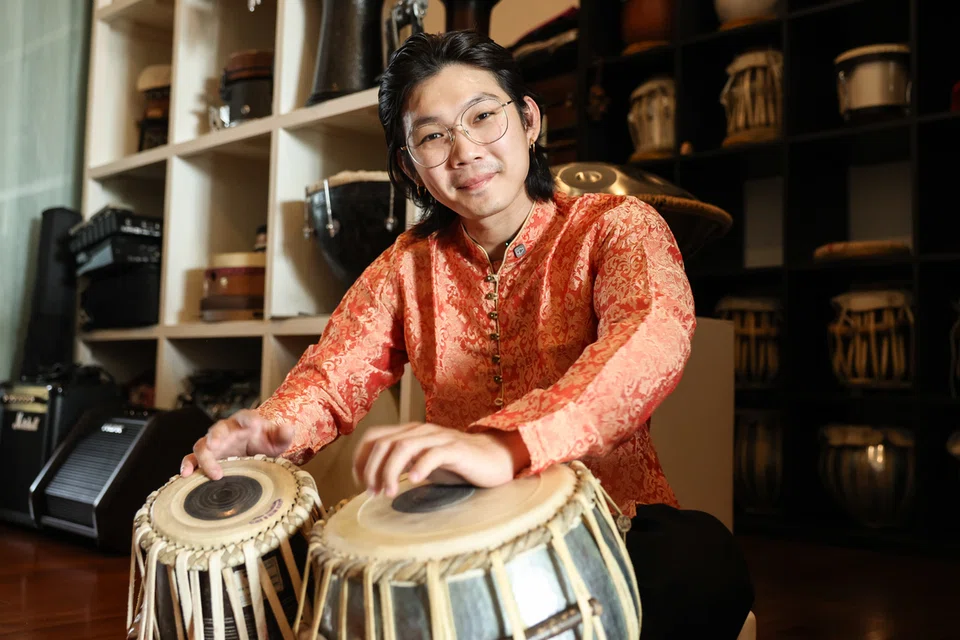

Govin Tan owns tablas made of sheesham wood, plastic, and steel, stacked on a wall like rows of dated entries in a journal. Each tabla marks a journey to India, to acquire the beloved instrument from its source.
The 34-year-old musician is ethnically Chinese but has been playing the tabla – a North Indian percussion instrument tuned by ear to the player’s preferred key – since he was 12.
At the behest of his very strict father (Mr Kenny Tan), a sitar player who spent years studying under classical masters in India, Mr Govin was made to become well acquainted with an instrument he did not naturally have an interest in.
Speaking to tabla! on Wednesday (Aug 5), he said “My brother (Mr Krsna Tan) played the sitar and needed an accompanist,” and coyly pointed at himself.
Before settling on the tabla, Mr Govin had run through a gauntlet of instruments. Starting with the sarod at five, then the sitar, followed by piano and guitar – seven years of lessons that, by his father’s reckoning, did not yield results the way the tabla did, earning him wins at competitions.
At 14, he became the first non-Indian to win the National Indian Music competition in 2006 and two years later won the open category. Regardless, “I honestly do feel I’m not that talented. I’m just hardworking,” he said.
Behind every musician and their ‘riyaaz’ (daily practice) is a strict guru that, sometimes literally, whips them into shape. For Mr Govin, that was his father – a stickler for dedication and discipline. The household ran on a militant cadence of: school, practice, dinner, practice, and sleep before waking for another day of the same. Sometimes practice would replace a night of sleep.
At the end of the day, the age-old adage of “do what you love, and love what you do”, that his father recurrently taught Mr Govin and his siblings, remained tacitly significant in his craft.
Naturally, the optics of a Chinese boy playing a tabla – an instrument that has not been recognised the way a guitar or piano has – would invoke much curiosity. However, the question of ethnic authenticity did not hit him until late in his teens, and did not resolve cleanly either.
It would be easy to frame Mr Govin’s story as a neat parable about multicultural harmony but the reality is more nuanced. He recalls knowing no different than being the boy who unabashedly partook in cultures outside his own, and not finding anything out of the ordinary about it.
The incident he offered as evidence of pushback, if that, was when his teacher called out ‘Radha Govinda Das’, part of Mr Govin’s full name, while taking attendance and was incredulous that the Chinese kid with his hand up was the bearer of the name.
While it is understandable that someone whose cultural immersion runs as deep as Mr Govin’s would draw attention, perhaps the greater aspiration is for stories like his to become unremarkable rather than exceptional.
“Music is universal, and it should remain that way,” Mr Govin said, referring to the way people are often inadvertently pigeonholed when they encounter someone whose vocation seems unusual for their background.
That insistence on universality is most evident in the part of his craft that is rarely spotlighted – the tuning of the tabla.
When asked about the tuning process, Mr Govin shared a metaphor that feels apt for the nation’s birthday we are celebrating this week.
“A lot of people don’t know that the tabla is actually a pitched percussion instrument,” he said, adding that it is tuned by gently tapping on the rims with a tuning hammer.
The top of the drum, he said, is divided into sections – cut into halves and then eights. Mid-tuning, the tabla creates tones that are close to perfect but not quite right. Instead of discarding or nullifying them, one uses the nearest true note as a reference point to keep working outward until the whole tabla agrees with it.
However, he said, “it is important to know where you (eventually) want to go” – a line that feels poignantly tethered to our island-nation.