
For several Singapore residents caught in Dubai during the ongoing Iran war, the journey home was not just a disrupted travel plan. It was a deeply unsettling experience marked by explosions, missile interceptions, midnight alerts and the constant fear that the next few hours could spiral into something worse.
When they finally landed at Changi Airport, the relief was overwhelming.
For Mr Varun Seth, 40, what began as a routine work trip turned into a week of anxiety. The senior director in a healthcare IT-related corporate role had travelled via Dubai and planned to continue to Hamburg, Germany, after a short stopover. But, as tensions escalated, his onward flight was cancelled, followed by repeated rebookings that also fell through.
Initially, he believed the crisis would ease quickly. It did not.
Mr Varun, a Singaporean, was fortunate not to be stranded at the airport, as he was staying with relatives in Dubai. But even from there, the conflict began to feel uncomfortably close. He heard loud explosions, received shrill SOS alerts on his phone late at night, and watched fear ripple through the city.
“The first few days were manageable, but when you start hearing interceptions and feeling the tremors through the windows and doors, it becomes unsettling,” he said. “That was when it really hit me that I was in a war zone.”
He did not see falling debris first-hand, but the noise of missile interceptions near his relatives’ home was enough to shake him. At one point, he called home to make sure his travel insurance and life insurance details were in order.
The uncertainty deepened as flights remained suspended. Eventually, after registering with Singapore’s Ministry of Foreign Affairs, Mr Varun secured a seat on the first Singapore Airlines repatriation flight. But even that involved a punishing 12-hour bus trip from Dubai to Muscat, Oman, before the flight home.
The overland journey, which took more than half a day, including immigration delays, brought together more than 150 Singaporeans and several other passengers, all sharing stories of disrupted plans, fear and desperate efforts to leave the Gulf.
Even after boarding the flight, Mr Varun said, the anxiety did not fully subside.
“The captain said the seatbelt sign would remain on longer, and I kept tracking mentally where we were,” he said. “I was only truly relieved after we reached Indian airspace. That was when I finally felt we were out of danger.”
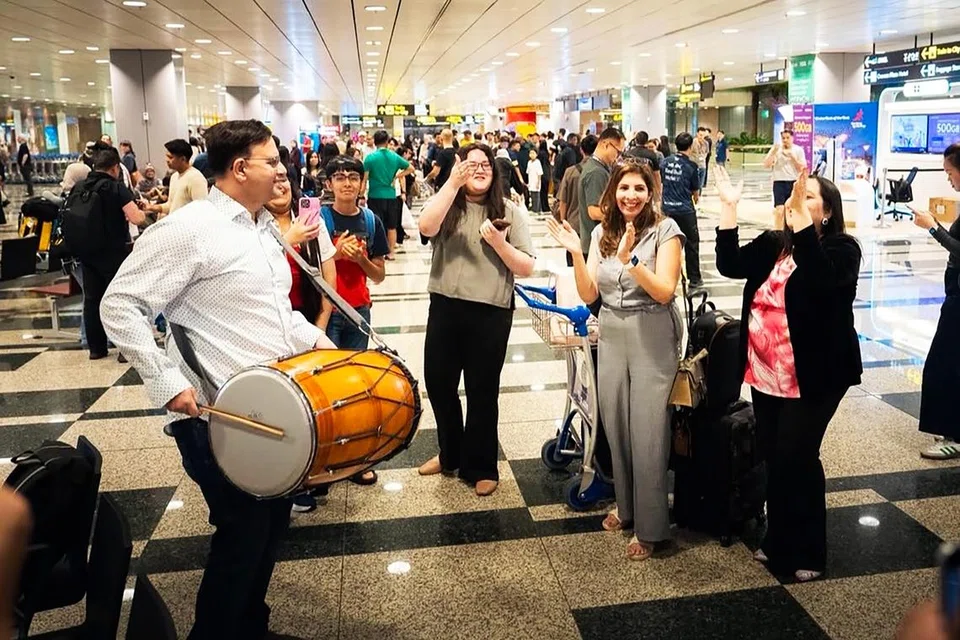
When the plane landed at Changi Airport, passengers clapped and cheered. Outside the arrival hall, Mr Varun was met by family and friends, including his friend Amitabh Mathur, who welcomed him with the beat of a dhol. His seven-year-old daughter ran to him with a tight hug and a hand-drawn card.
“It was a moment of happiness and gratitude,” he said. “You realise how much safety means only when you have lived without it.”
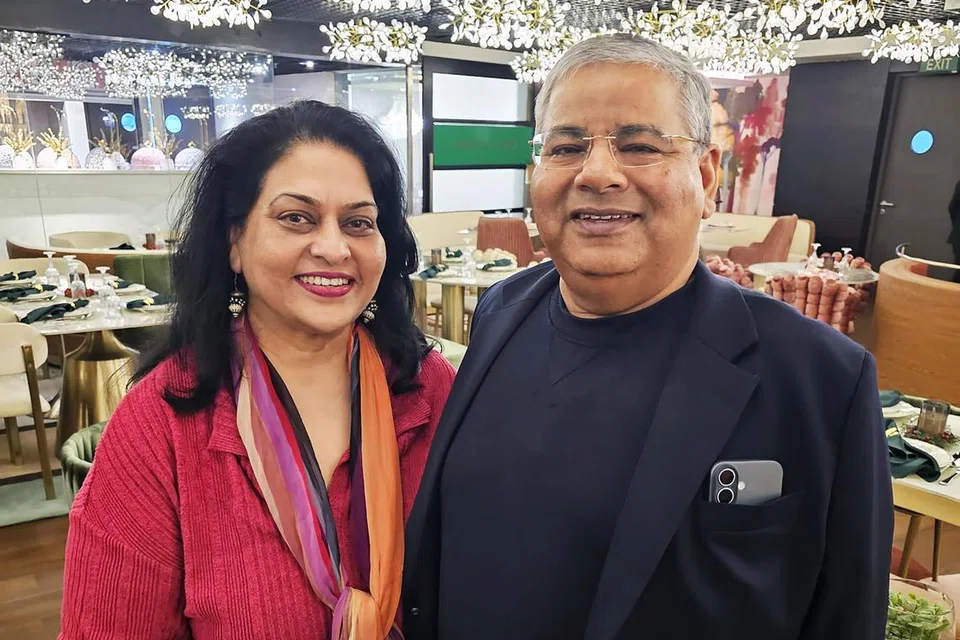
For Mrs Sunita Mathur, 57, and her husband Pankaj Mathur, 60, the trauma was even more immediate.
The couple, Indians living in Singapore, had been in Dubai ahead of a work summit in Abu Dhabi and were staying in the Jumeirah Beach Residence area, a premier 1.7 km waterfront community featuring high-rise towers. Unlike Mr Varun, they witnessed the conflict far more closely.
Mrs Sunita, an artiste and homemaker who is on a dependent’s pass, recalled the first signs of unease while having lunch at the Royal Atlantis, a luxury beach Resort on Palm Jumeirah. A nature lover, she noticed birds behaving restlessly before the first loud blasts were heard. Soon after, news alerts confirmed an attack near Abu Dhabi.
That was only the beginning.
Back at their residence near the marina, the couple could actually see missiles and interceptions in the sky from the balcony. The sounds were deafening. The fear was constant.
“We were on the 43rd floor and in panic mode,” Mrs Sunita said. “We did not know what would happen if there was a direct strike or if debris fell near us. Every couple of hours, there seemed to be another wave.”
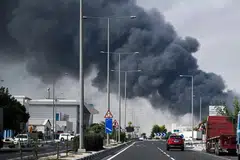
She described seeing missiles split into multiple fragments after interception, followed by flashes and explosions overhead. The attack on the nearby port, visible from where they were staying, was especially frightening, with thick black smoke hanging in the air for two days.
The couple slept with passports, medicines and cash close at hand, dressed and ready to leave at a moment’s notice. Residents were shown basement shelter areas, while mobile alerts repeatedly warned of danger. Mrs Sunita said the experience left a deep mark on her.
“I am normally a strong person, but this shook me,” she said. “Even after coming back, ambulance sirens and alert sounds still make me panic.”
The Mathurs eventually managed to secure seats on an Emirates flight to Singapore. But even at the airport, the nightmare was not over.
The departure process was interrupted by fresh alerts and security scares. Passengers were rushed from the boarding area to safer zones, then brought back again. After boarding, they sat for nearly two hours waiting for clearance to take off.
“Only when the aircraft finally climbed out of Dubai did we begin to believe we might actually make it home,” said Mr Pankaj, a senior executive in the IT industry who was in Dubai en route to Abu Dhabi for a company event.
Back in Singapore, family members waiting at Changi had gone through their own ordeal.
Mr Pankaj’s younger brother Amitabh and his wife Manisha said the days of missile alerts, cancelled flights and uncertain communication had left them sleepless and deeply anxious.
Seeing their loved ones walk through the arrival gate was, they said, “nothing short of a miracle”.
For those who returned, the journey home ended in relief, hugs and tears. But the fear they carried back with them will likely take much longer to fade.